
In the autumn of 1941, with German forces approaching Moscow, the Soviet Union did something it did with hundreds of factories that year: it put the Second Moscow Watch Factory on trains and sent it east. The equipment and workers landed in Chistopol, a small town on the Kama river in Tatarstan. The factory that grew from those crates became Vostok — the USSR’s military watchmaker and the maker of one of the great tool watches of the 20th century.
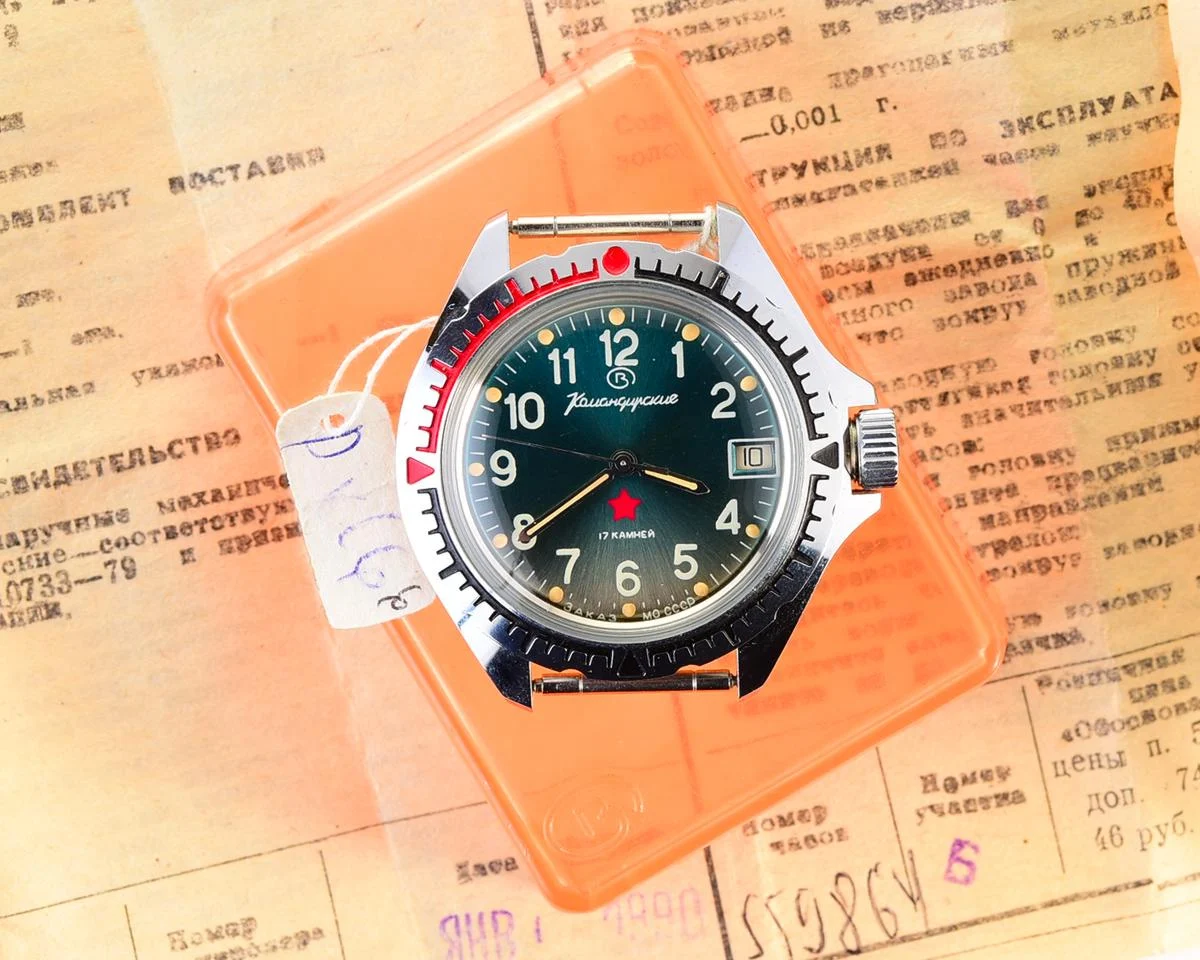
Special series watches that sold exclusively for active army servicemen in Voentorg stores
From wartime workshops to “Vostok”
Through the war the Chistopol plant produced for the front. Civilian watchmaking took over afterwards, with early production including Pobeda models, and by the late 1950s the factory’s watches carried a new name: Vostok — “East,” and soon also the name of the spacecraft that carried Gagarin. On export models you’ll often see it spelled Wostok, the German transliteration.
1965: The Ministry of Defence places an order
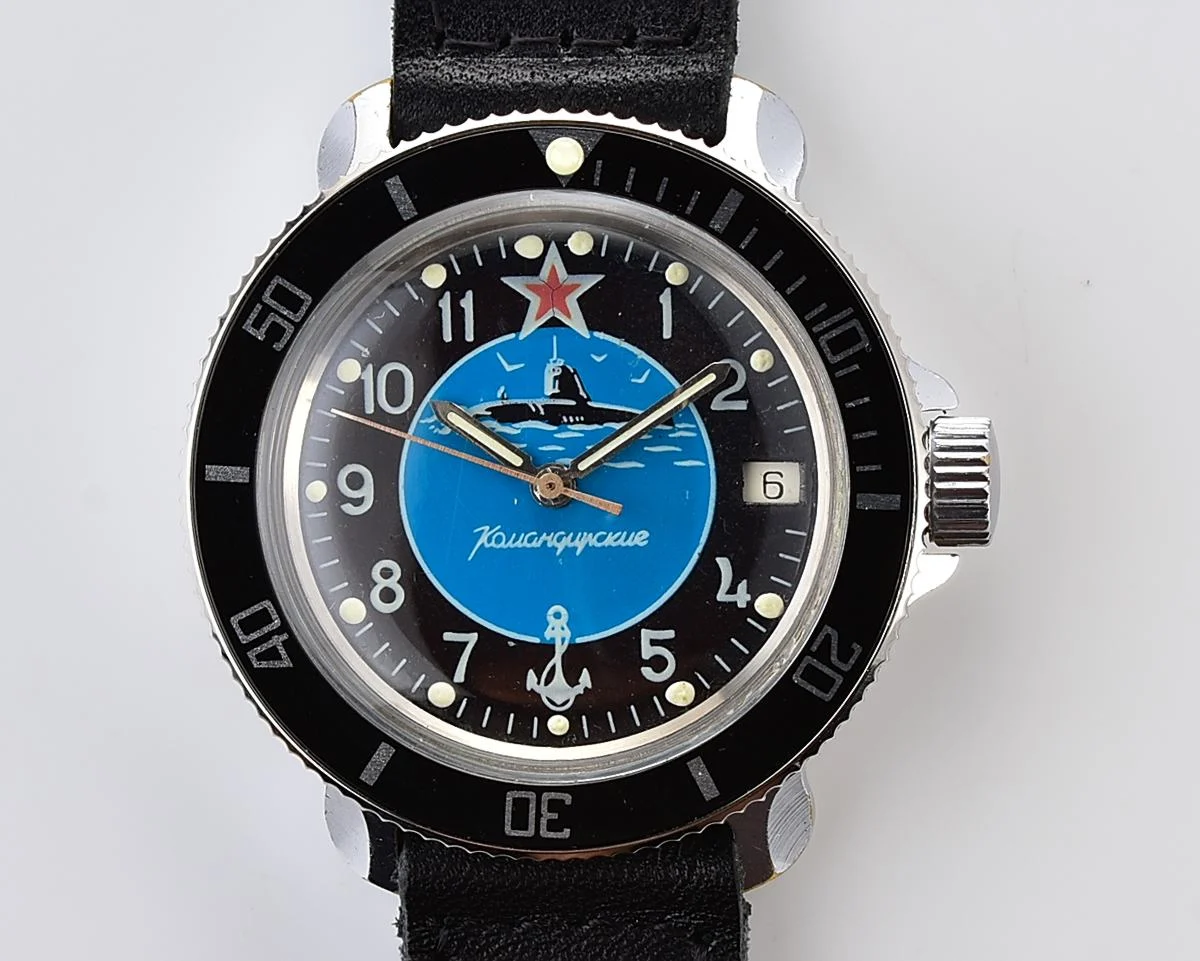
In 1965 Chistopol became an official watch supplier to the USSR Ministry of Defence, and the Komandirskie — the “commander’s watch” — was born. Genuine military-order pieces carry the marking «ЗАКАЗ МО СССР» (“by order of the Ministry of Defence of the USSR”) on the dial. The Komandirskie became the archetypal Soviet military watch: shock-resistant, luminous, unpretentious, and produced in an endless parade of dial designs — tanks, ships, paratroopers, red stars — that today form a collecting universe of their own.
1967: The Amphibia solves a problem sideways
When the Soviet military wanted a 200m dive watch, Chistopol’s engineers had a problem: the key Swiss solutions were patented, and licensing Western technology was not exactly the Soviet style. So they solved it differently — and, arguably, better.
The Amphibia‘s case back isn’t screwed down rigidly against its gasket. It’s held by a threaded ring, and the thick rubber gasket stays slightly springy — so as the watch goes deeper, water pressure itself presses the case back tighter, improving the seal exactly when you need it most. Add a thick domed acrylic crystal that flexes inward under pressure instead of cracking, and a crown that disengages from the movement when pushed in, and you have a dive watch whose engineering logic still earns admiration today. It went into production in 1967 and has never left.
The movements
Vostok’s vintage calibres — the hand-wound 2409 and 2414, and the automatic 2416 family — are simple, tough and famously tolerant of hard use. They were designed for soldiers, not salons, and they are among the easiest vintage movements in the world to service and find parts for today.
After the USSR
Chistopol kept making watches through the post-Soviet turbulence, and Amphibias and Komandirskie models are still produced there today. For collectors, the Soviet-era pieces — especially clean examples with original military-order dials — remain the heart of the story.
FAQ
What’s the difference between Komandirskie and Amphibia?
The Komandirskie is the military field watch (water-protected, but not a true diver); the Amphibia is the 200m dive watch with the pressure-sealing case design. Same factory, different missions.
What does «ЗАКАЗ МО СССР» mean?
“By order of the Ministry of Defence of the USSR” — it marks watches produced under the official military contract, and it’s one of the details collectors check first for originality.
Can a vintage Amphibia still dive?
The design can; the 50-year-old gaskets usually can’t. A vintage Amphibia should get fresh seals and a pressure test before it sees water. Ours are serviced, but we still recommend keeping true diving to watches tested for it — details in our servicing policy.
Explore our serviced Vostok collection, from Komandirskie military models to Amphibia divers.