
Most watch factories are proud of a founding date somewhere in the 1850s. The Petrodvorets Watch Factory — home of Raketa — was founded in 1721 by Peter the Great, which makes it older than the United States, the metric system, and every Swiss watch brand you can name. It just spent its first two centuries doing something else.
From gemstones to jewel bearings
Peter the Great established the works at Peterhof, outside St. Petersburg, as a lapidary factory — cutting and polishing hard stone for the imperial court. Its craftsmen worked marble, jasper and gems for palaces and cathedrals for two hundred years.
That stone-cutting expertise turned out to be the perfect dowry for watchmaking: from the 1930s the factory produced jewel bearings — the tiny ruby pivots at the heart of every mechanical watch — for the young Soviet watch industry.
War, ruin and rebirth
The factory was devastated during the Second World War as the front line reached the Leningrad suburbs. Rebuilt after the war, it began assembling complete watches in 1949 — first the Pobeda and the Zvezda — and in 1954 it was renamed the Petrodvorets Watch Factory.
Then came April 1961. Yuri Gagarin orbited the Earth, the USSR fell in love with rockets, and in 1962 the factory launched its own tribute: a new watch brand called Raketa — “rocket.” It became the factory’s trademark for the rest of the Soviet era.
A true manufacture
Here is the fact that earns Petrodvorets respect even from committed Swiss-watch snobs: the factory manufactures its movements from A to Z, including the hairspring and escapement — the two components that even most prestigious “manufactures” quietly buy from specialist suppliers. Watchmaking has perhaps a handful of factories in the world that can claim this. One of them is in Petrodvorets.
The workhorse of the vintage era is the Raketa 2609.HA, a 19-jewel hand-wound calibre that powered an enormous range of models through the 1970s and 80s — simple, honest, and easy to service half a century later.
Watches for people with unusual problems
Raketa’s engineers had a talent for solving problems most watch brands never think about:
- 24-hour watches — with a dial where the hour hand goes around once per day — built for polar explorers, submariners and Arctic pilots, people for whom “day” and “night” are administrative concepts. Many of these live in our space and exploration themed collection.
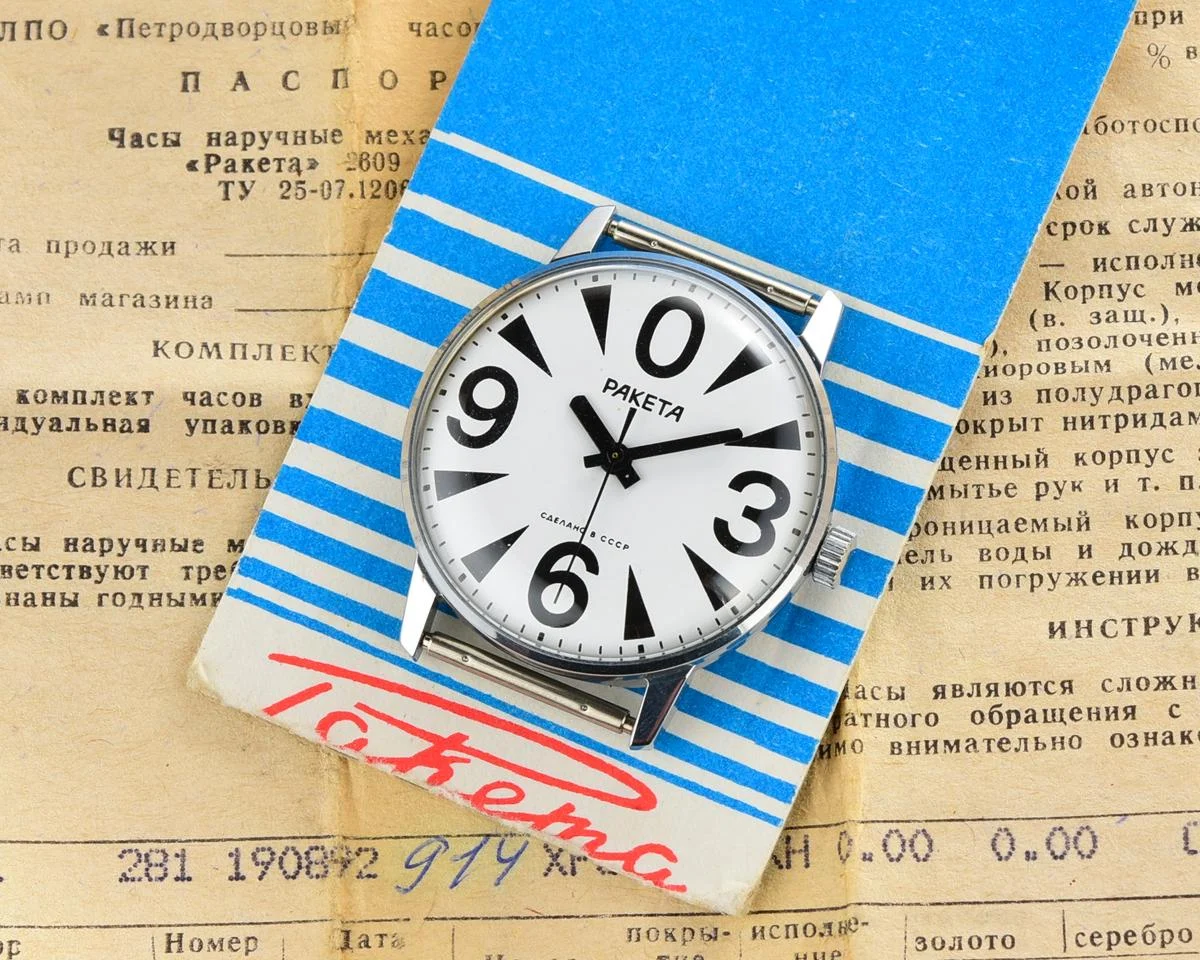
- The Big Zero — a dial with a large 0 instead of 12, one of the most recognizable designs of Soviet watchmaking and, depending on who you ask, either a bold graphic statement or a joke about starting your day from nothing. Both readings are correct.
- Braille watches, doctors’ watches with pulse scales, and dials for railway workers — the factory made watches as tools for specific human lives, not as jewelry.
After the USSR
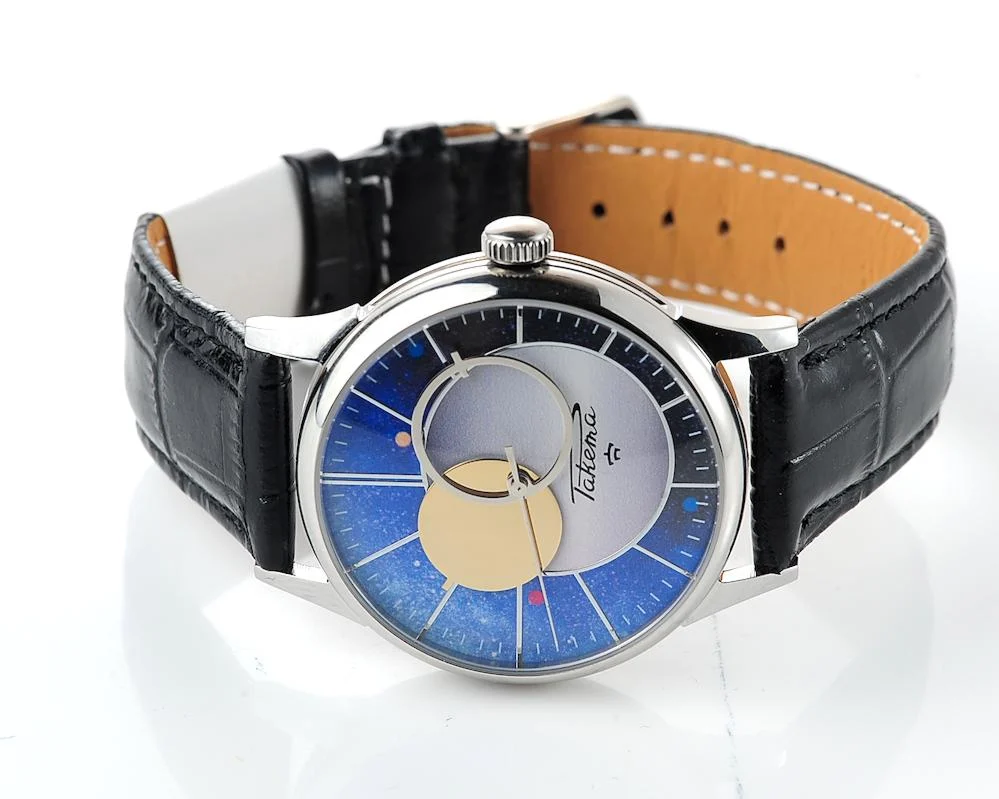
Petrodvorets survived the collapse of the Soviet Union — barely, like everyone — and the Raketa brand is still produced there today, movements and hairsprings included. It remains one of the very few places on Earth where the whole mechanical watch, down to its beating spring, is born under one roof.
FAQ
What does “Raketa” mean?
“Rocket” — the brand was launched in 1962 in honor of Gagarin’s spaceflight and the Soviet space program.
What other brands did the factory make?
Over the years Petrodvorets produced watches under names including Pobeda, Zvezda, Baltika, Neva, Svet and Start — which makes the factory’s family tree a happy hunting ground for collectors.
Is a vintage Raketa a good first Soviet watch?
Excellent — huge design variety, a robust movement, and real manufacture heritage. See how it compares in our guide: Vostok vs Raketa.
Browse our serviced vintage Raketa watches — from Big Zeros to 24-hour polar dials.