Description
ALBA (a Seiko brand) vintage quartz watch
MADE IN JAPAN
“Seiko” (精工) is a Japanese word meaning “precision,” “exquisite workmanship,” or “refined craftsmanship.”
It comes from the characters:
-
精 (sei) – fine, precise, refined
-
工 (ko) – craft, workmanship
Originally, Seiko’s watchmaking division was called Seikosha (精工舎), meaning “House of Precision.”
The name first appeared on a watch dial in 1924, shortened from Seikosha and keeping the core meaning; the company itself was renamed Hattori Seiko in 1983 and Seiko Corporation in 1990.
So the brand name literally ties directly to the idea of precision engineering—which is exactly what the company wanted to be known for in its watches.
About the Alba AKA Line
Alba is a Seiko Group brand, launched in Japan in 1979 as a more fashion-minded label alongside the main Seiko range. The name is Italian for “dawn”.
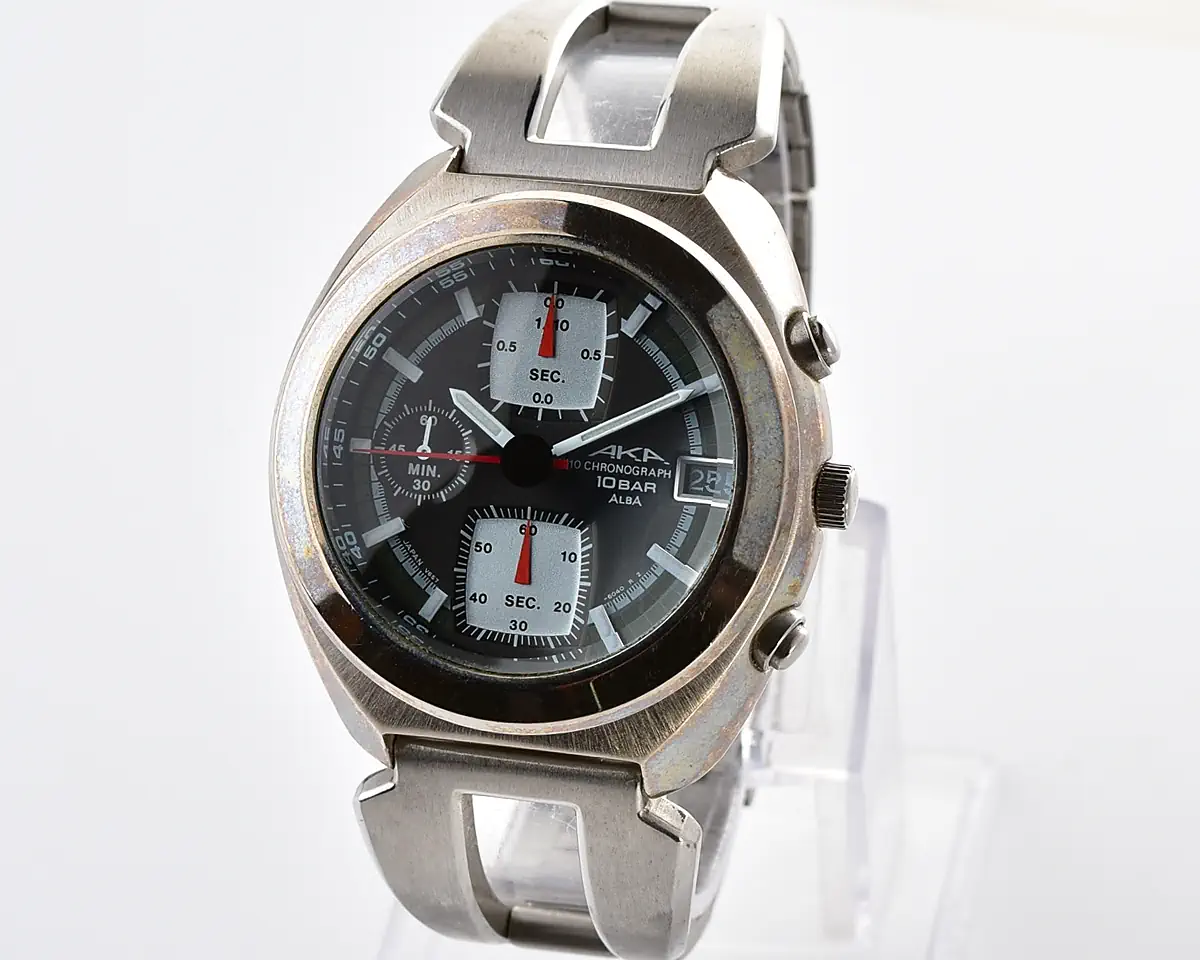
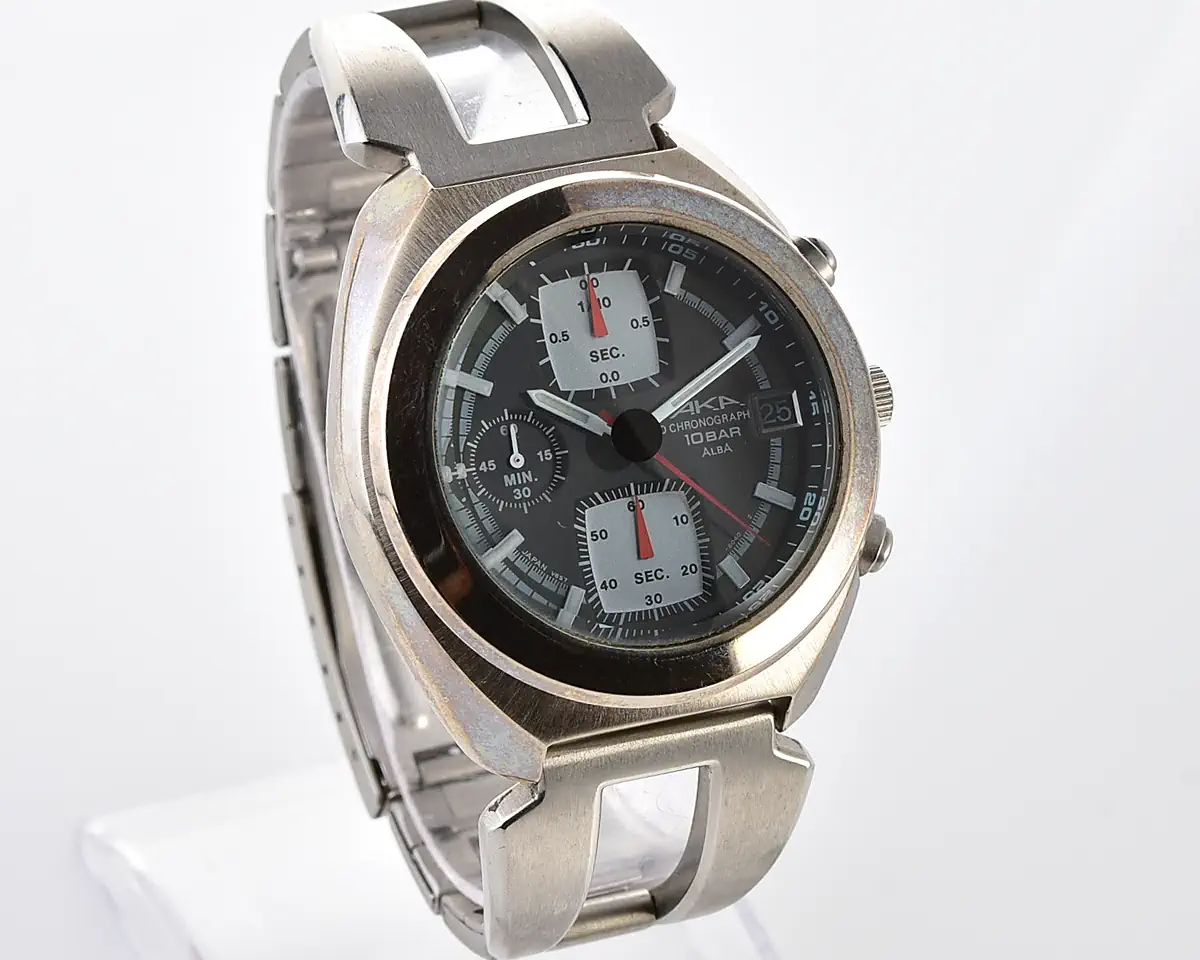
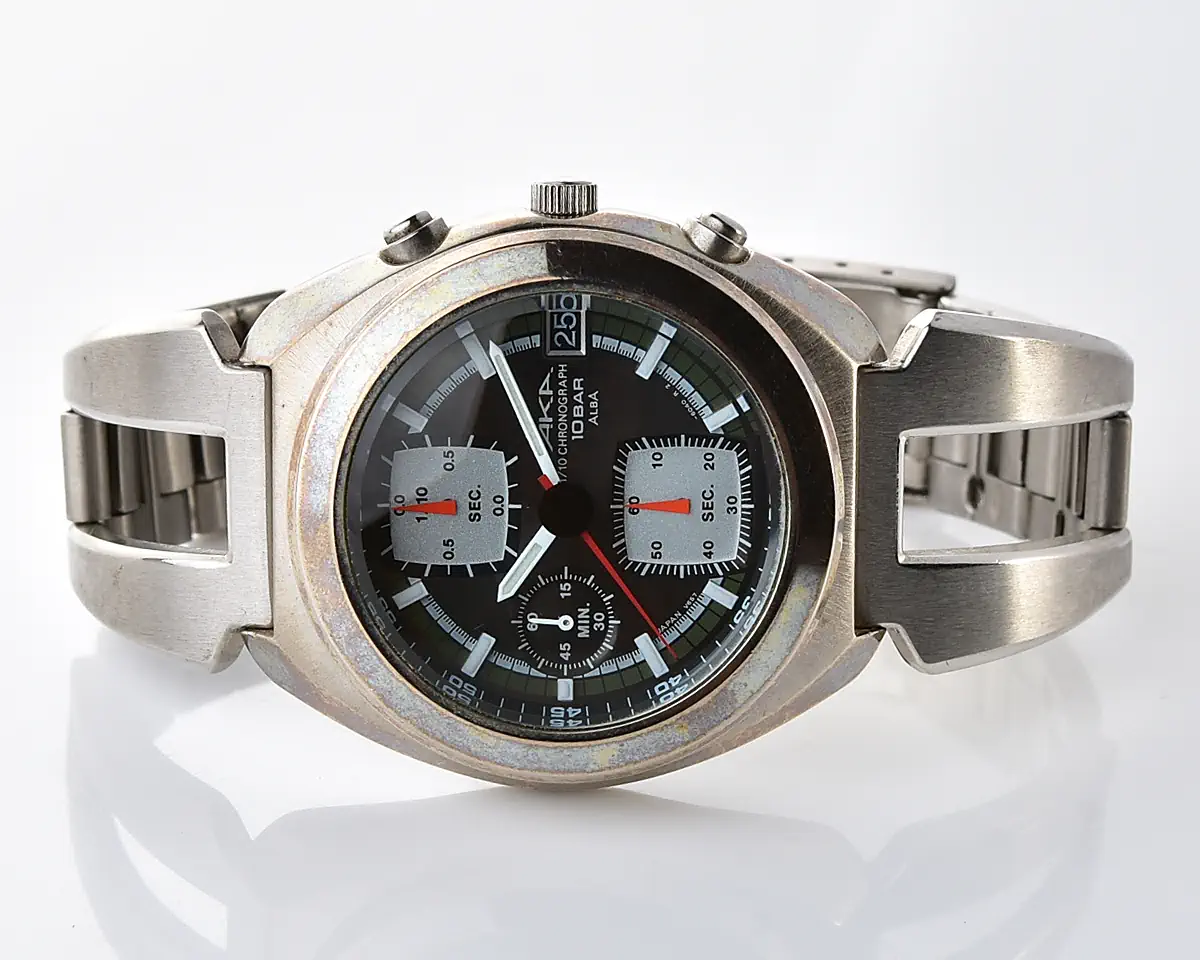
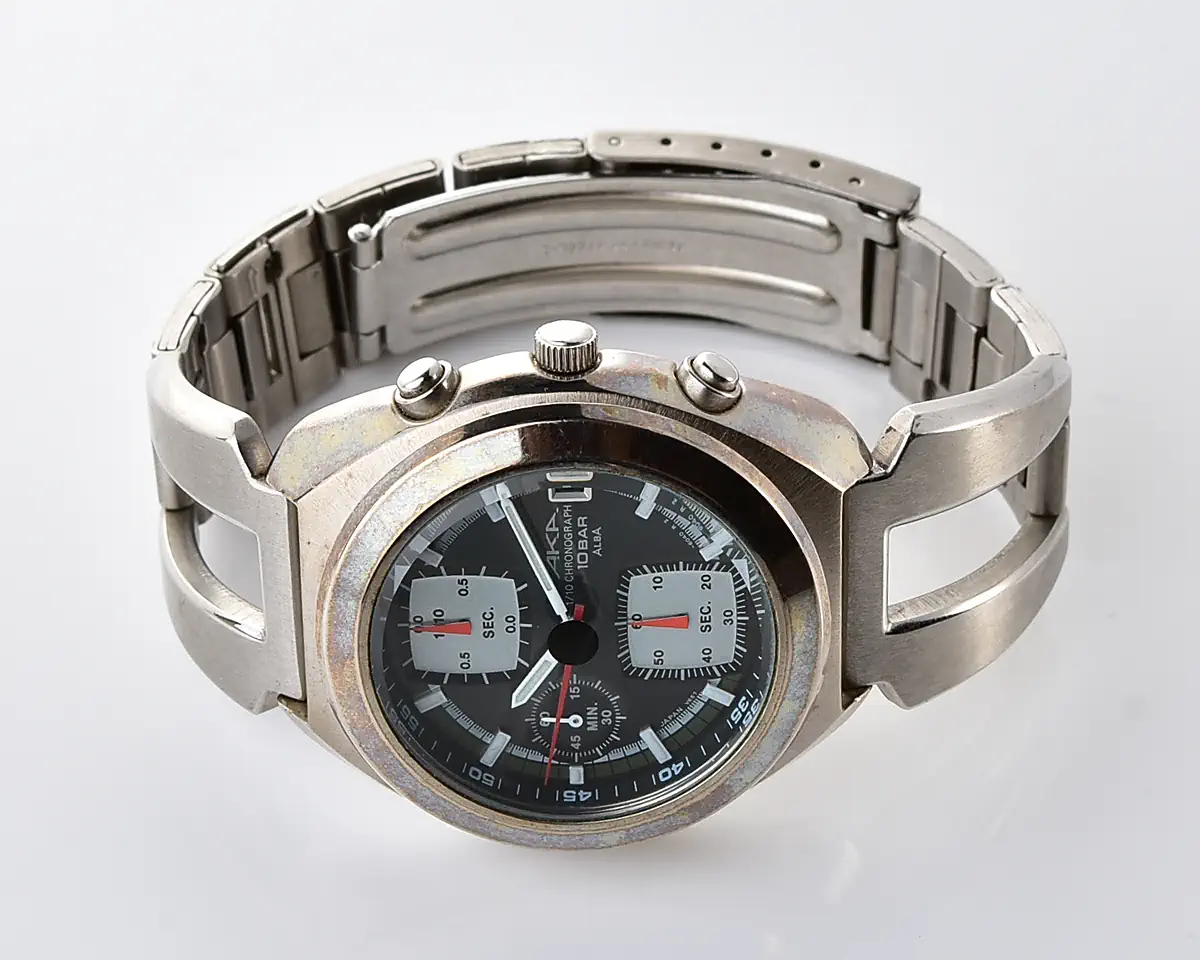
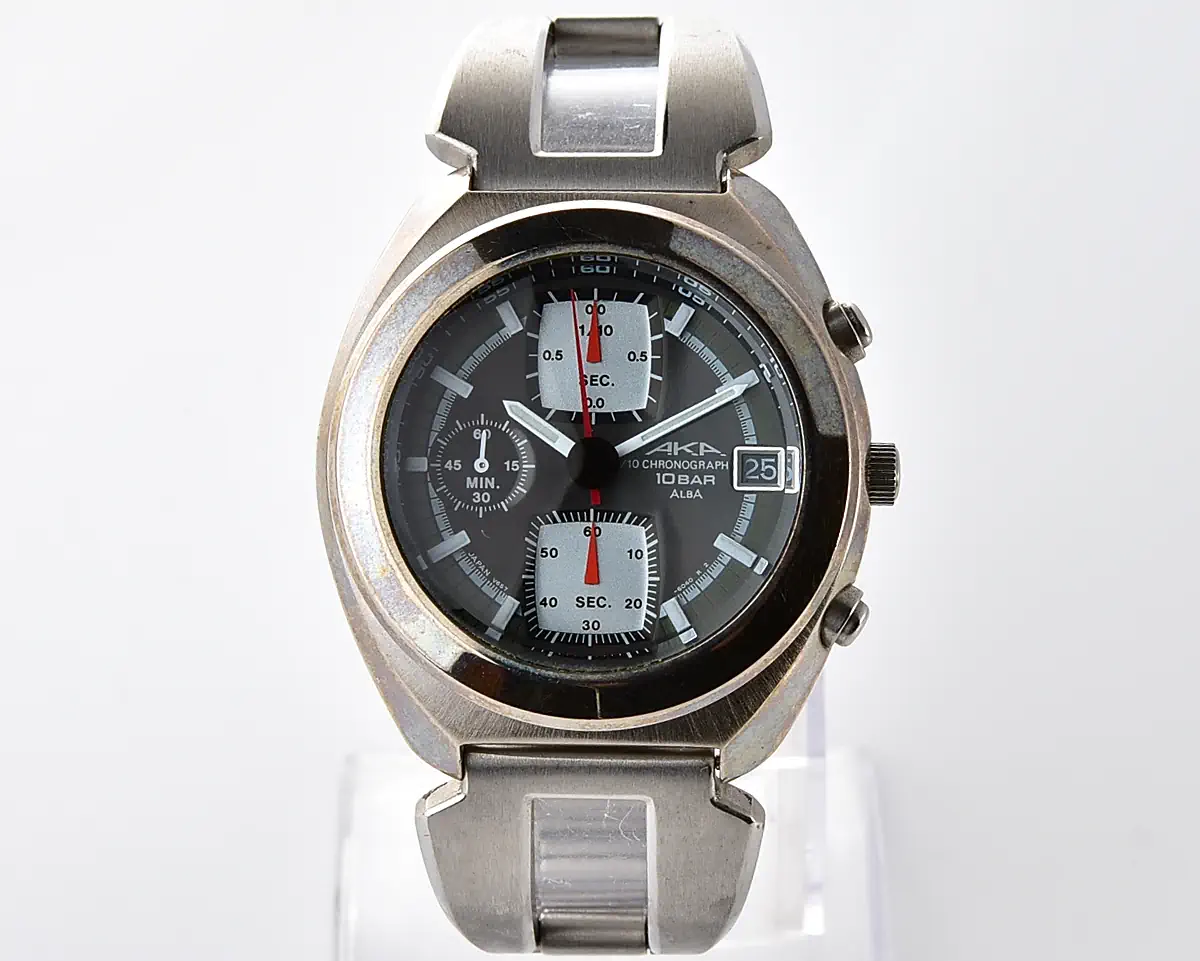
The AKA series arrived in the mid-1990s as an Alba exclusive, aimed at the young and fashionable, and this reference, the V657-6030, dates from 1996. It went for a bold look: a chunky, angular case, squared-off recessed sub-dials in a contrasting silver-grey, red hands and a bracelet whose first links flare into the case like a tuning fork. Collectors’ sources put its original Japanese price at ¥15,000, the highest in the AKA range at the time.
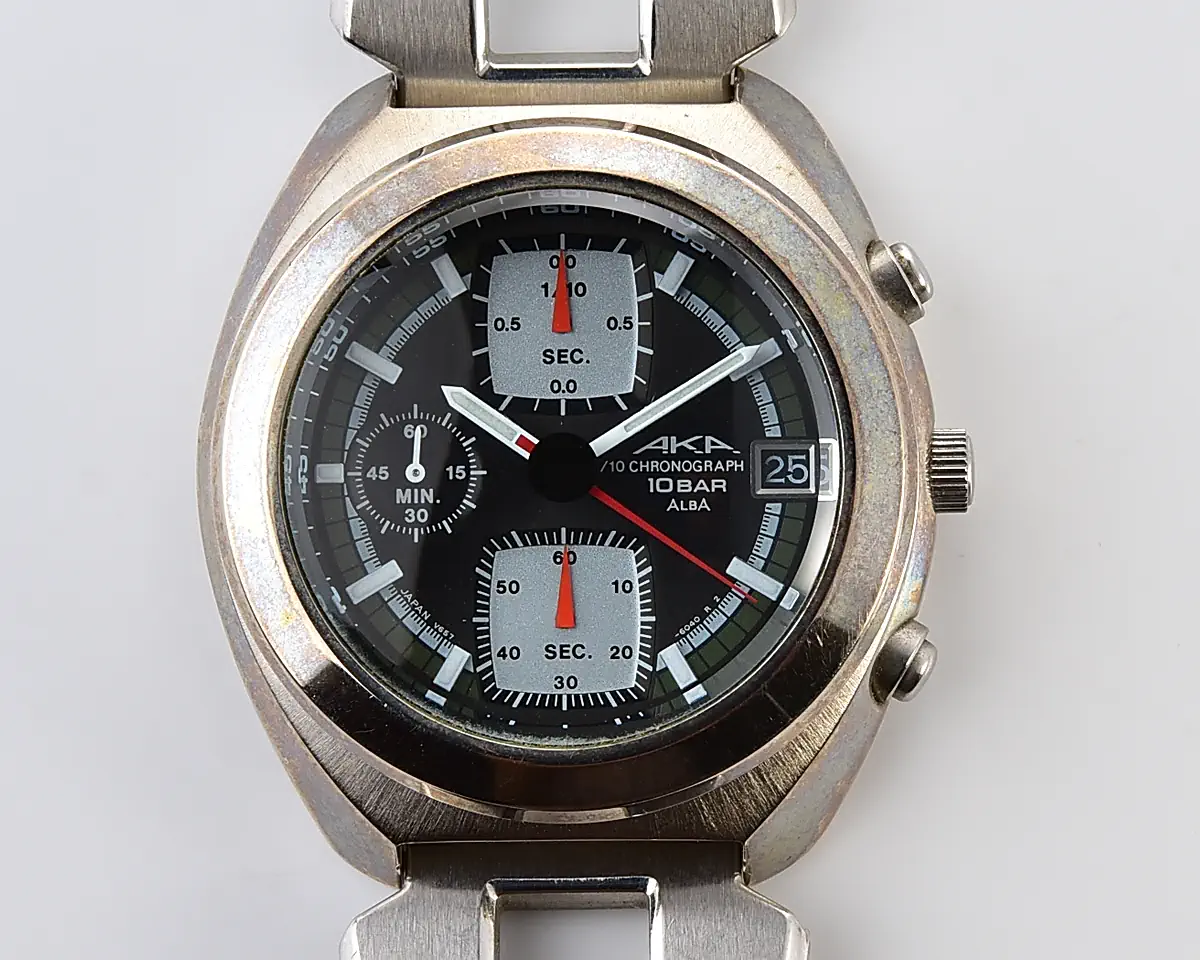
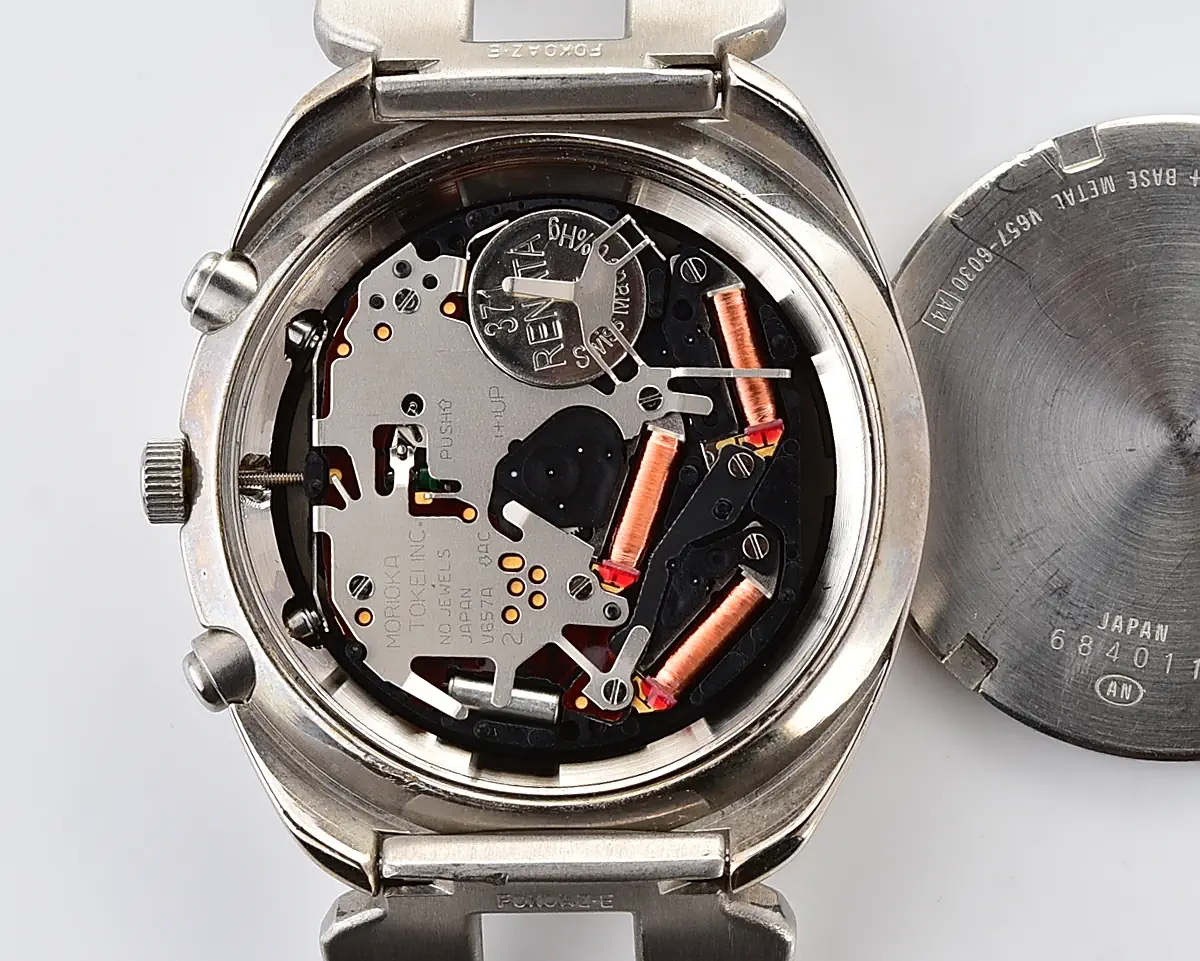
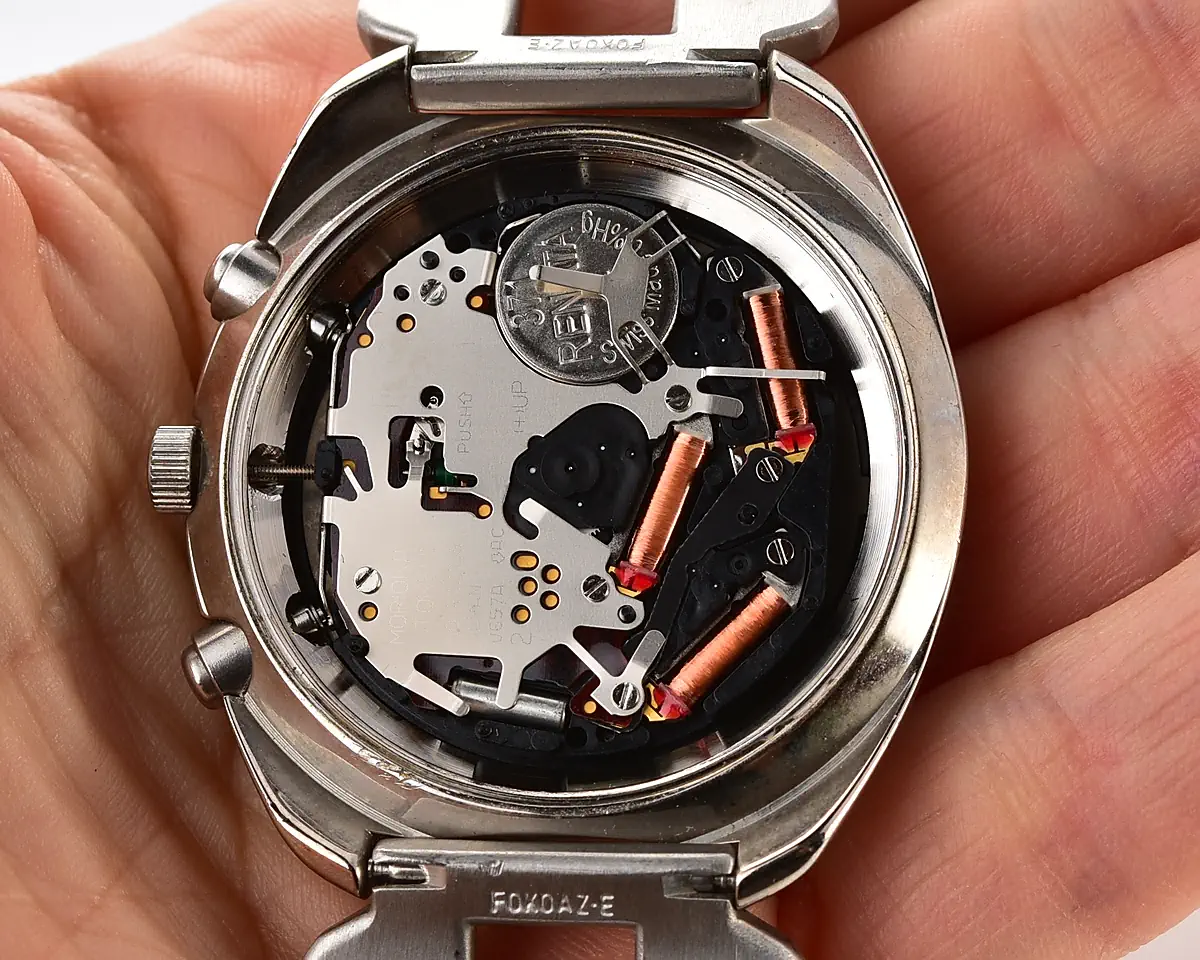
Inside is caliber V657, a quartz chronograph movement with a 1/10-second timer, a 60-second register and a 60-minute register, plus a date at 3 o’clock. It carries no jewels, as is normal for a quartz module.
About This Watch
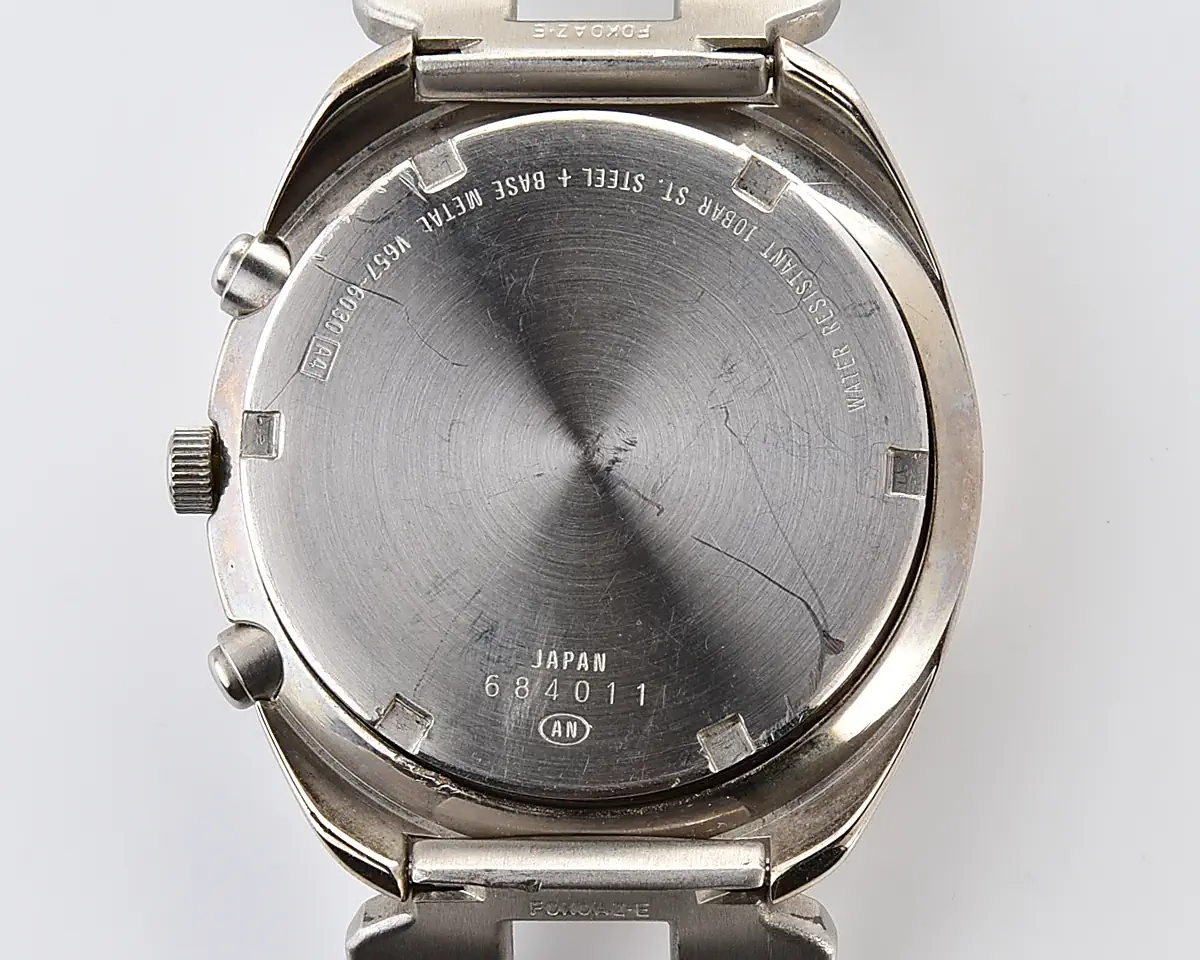
This is an Alba AKA chronograph, reference V657-6030 (as engraved on the case back), serial 684011. On Seiko-group serials the first digit is the year and the second the month, so 6 and 8 read August 1996, which matches the 1996 date collectors give this reference.
The dial is black with silver-grey squared sub-dials – 1/10 second at 12, minutes at 9, seconds at 6 – red hands, pale baton hour markers and a date window at 3, printed “AKA 1/10 CHRONOGRAPH 10 BAR ALBA”. The dial fine print reads V657-6040 while the case back reads V657-6030; dial and case carry separate code numbers on Seiko-group watches, so that is normal and not a mismatch.
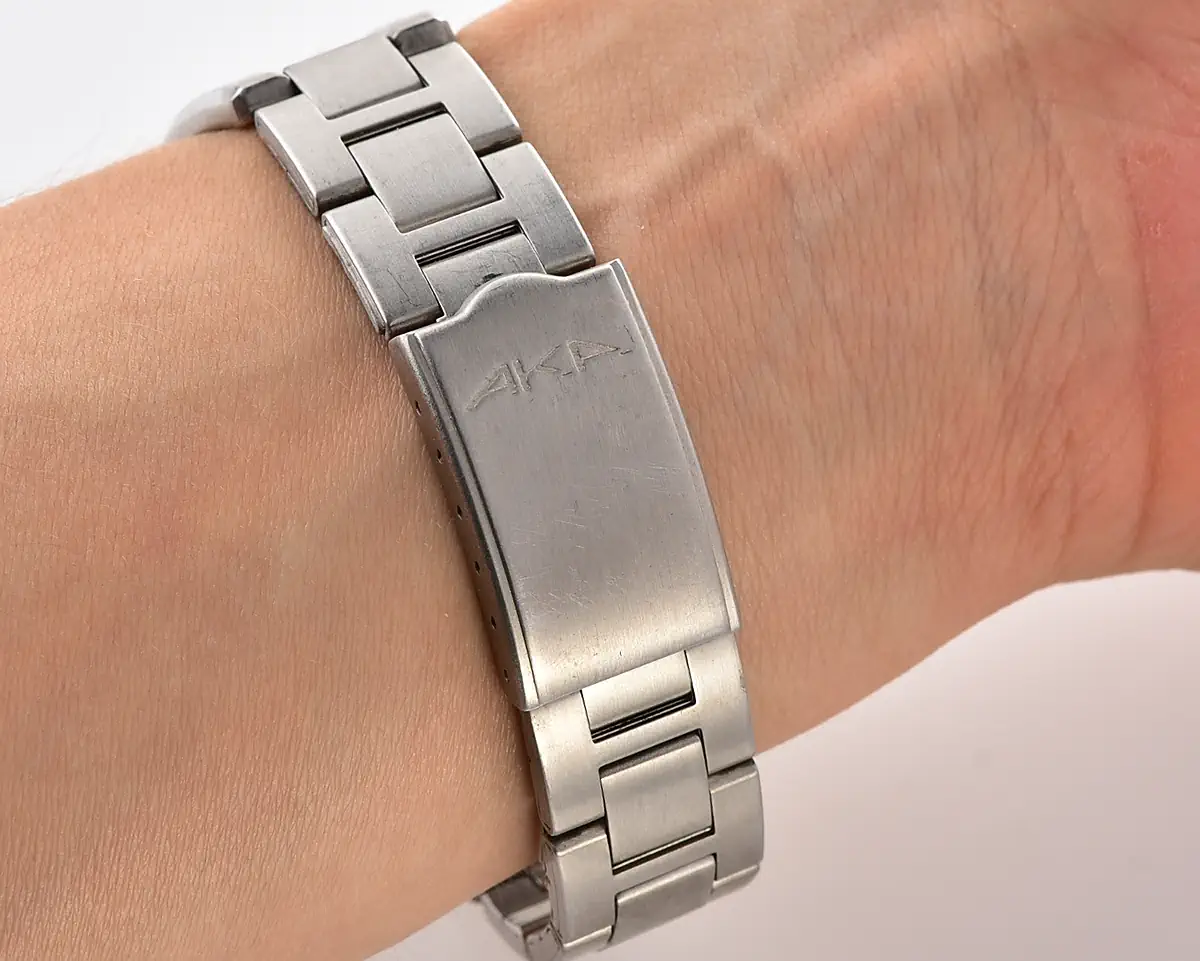
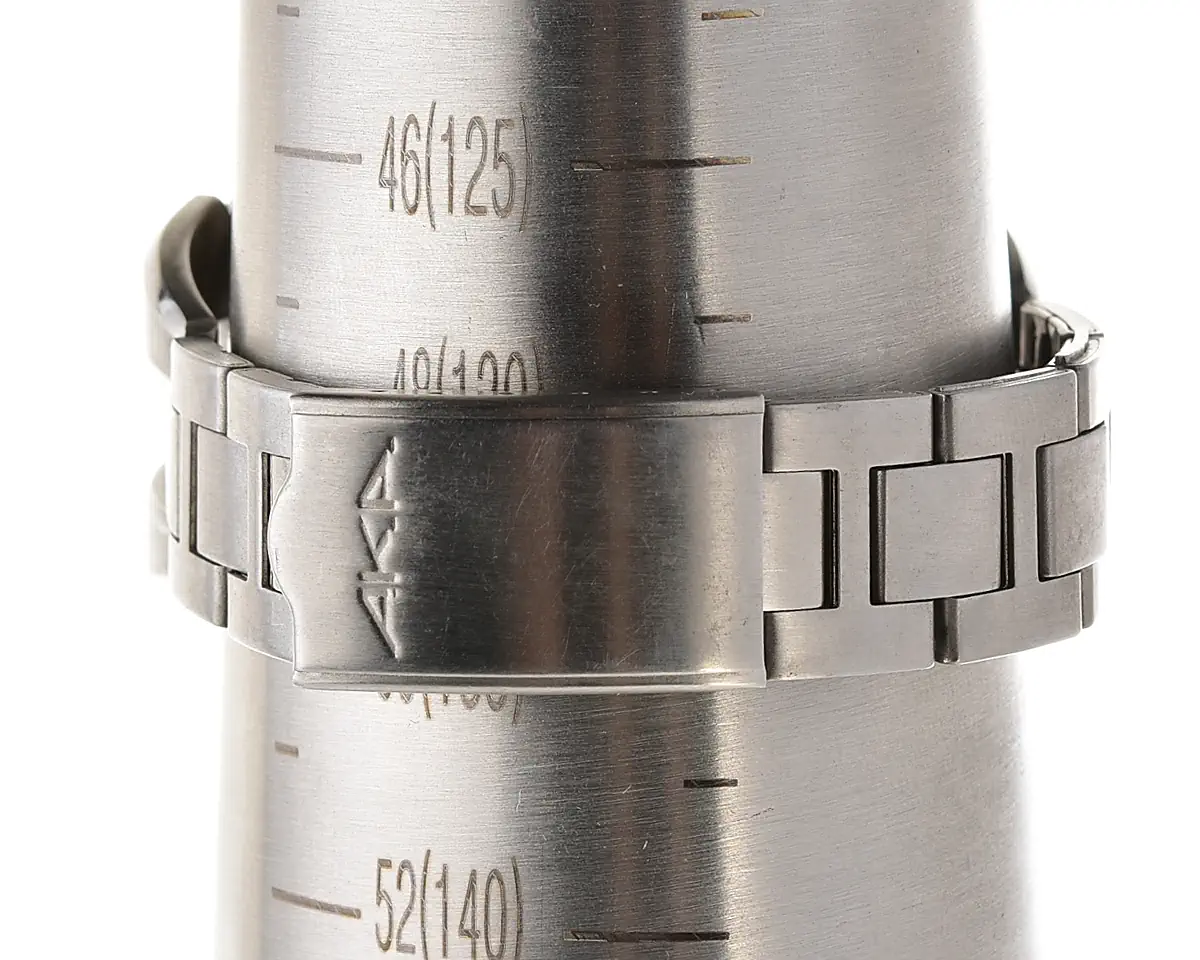
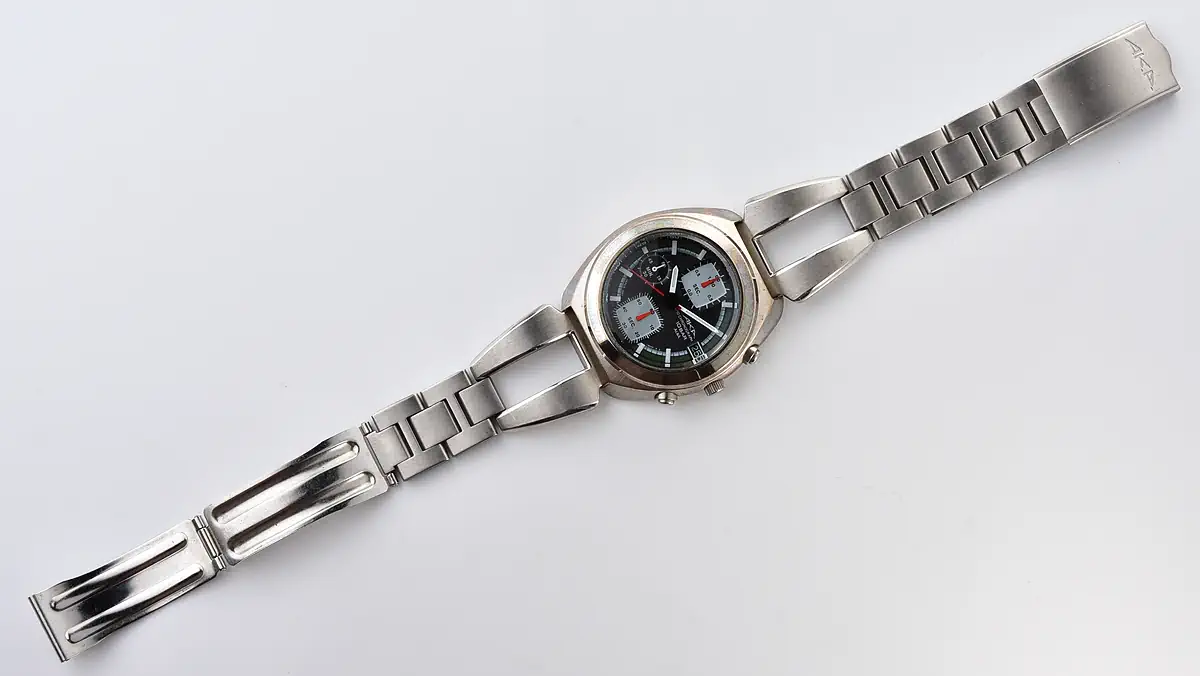
The movement is a V657A, signed Morioka Tokei Inc., Japan, with a Renata silver-oxide cell fitted. It sits on its original steel bracelet, whose folding clasp is stamped with the AKA logo.
Technical Specifications
- Brand: Alba (a Seiko Group brand)
- Line: AKA
- Reference Number: V657-6030
- Movement: Caliber V657A quartz chronograph, no jewels (plate signed Morioka Tokei Inc., Japan)
- Serial Number: 684011
- Production Date: August 1996 (from the serial)
- Case Material: Stainless steel and base metal (as marked on the case back)
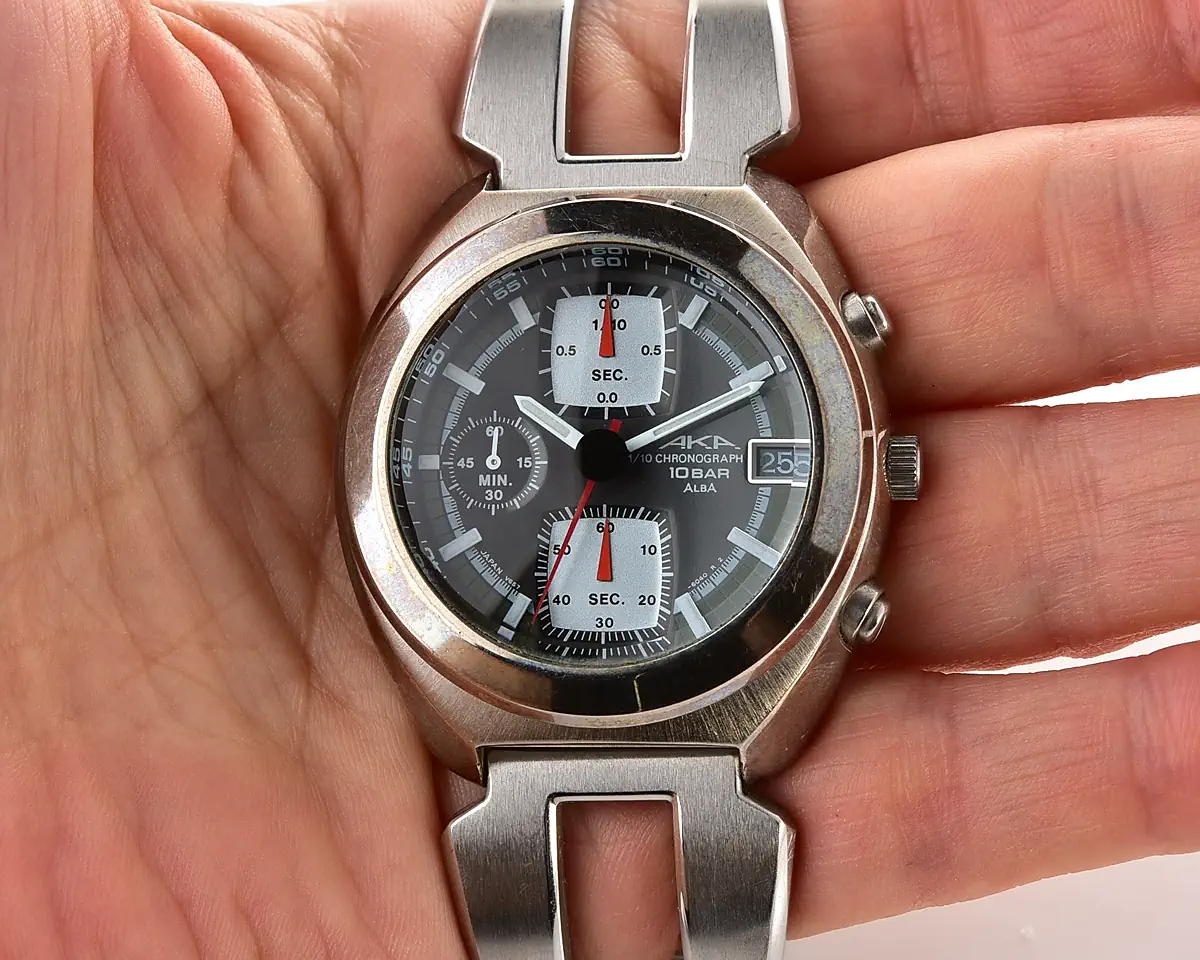
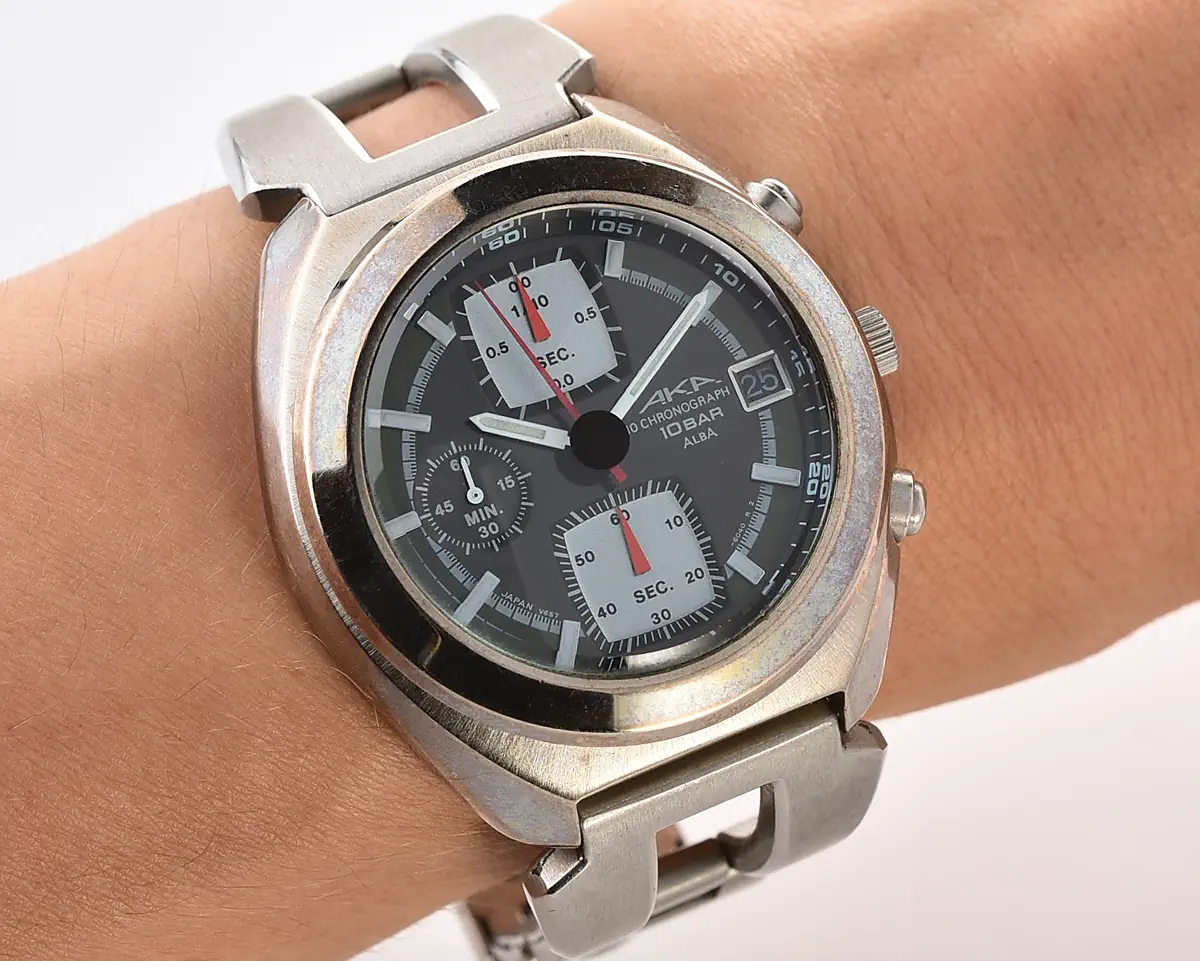
- Case Diameter: Approx. 39 mm (excluding crown)
- Dial: Black, silver-grey sub-dials, red hands, date at 3 o’clock
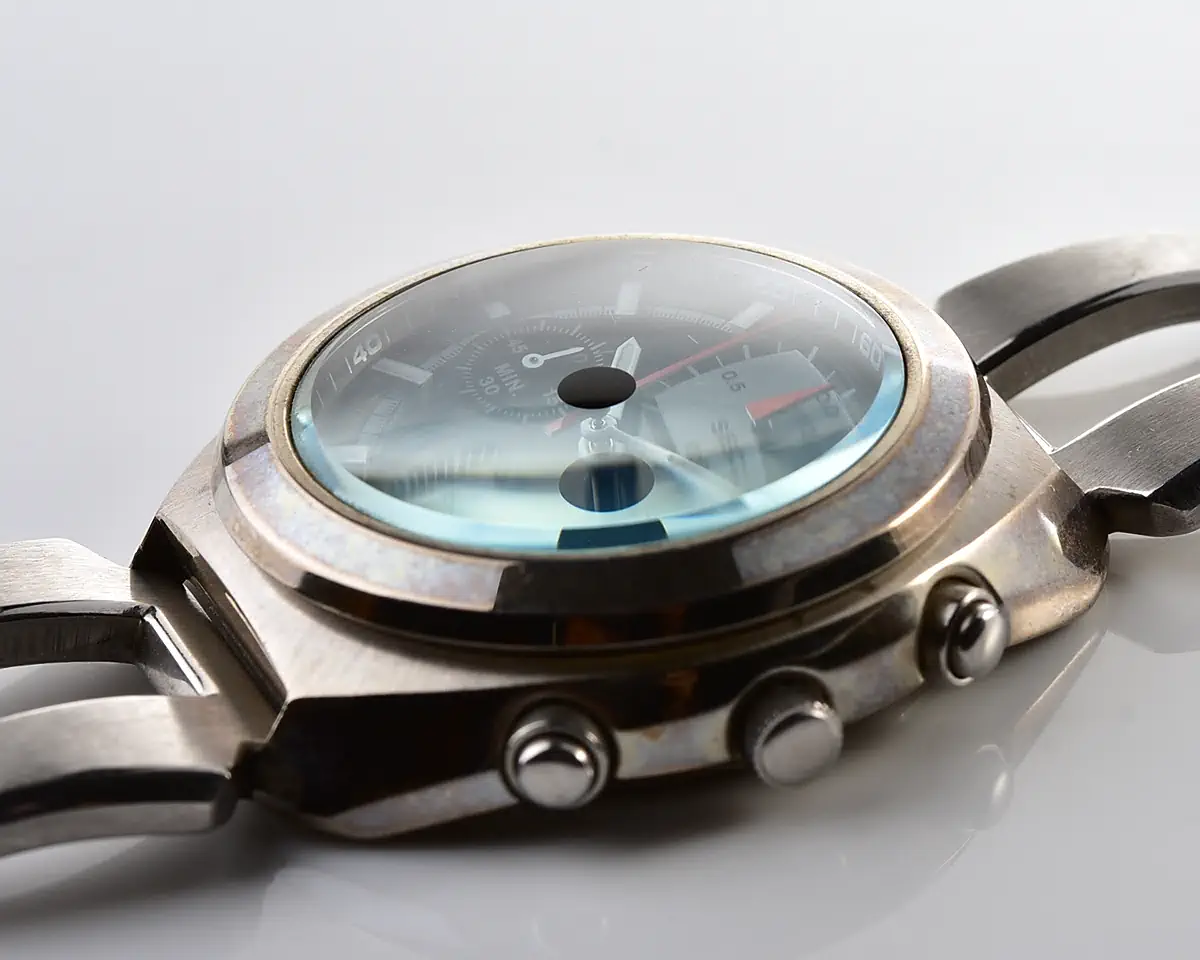
- Crystal: Domed mineral glass
- Case-back: Steel back marked “WATER RESISTANT 10 BAR”, V657-6030 and JAPAN
- Country of Manufacture: Japan
Condition Report
Case: the brushed surfaces show light wear and fine scratches on the flanks, and the polished bezel has picked up a rainbow-toned patina and small marks, all visible in the photos. The case back carries scratches. Dial: black and clean, with sharp printing; a few specks of dust sit under the crystal along the lower edge of the dial. Crystal: no cracks or chips visible. Bracelet: brushed steel with light scratches, and scuffing on the folding clasp, whose AKA logo is still clear.
How to Operate This Watch
Based on Seiko’s own instruction manual for caliber V657. The three small hands on the dial belong to the stopwatch: 1/10 second at 12, minutes at 9, seconds at 6. The hour, minute and centre seconds hands tell the time. The upper pusher (2 o’clock) is button A and the lower pusher (4 o’clock) is button B.
Setting the time and date
- Check first that the three stopwatch hands are at zero (see below).
- Pull the crown out to the first click and turn it clockwise until the previous day’s date appears.
- Pull it to the second click when the seconds hand is at 12, then turn clockwise until the desired date appears.
- Set the hour and minute hands, then push the crown back in on a time signal.
- Do not set the date between 9 p.m. and 1 a.m., or it may not change properly. When setting the hour, check the AM/PM: the date changes once in 24 hours, so turn the hands past 12 and see whether the date changes.
- Set the minute hand 4 to 5 minutes ahead of the desired time, then turn it back to the exact time. Do not press any pusher while the crown is at the second click.
Using the stopwatch (up to 60 minutes, in 1/10-second steps)
- Standard timing: A to start, A to stop, B to reset.
- Accumulated time: A start, A stop, A restart, A stop, then B to reset.
- Split time: A to start, B to split (the hands freeze on the split time while timing carries on), B to release the split and catch up, A to stop, B to reset.
- While the stopwatch is timing, the 1/10-second hand stays at zero after the first minute; it shows the 1/10 seconds only once you stop or split.
- Never pull the crown out while the stopwatch is counting. After a long timing it can take up to about 40 seconds for the hands to return to zero on reset.
If a stopwatch hand does not rest at zero
Pull the crown out to the second click. Press A repeatedly until the 1/10-second hand is at zero, then press B repeatedly until the seconds and minute hands are at zero (hold the button and the hands move fast). Push the crown back in.
Battery
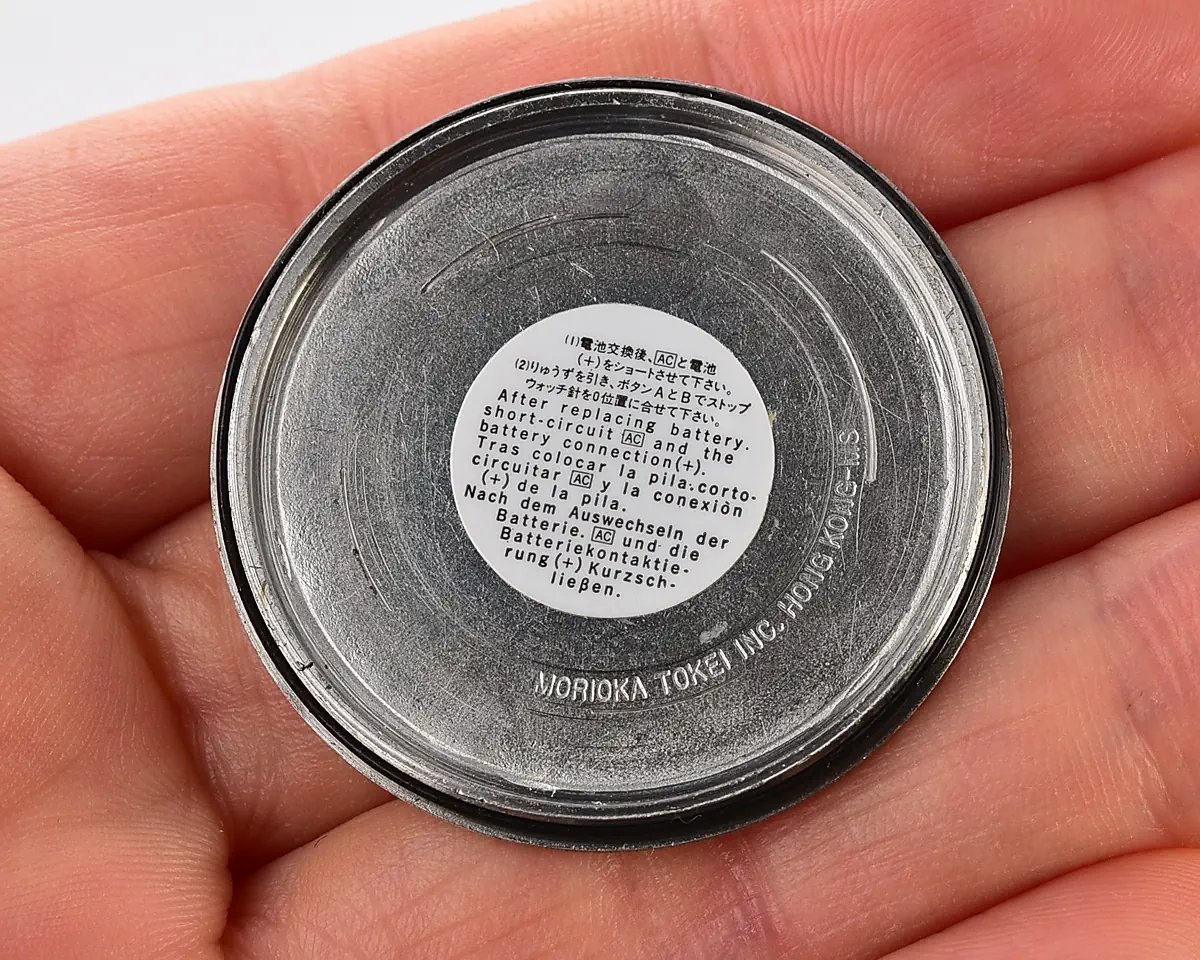
Seiko specifies an SR920SW silver-oxide cell (about 2 years of life, less if you time for more than an hour a day). After a battery change, pull the crown to the second click, press and hold A and B together for 2 seconds, zero the stopwatch hands with A and B as above, then set the time and push the crown in. Have it done by a watchmaker.
Full manual: Seiko Cal. V657 instructions (PDF)
This watch has recently been serviced by a professional watchmaker and keeps good time.
Comes complete with original steel bracelet*.
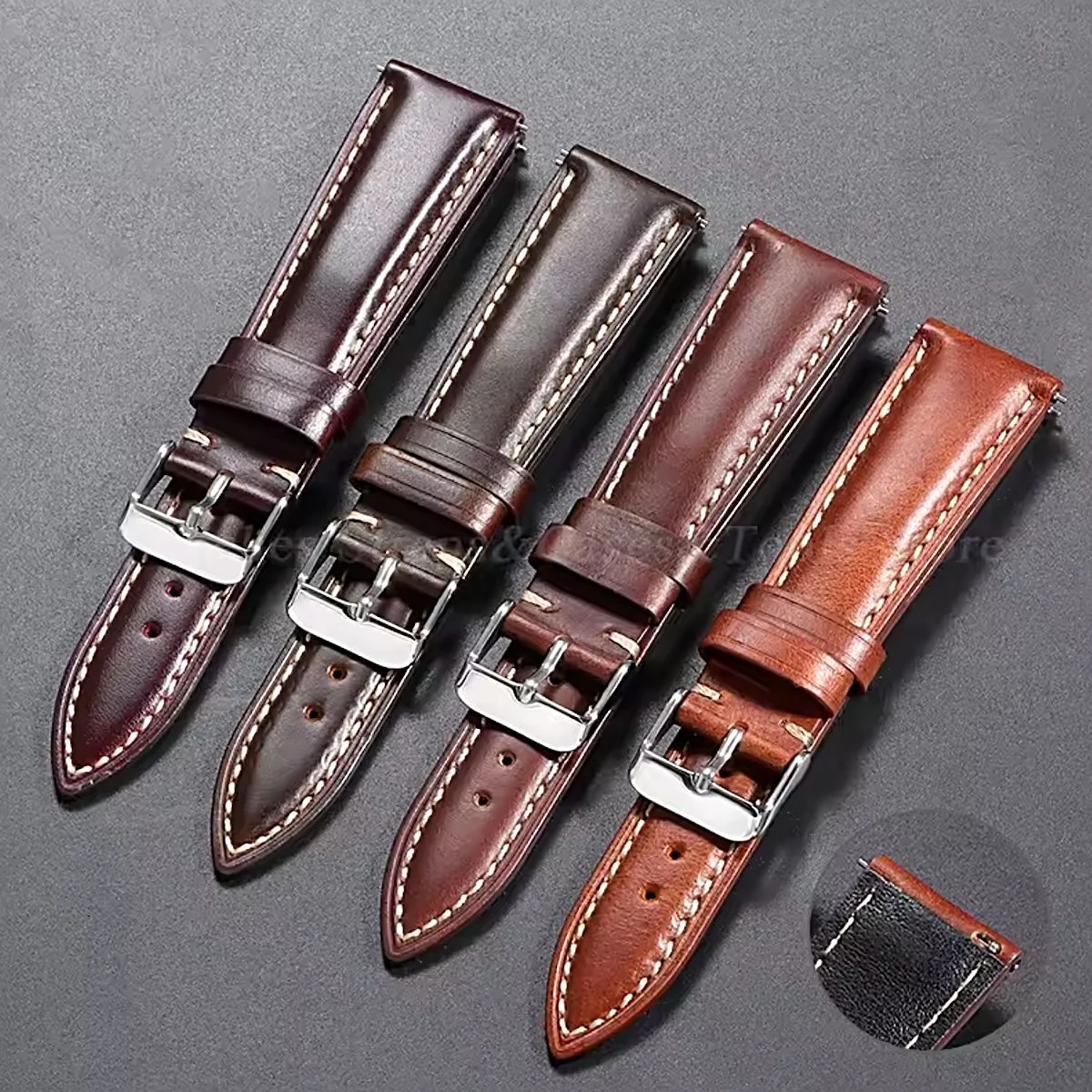
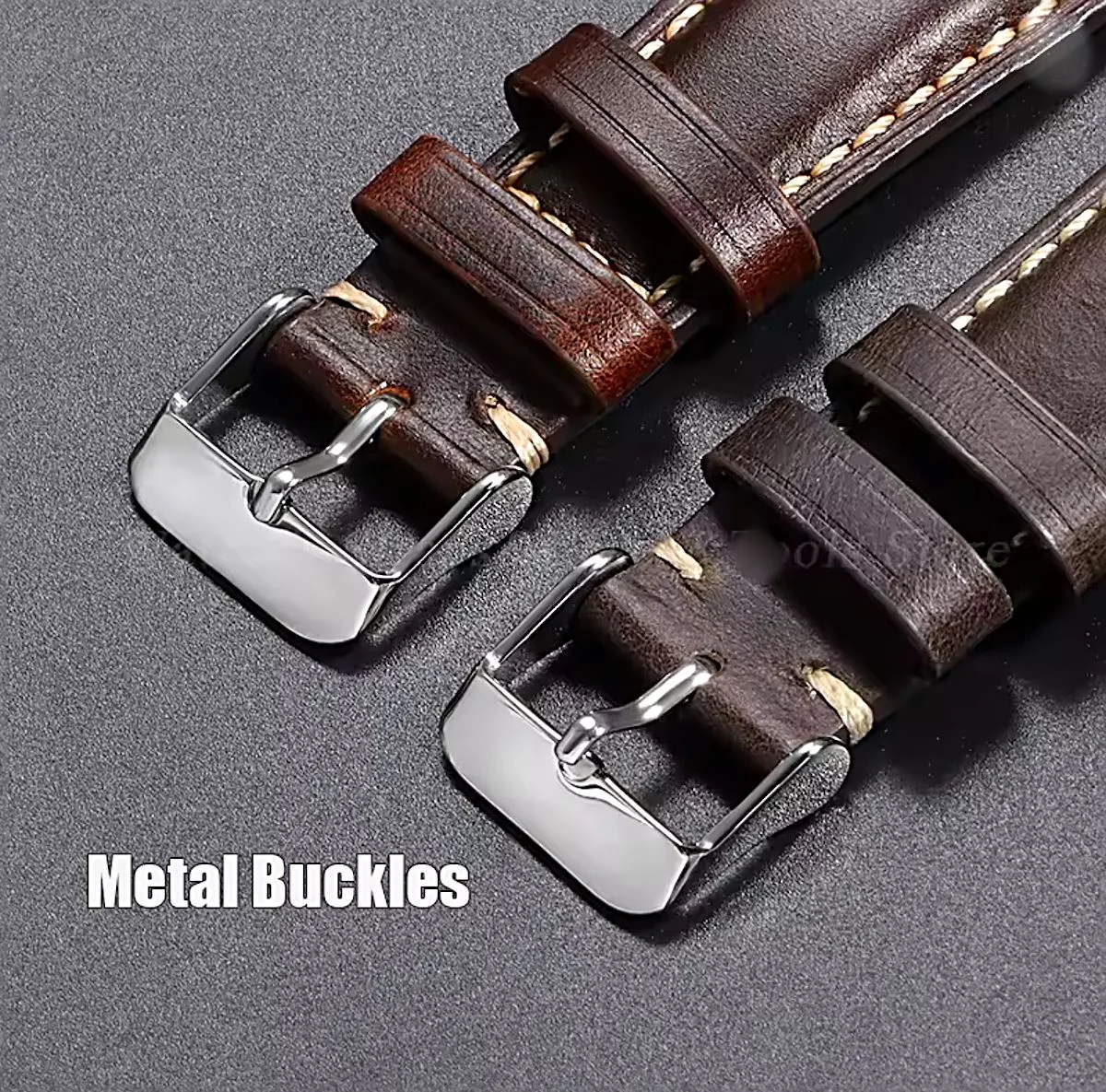
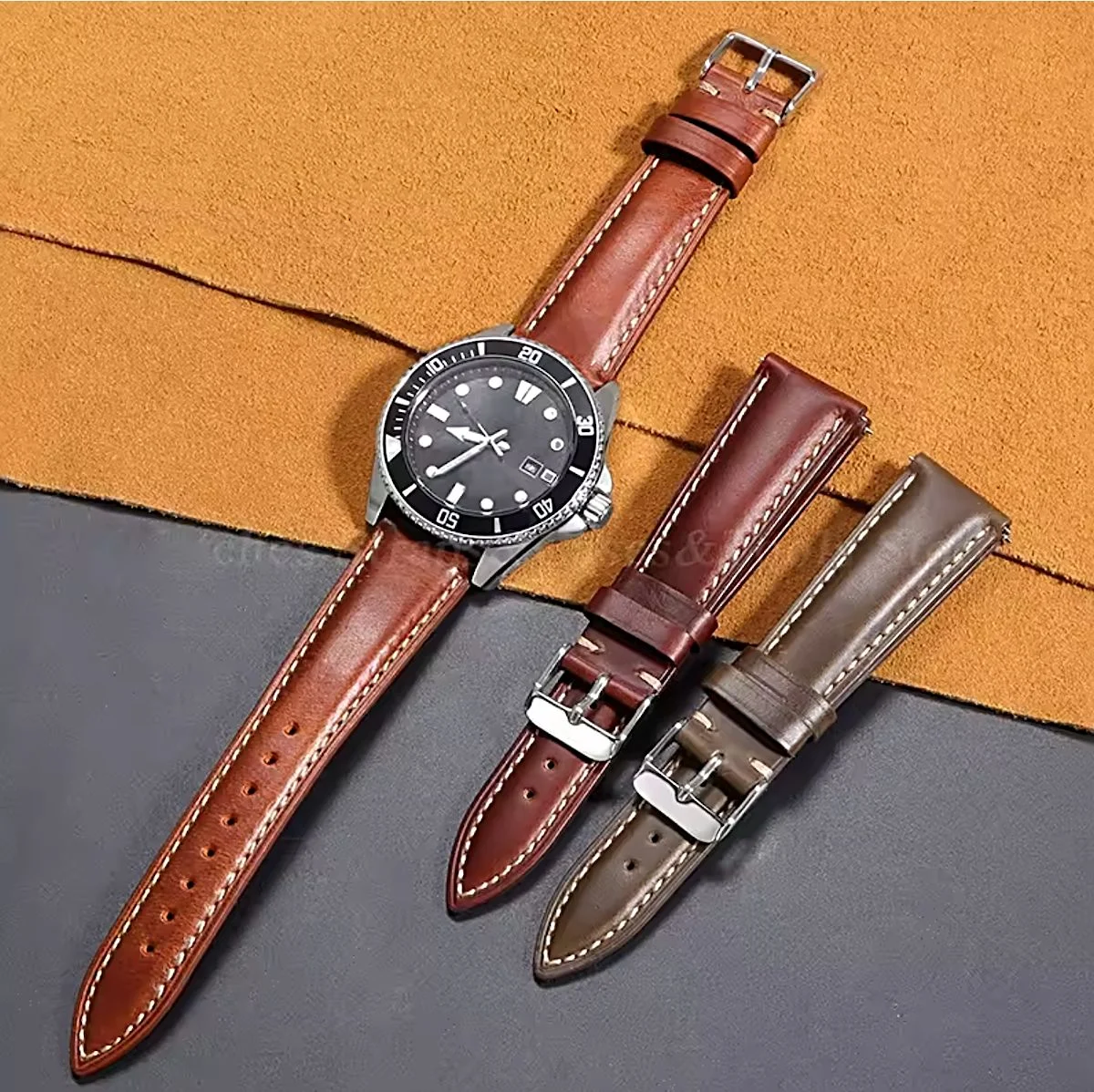
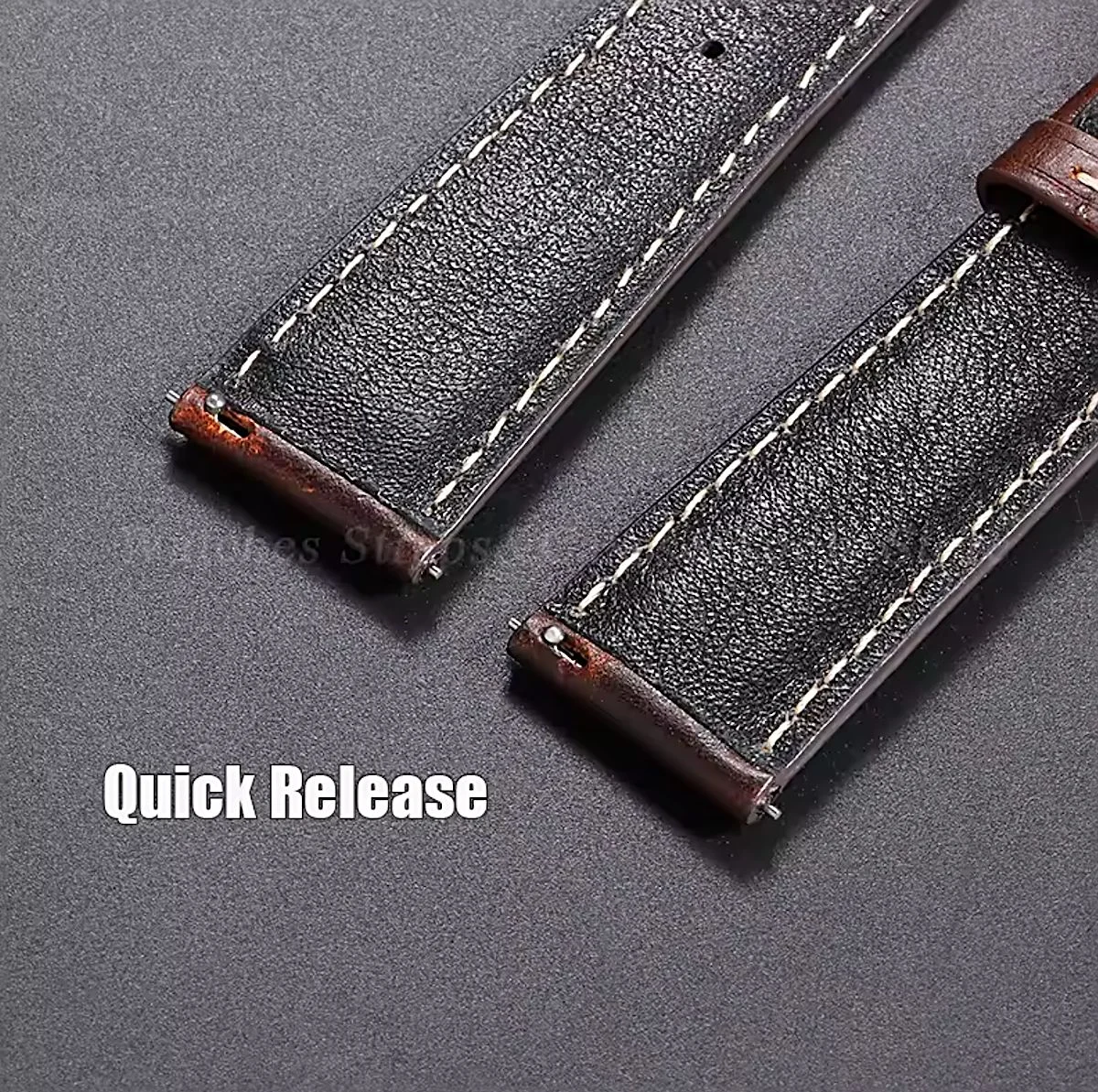
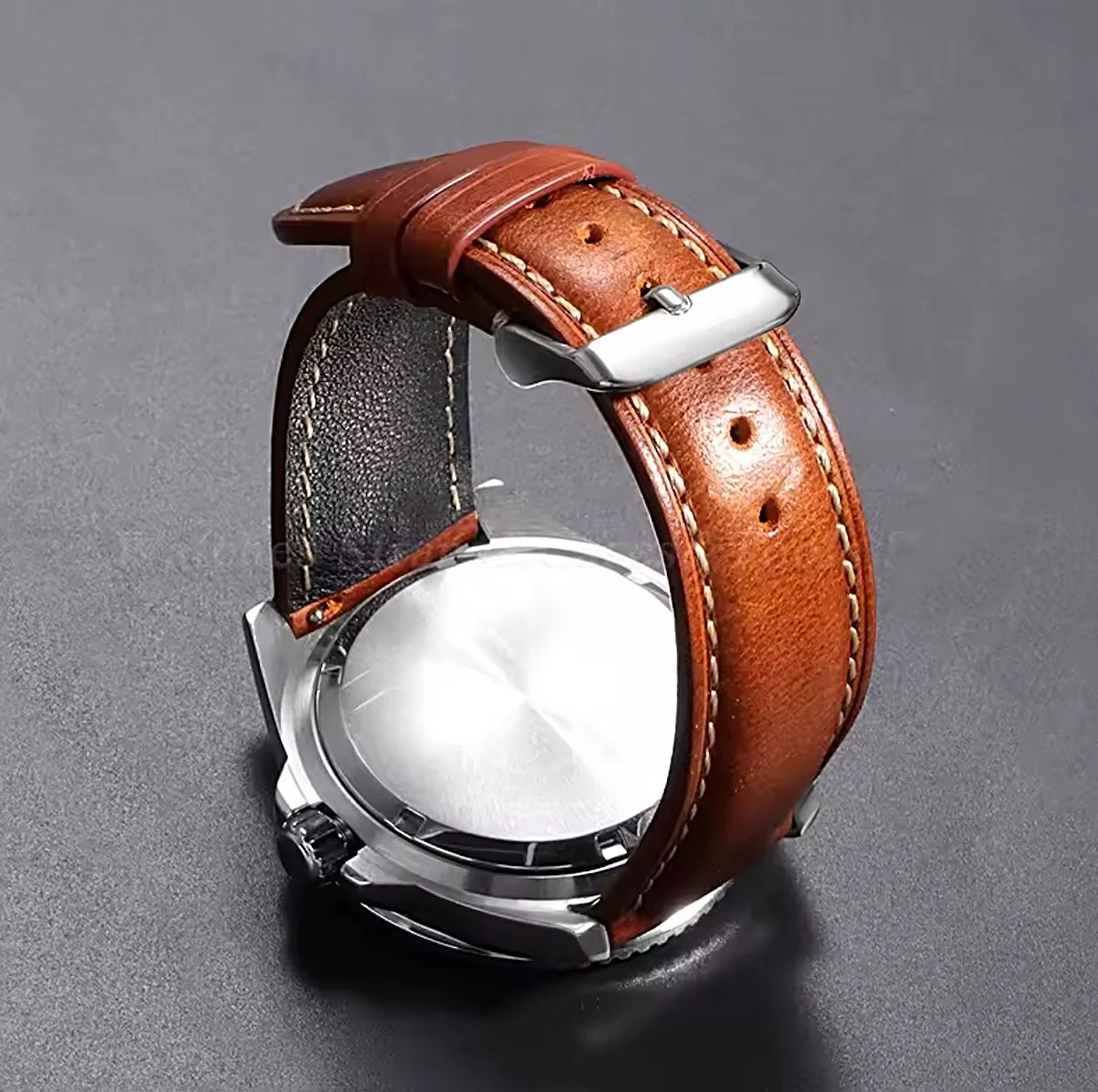
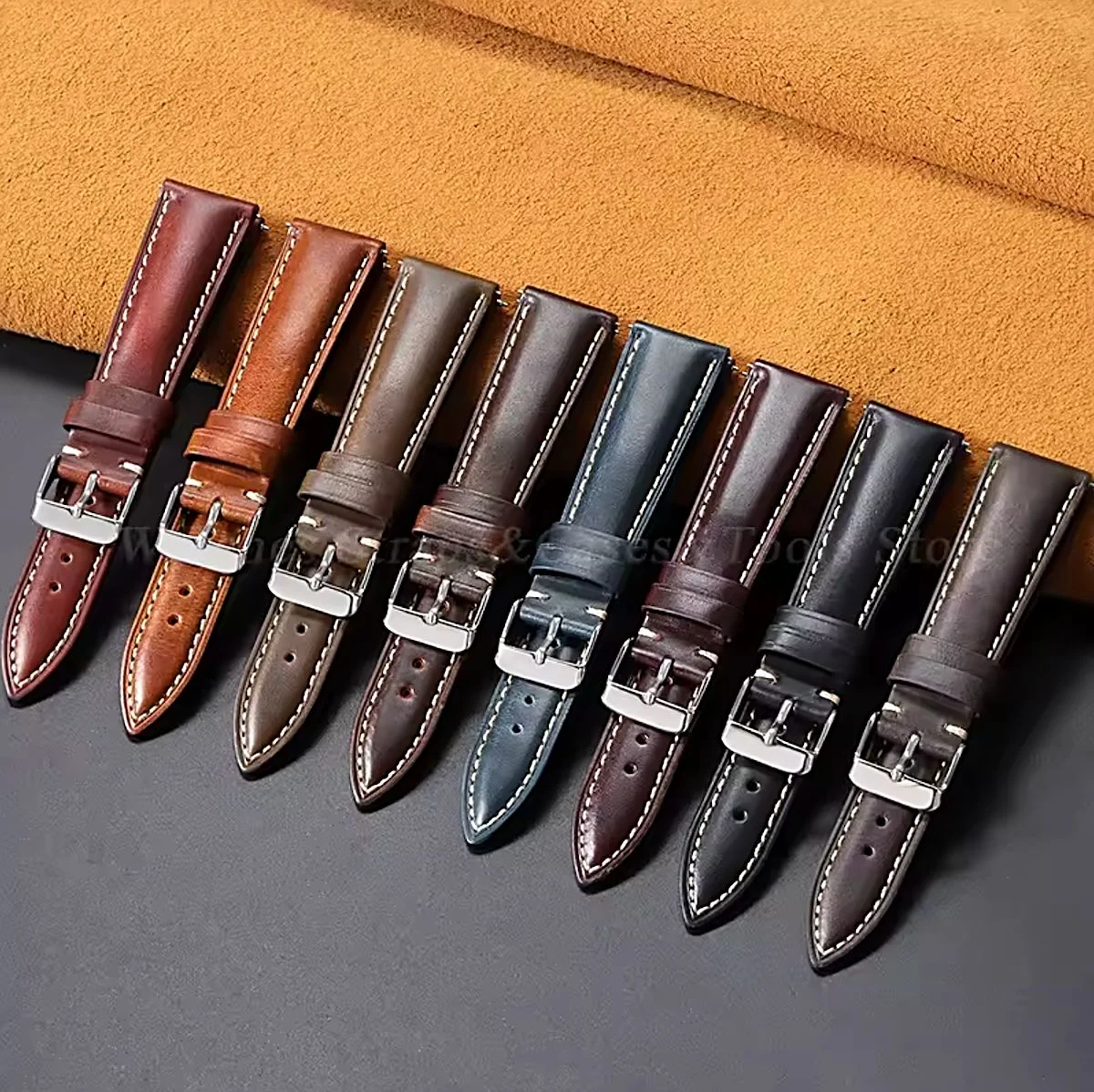
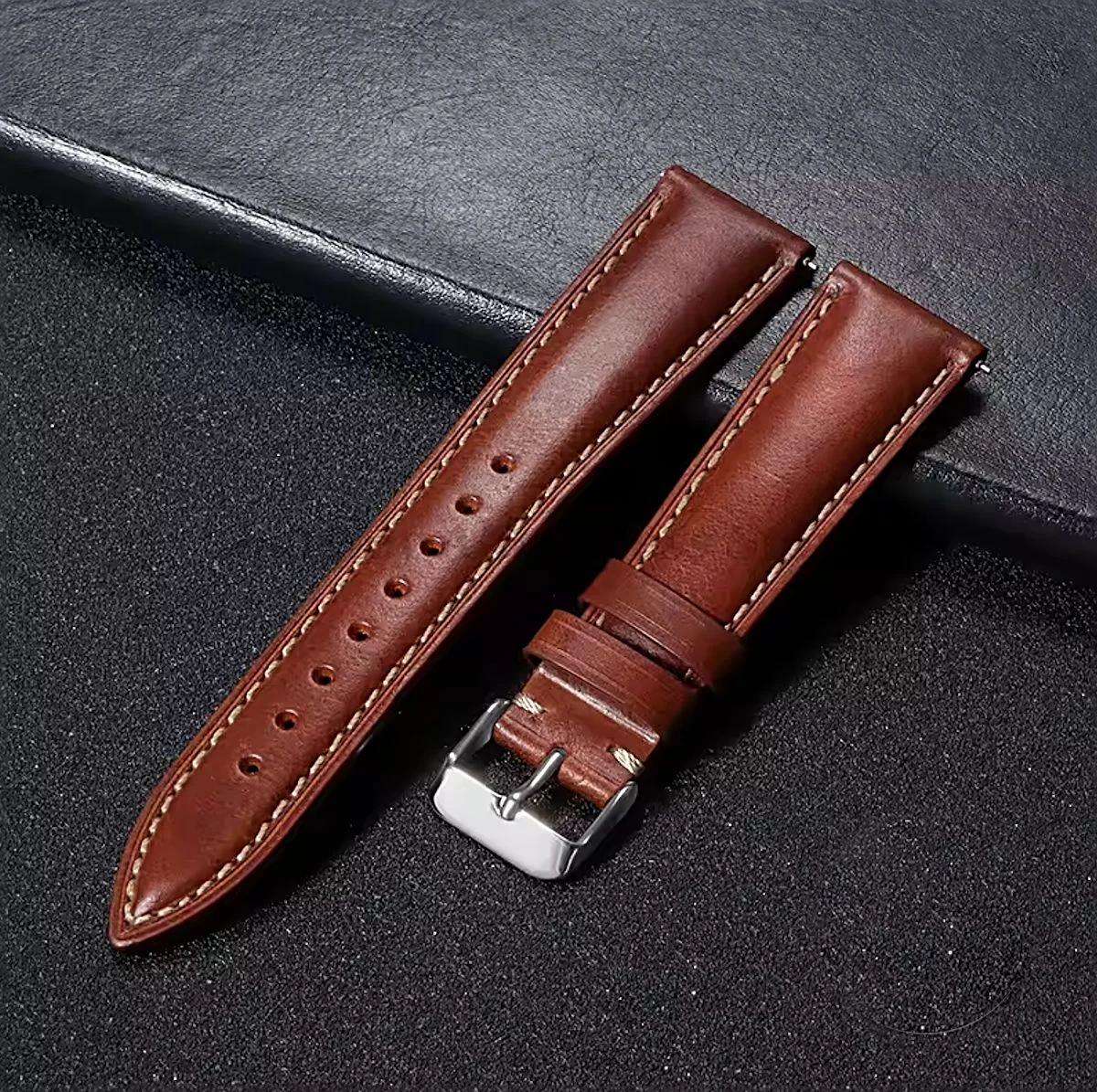
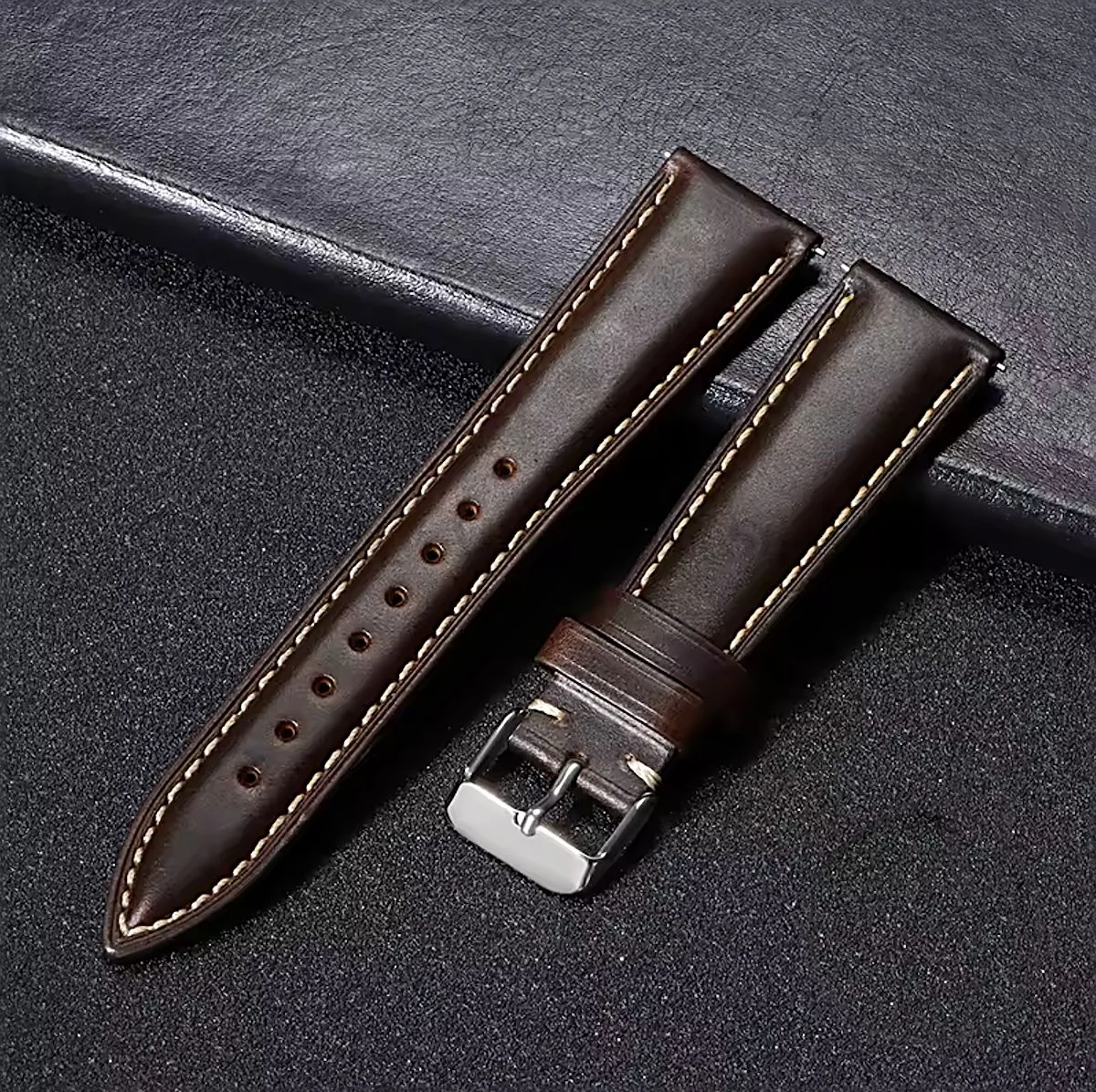
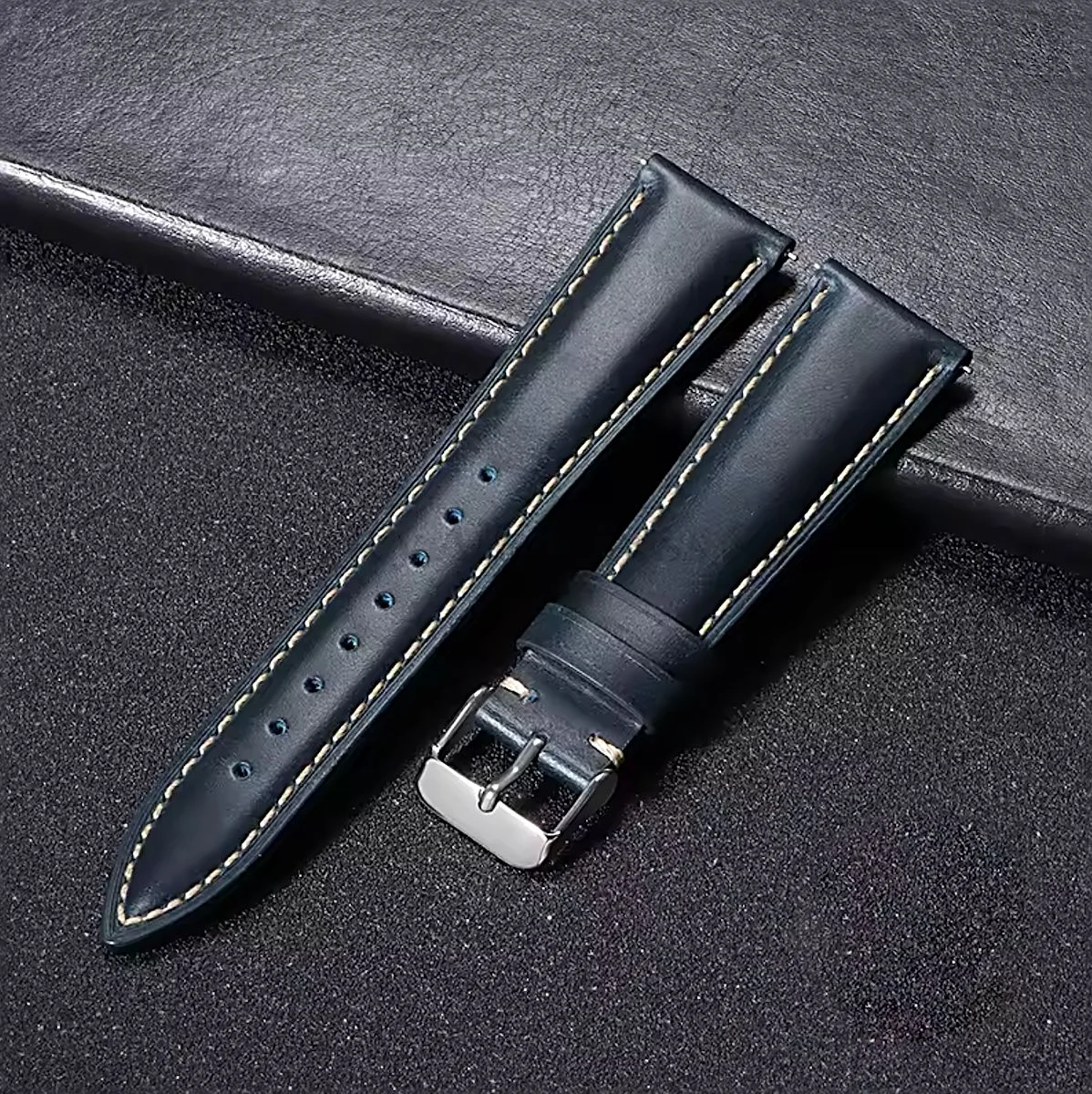
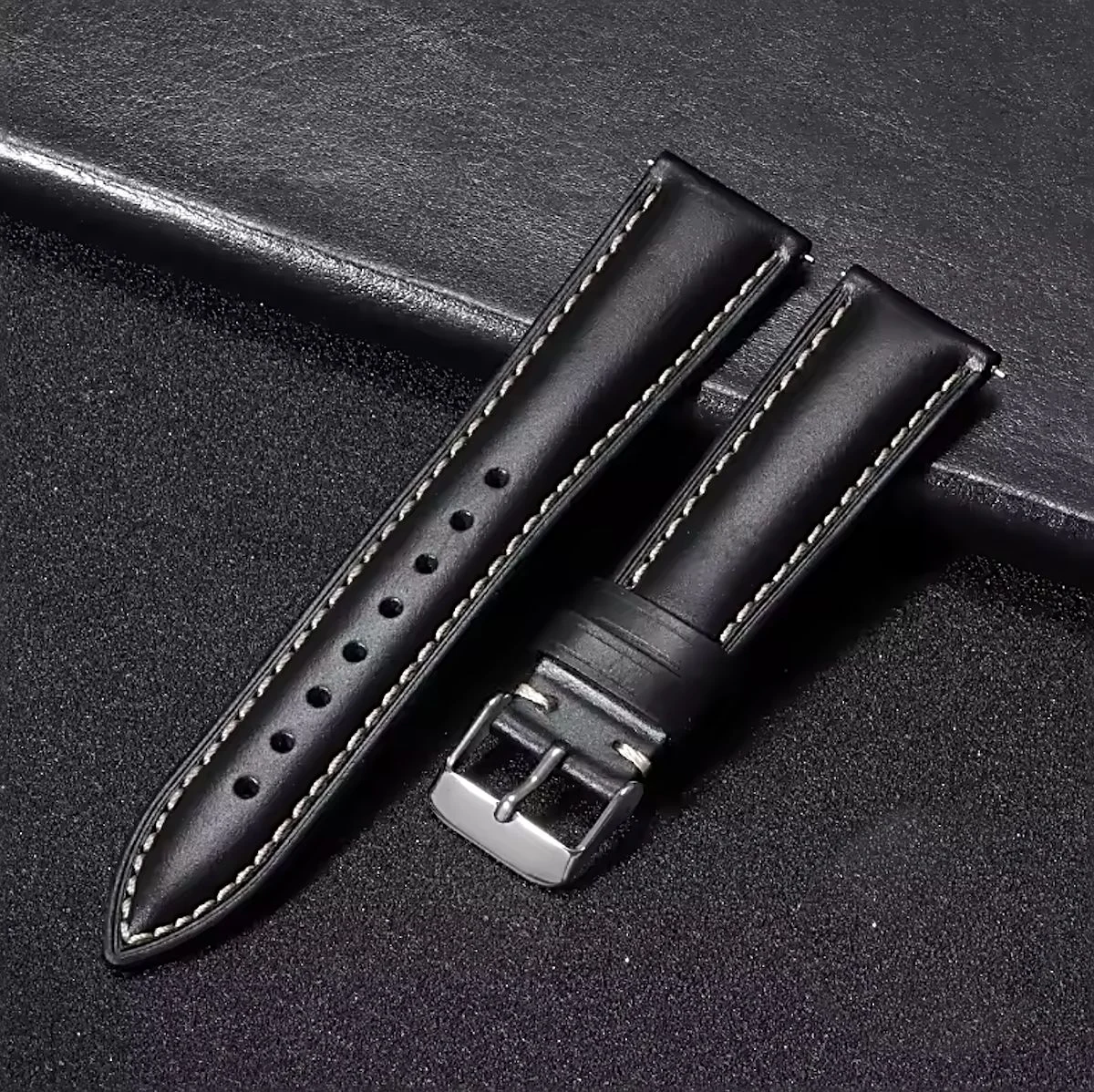
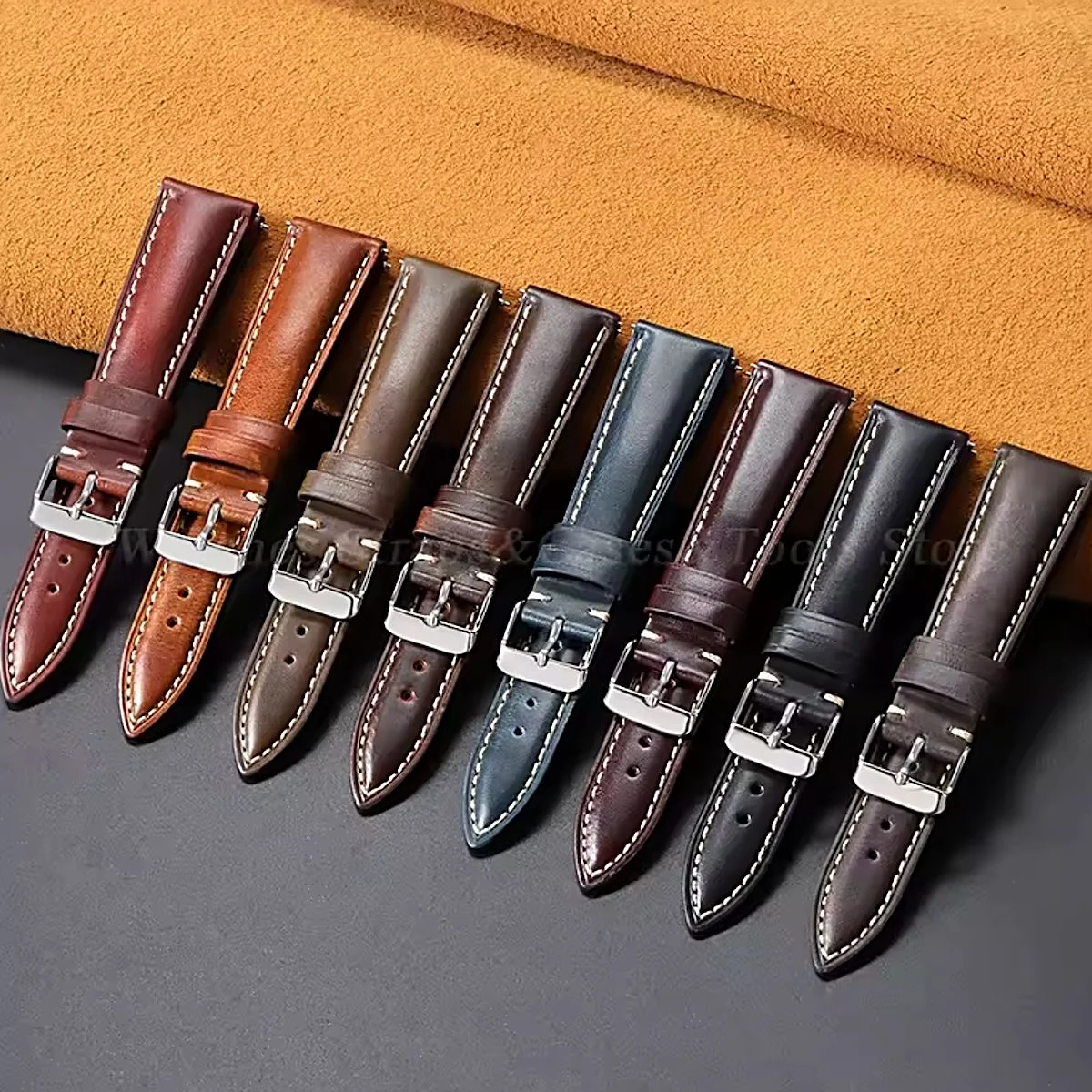
(*)Note: Stock bracelets are often shortened by previous owners and may not fit you (see bracelet size in the product images). We match the strap to this watch’s lug width, so there is nothing for you to measure — just pick a padded leather strap for Seiko from the options at the top of the page.
This watch ships from 🇺🇦 Ukraine with tracking number
Why Collectors Want This Watch Today
The AKA is a 1990s Japanese design that never tried to be subtle: a chunky case, squared-off sub-dials and a tuning-fork bracelet that people still pick out of a crowd. It is a real 1/10-second quartz chronograph rather than a fashion watch with fake pushers, and it is easy to live with – no winding, just a battery.
It is not a rarity. Alba made the V657-6030 in several colourways, and examples turn up regularly. What it offers is a distinctive, well-styled and inexpensive slice of mid-1990s Japanese watch design, in the black version.
Modes of payment:
- PayPal
- Credit Cards (VISA, MasterCard, American Express, Discover)
- bitcoin
We guarantee the item you receive looks and works exactly as advertised — or your money back.
Seiko lug-width matched leather straps — 18 / 19 / 20 mm
About the watch factory
Seiko Group Corporation (セイコーグループ株式会社, Seikō Gurūpu kabushiki gaisha), commonly known as Seiko, is a Japanese maker of watches, clocks, electronic devices, and semiconductors. Founded in 1881 by Kintarō Hattori in Tokyo, Seiko introduced the world’s first commercial quartz wristwatch in 1969.
Seiko is widely known for its wristwatches. Seiko is one of the few watch companies that is fully vertically integrated. Seiko is able to design and develop all the components of a watch, as well as assemble, adjust, inspect and ship them in-house. Seiko’s mechanical watches consist of approximately 200 parts, and the company has the technology and production facilities to design and manufacture all of these parts internally.
Seiko offers one of the widest ranges of watch technologies in the world—quartz, kinetic, solar, mechanical, and Spring Drive—spanning everything from affordable everyday pieces to six-figure haute horlogerie. Over the decades it has launched multiple global brands, including Lorus, Pulsar, and Alba, while elevating its prestige through innovations like Spring Drive, which helped push Seiko into higher-end territory. In 2017, Grand Seiko was spun off into its own standalone luxury brand, while Credor remains part of Seiko’s own lineup, sold primarily in Japan. Seiko’s own global lineup now includes Grand Seiko, King Seiko, Prospex, Astron, Presage, and Seiko 5 Sports.
Among Seiko’s key lines, Seiko 5 (born in 1963) is the gateway mechanical series known for durability and value; Lord Matic defined 1970s style with faceted crystals and colorful dials; Astron remains Seiko’s flagship GPS-solar tech line; Presage focuses on traditional mechanical craftsmanship with enamel and urushi dials; and Prospex delivers professional-grade dive, field, and pilot watches often embraced by enthusiasts. At the top end, Grand Seiko emphasizes precision, Zaratsu polished design, and movements like Spring Drive, while King Seiko—revived in the 2020s—brings back sharp, elegant 1960s styling with modern calibres.
Finally, Credor represents Seiko’s pinnacle of artisanal watchmaking, producing low-volume pieces in precious metals and showcasing Japanese decorative arts and haute complications from the Micro Artist Studio. Beyond watches, Seiko has also produced various electronic devices and, historically, jewelry and eyewear—though those divisions have since shifted to other companies.