Description
UMF RUHLA vintage mechanical pocket watch
EAST GERMAN CLASSIC!
“UMF” stands for Uhren- und Maschinenfabrik — “watch and machine factory” — and Ruhla is the small town in the Thuringian Forest where it stood. Together they form the dial signature of what became East Germany’s largest watch factory, used from 1 May 1952, the day the old Gebrüder Thiel works was taken into state ownership.
“Saturn” was not a UMF invention. It was the name Gebrüder Thiel gave to the last and best pocket-watch calibre it ever designed, introduced in 1937. The new state-owned factory simply kept building it — and kept the name — under the UMF mark.
About the Saturn Pocket Watch
Ruhla built its reputation on volume rather than refinement. For most of its life the factory turned out simple, inexpensive watches by the million, almost all of them running a pin-lever escapement — the cheap-to-make Stiftankerhemmung that made a Ruhla affordable to everyone.
The Saturn is the exception. Developed by Gebrüder Thiel in 1937 as an 18-line pocket-watch calibre, it was given a proper Swiss lever escapement with jewelled pallets and balance, seven jewels in total, and a coupling winding system with a pull-out stem for hand-setting. It was the top of the factory’s range and one of its most-produced models, and it stayed in production until 1961 — the last decade of that run under the UMF name.
About This Watch
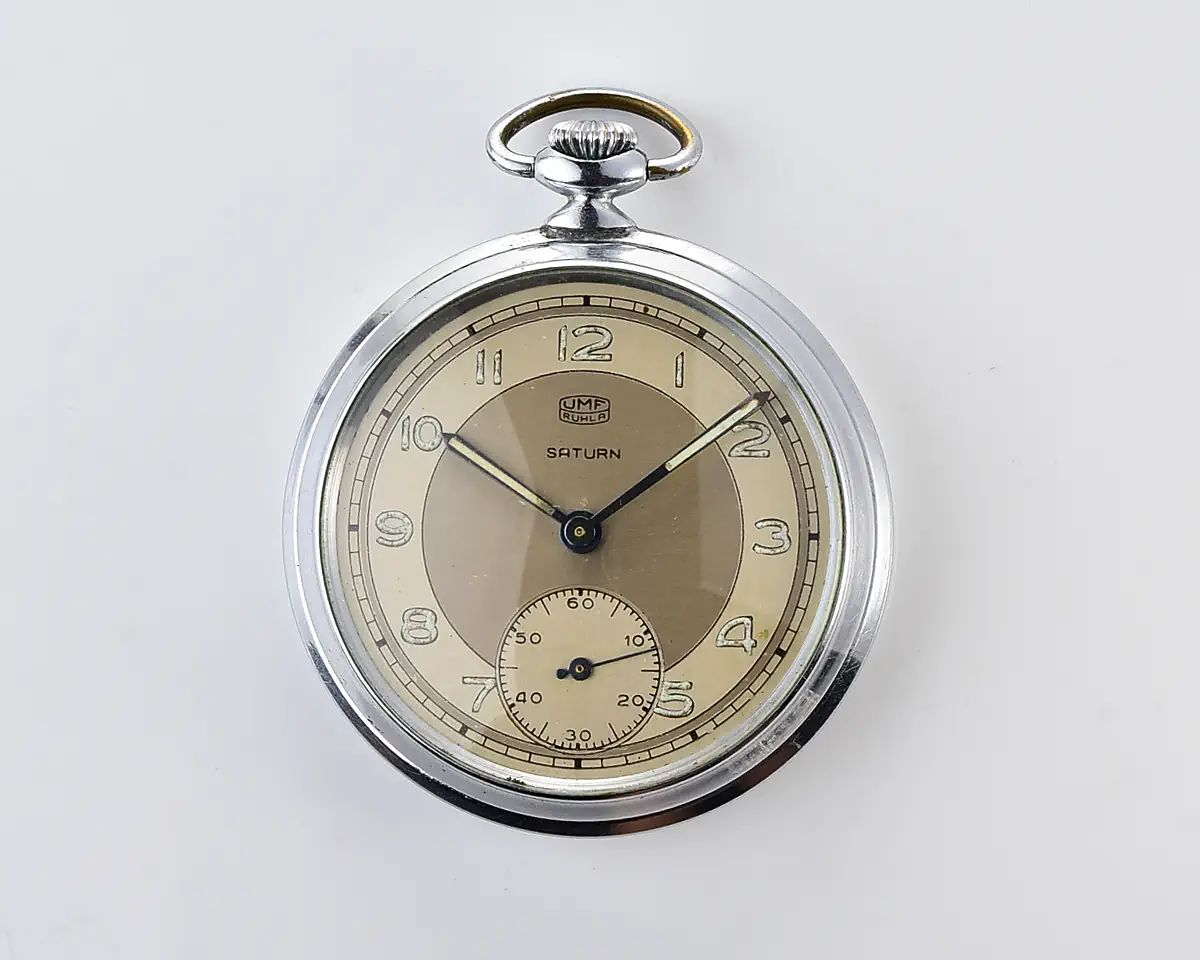
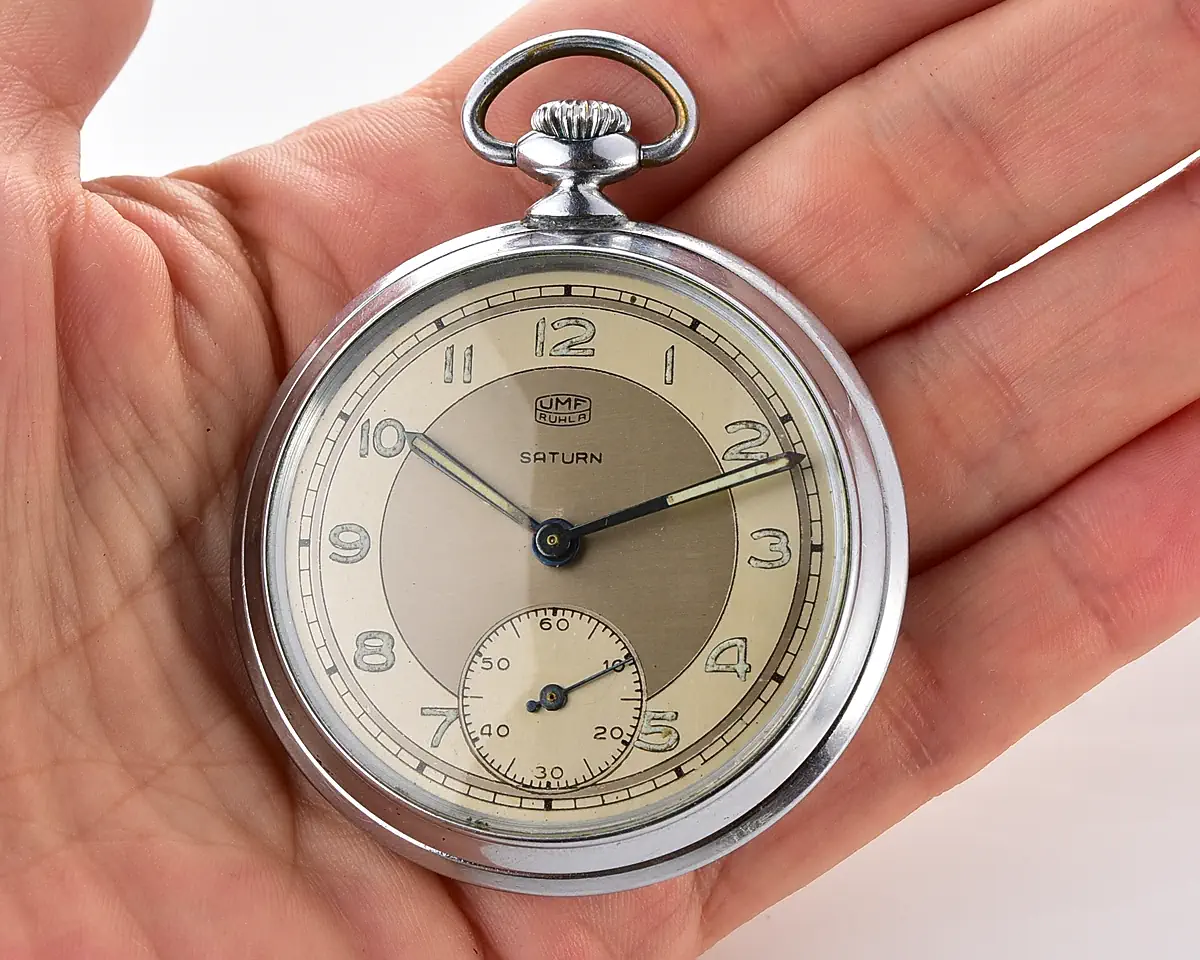
This is a UMF Ruhla Saturn in its open-face form: no cover over the dial, a large chrome-plated case of about 50mm, and the bow and crown at twelve o’clock where a pocket watch wants them.
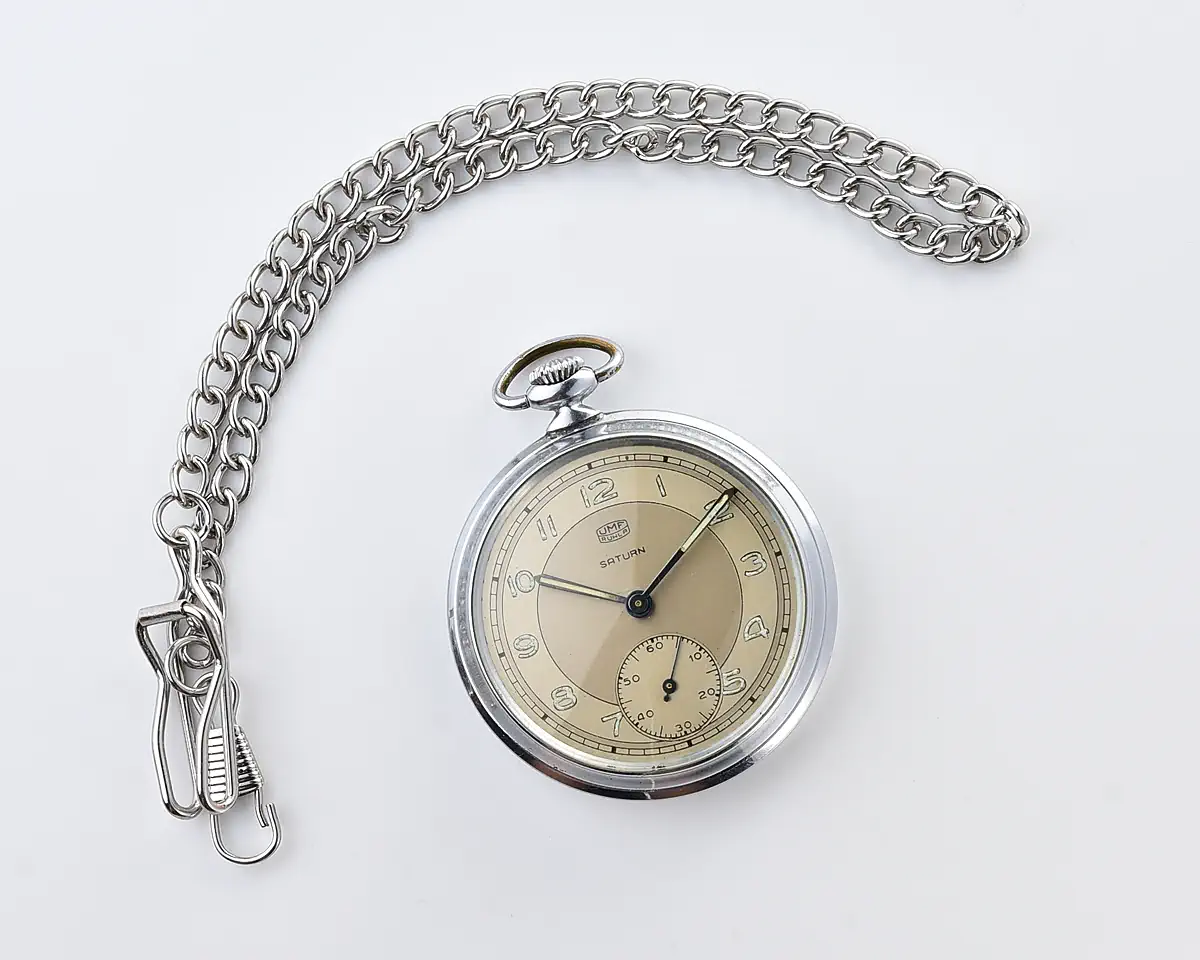
The dial is the best part. It is a two-tone design typical of the late 1930s taste the Saturn was born into and carried on through the 1950s — a pale silvered outer ring carrying a fine railway minute track, and a warmer sunburst centre disc that shifts from champagne to olive as the watch turns in the light. The Arabic numerals are outlined rather than printed solid, and each outline is filled with luminous compound; the same compound runs down the centre of the dark hands. A subsidiary seconds dial with its own graduated scale sits at six. Above the centre are the two marks that identify it: the UMF RUHLA logo in its rounded cartouche, and SATURN below it.
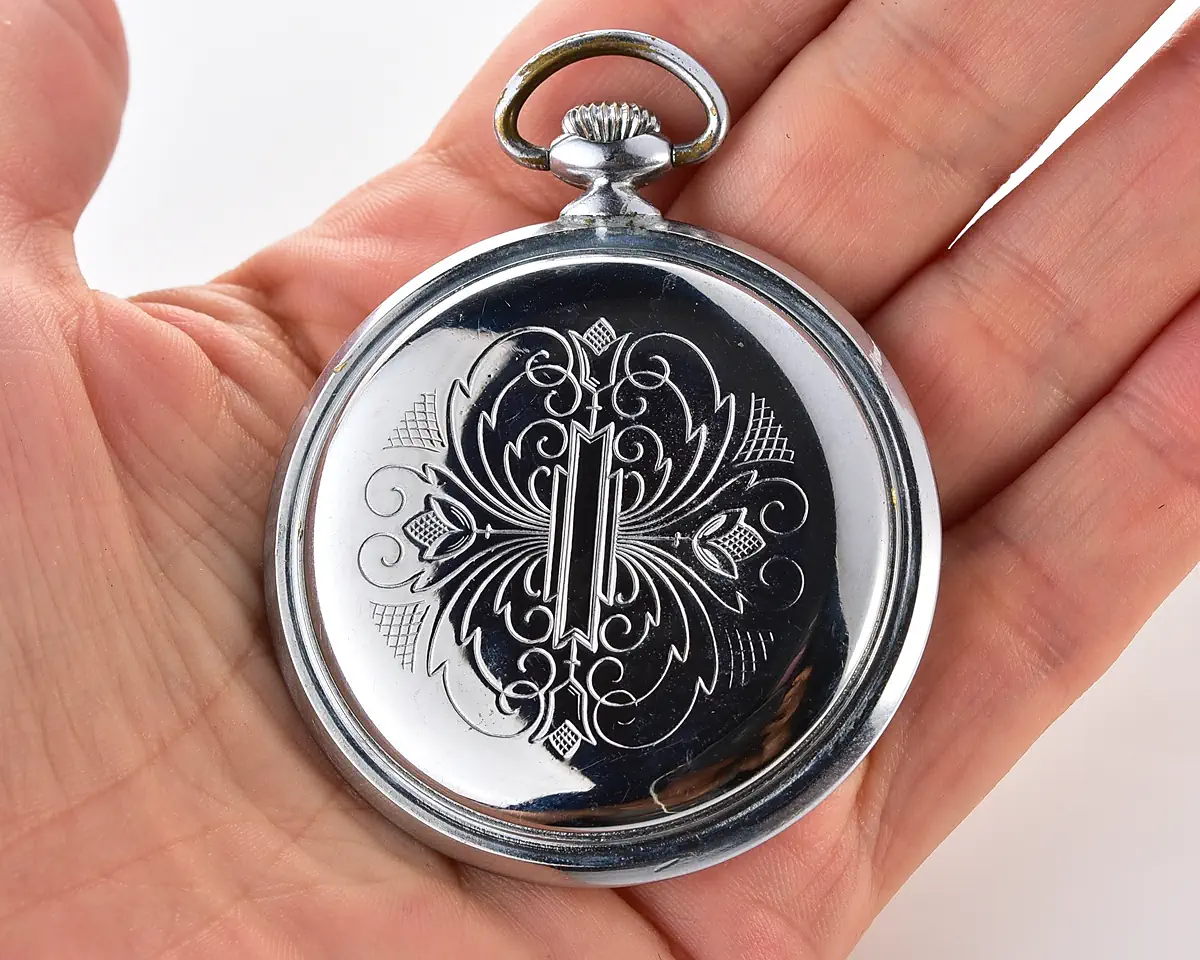
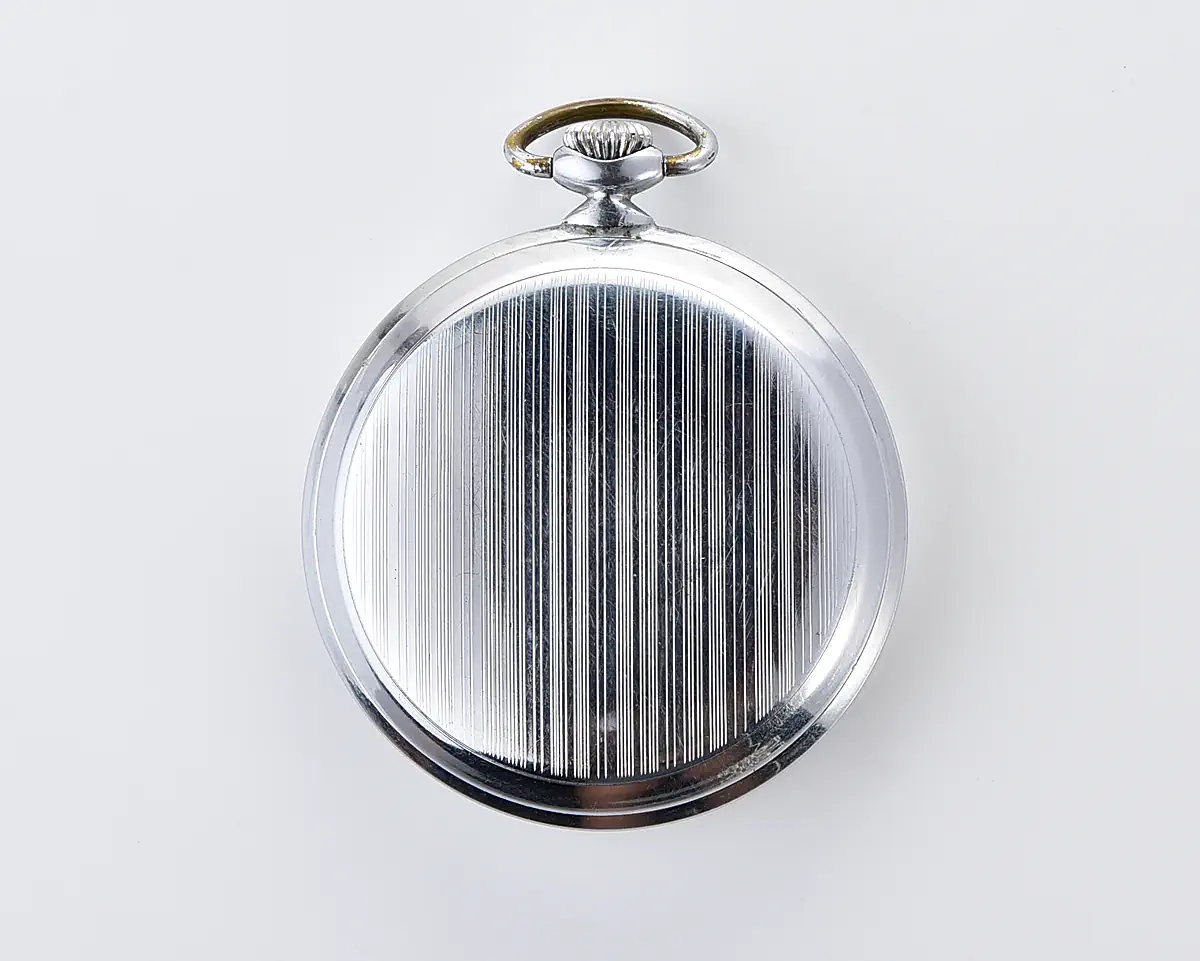
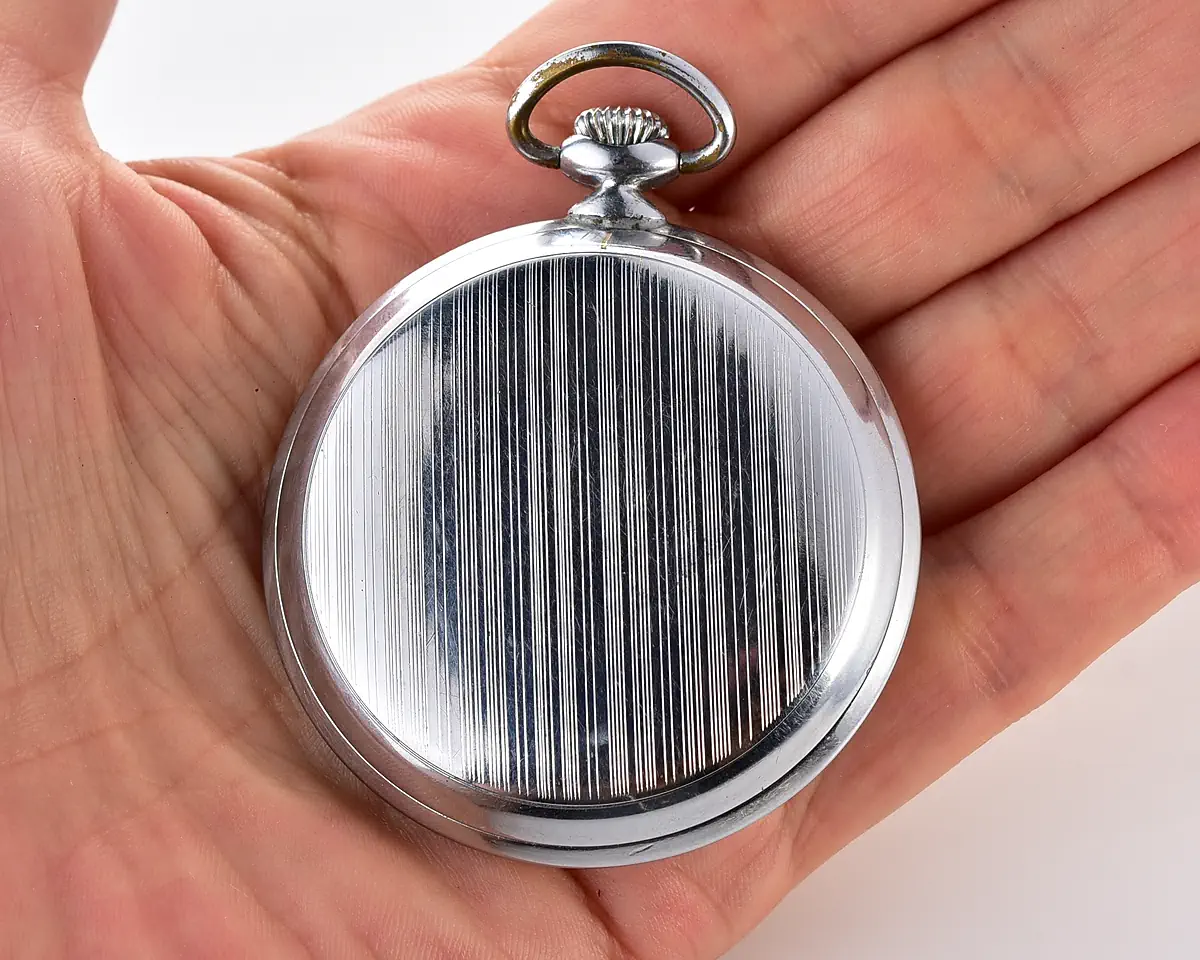
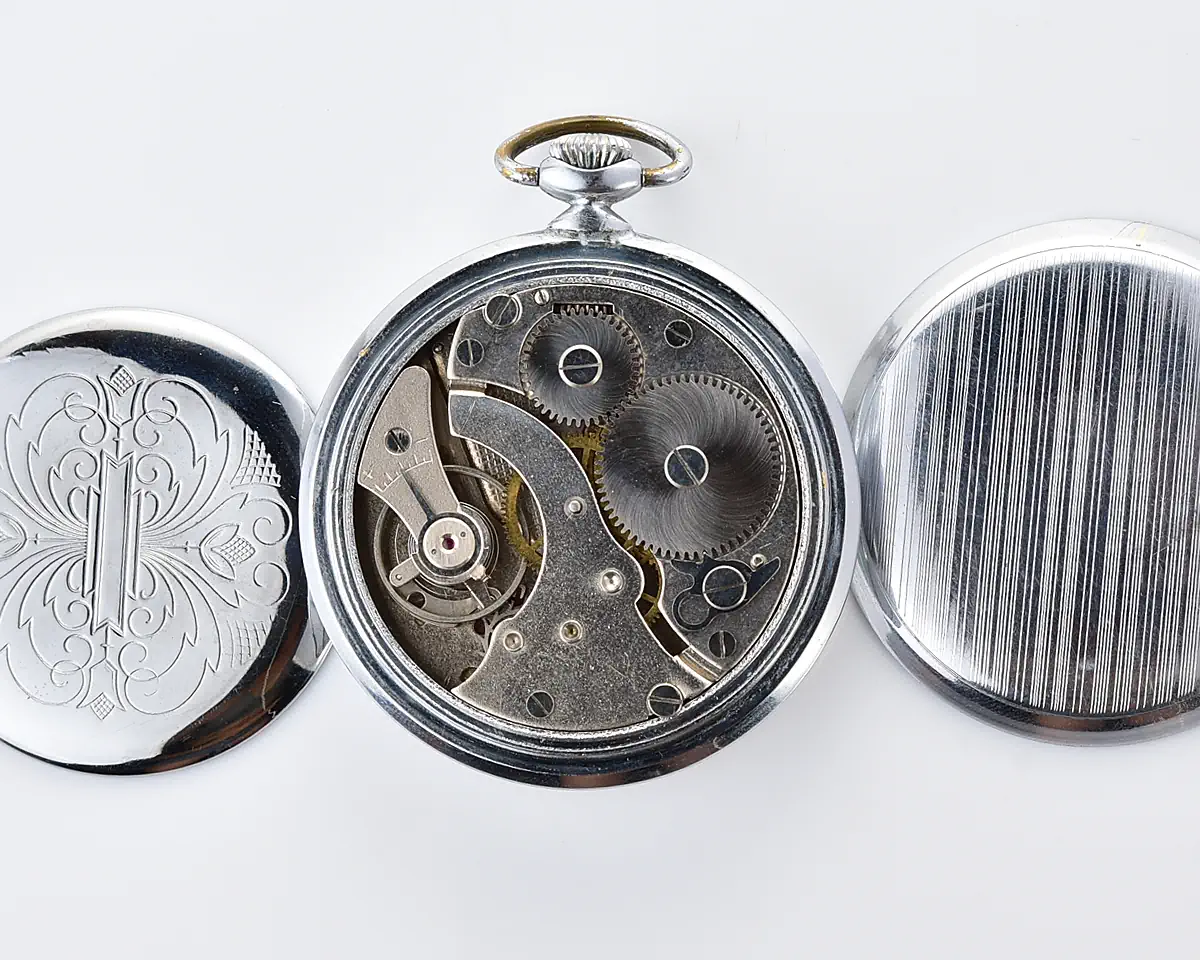
The back is worth turning over twice. The outer case-back is engine-turned with fine vertical lines that catch the light like brushed silver. Underneath it sits a second, inner dust cover — and that one has been hand-engraved, a deep foliate cartouche wrapped around a monogram, the sort of work a jeweller did for a customer who intended to keep the watch. It is personal to this example, and it has survived intact.
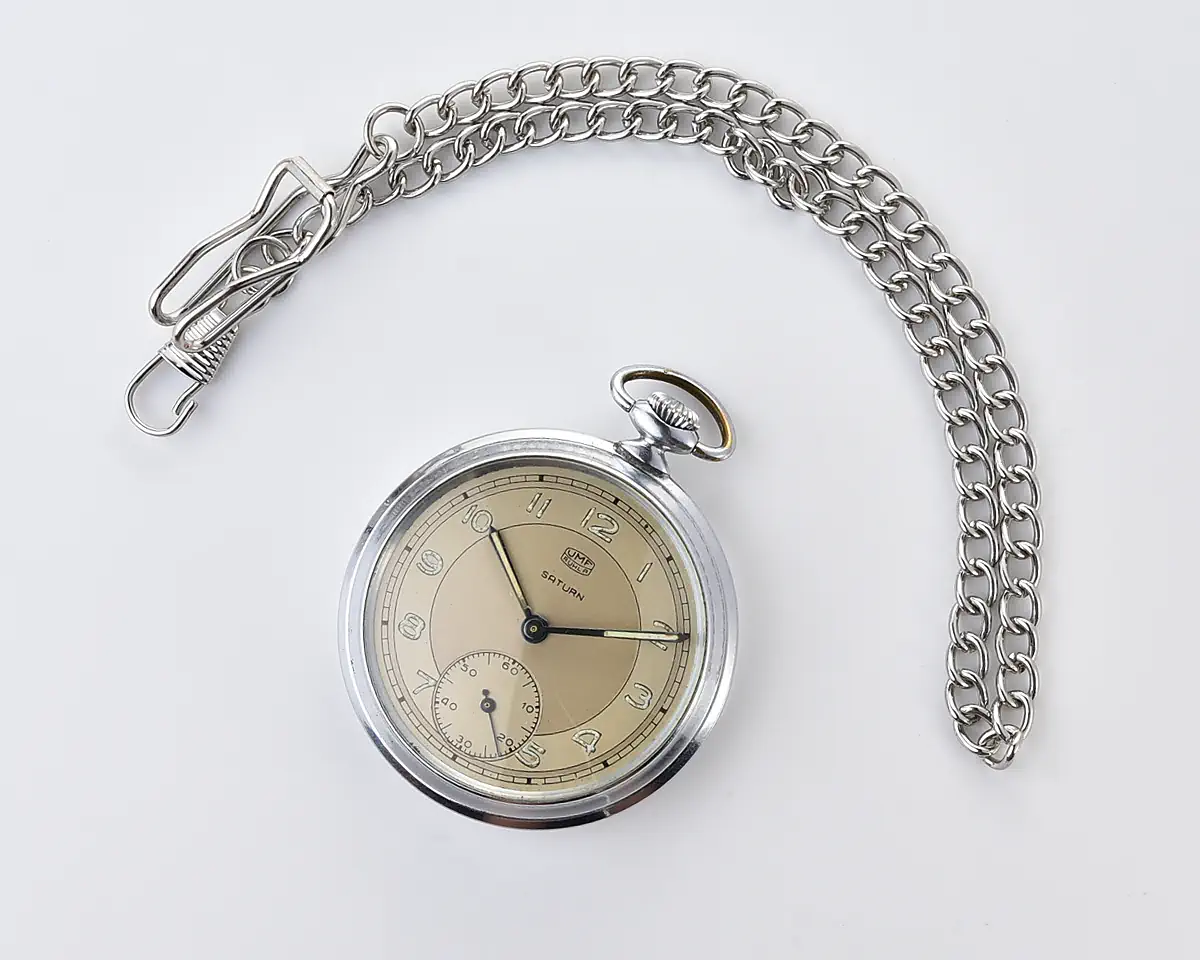
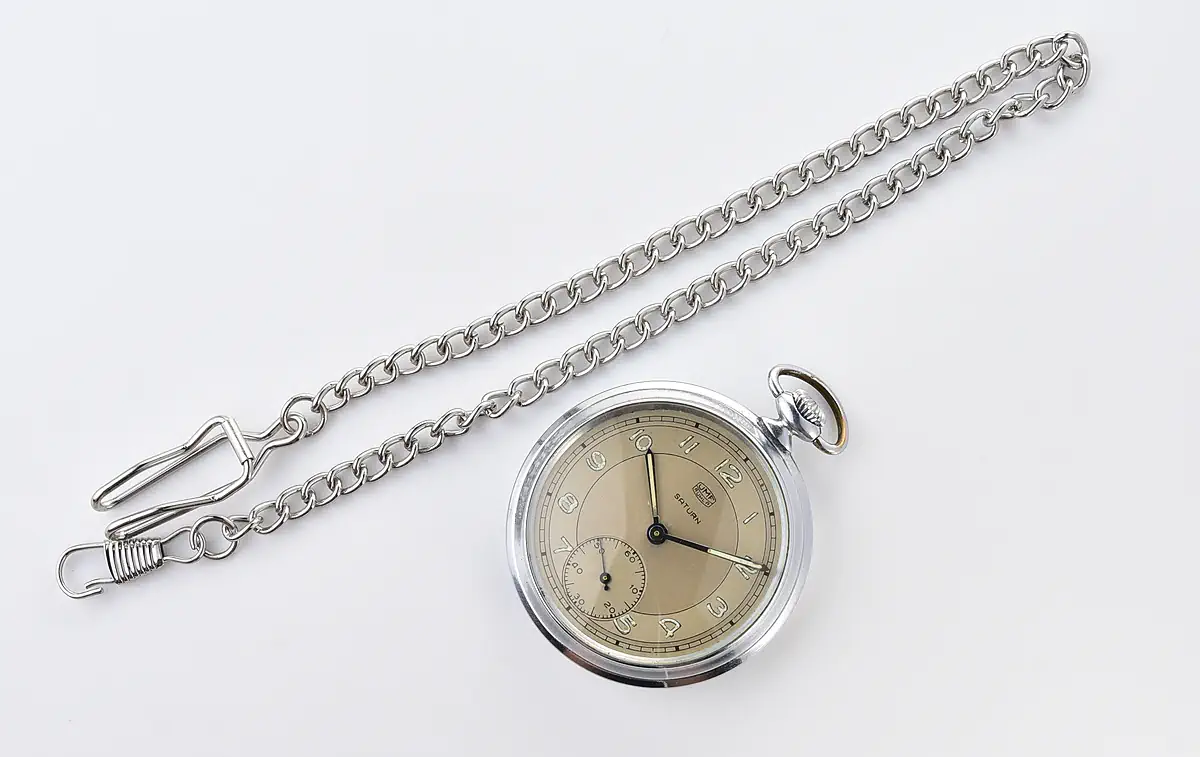
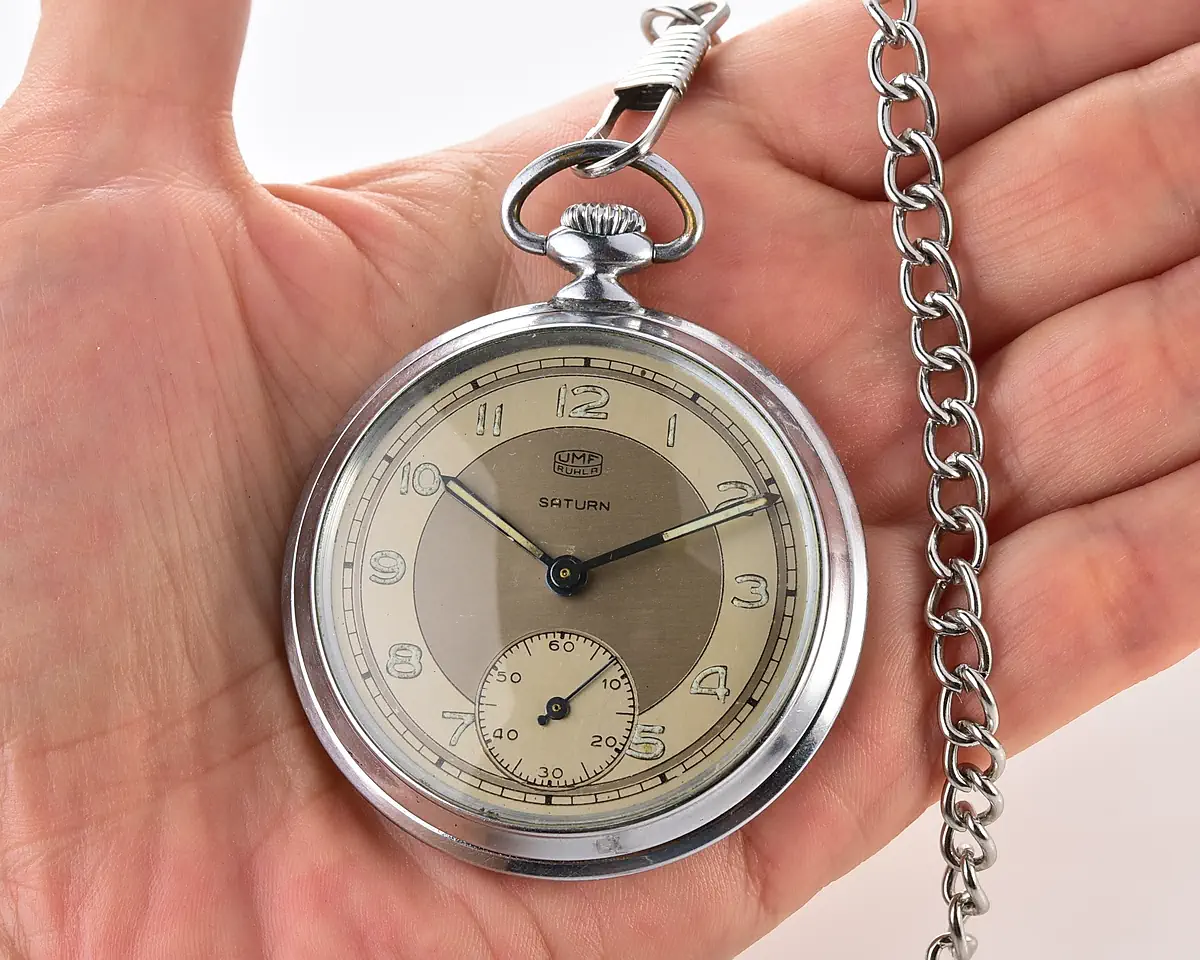
Dating it is straightforward and does not need a serial number. The UMF dial signature only came into use on 1 May 1952, when the factory was nationalised, and Saturn production ended in 1961 — so this watch was made in the 1950s. It comes with a vintage steel curb-link chain, so it can be carried the way it was meant to be.
Technical Specifications
- Brand: UMF Ruhla (VEB Uhren- und Maschinenfabrik Ruhla, East Germany)
- Model: Saturn
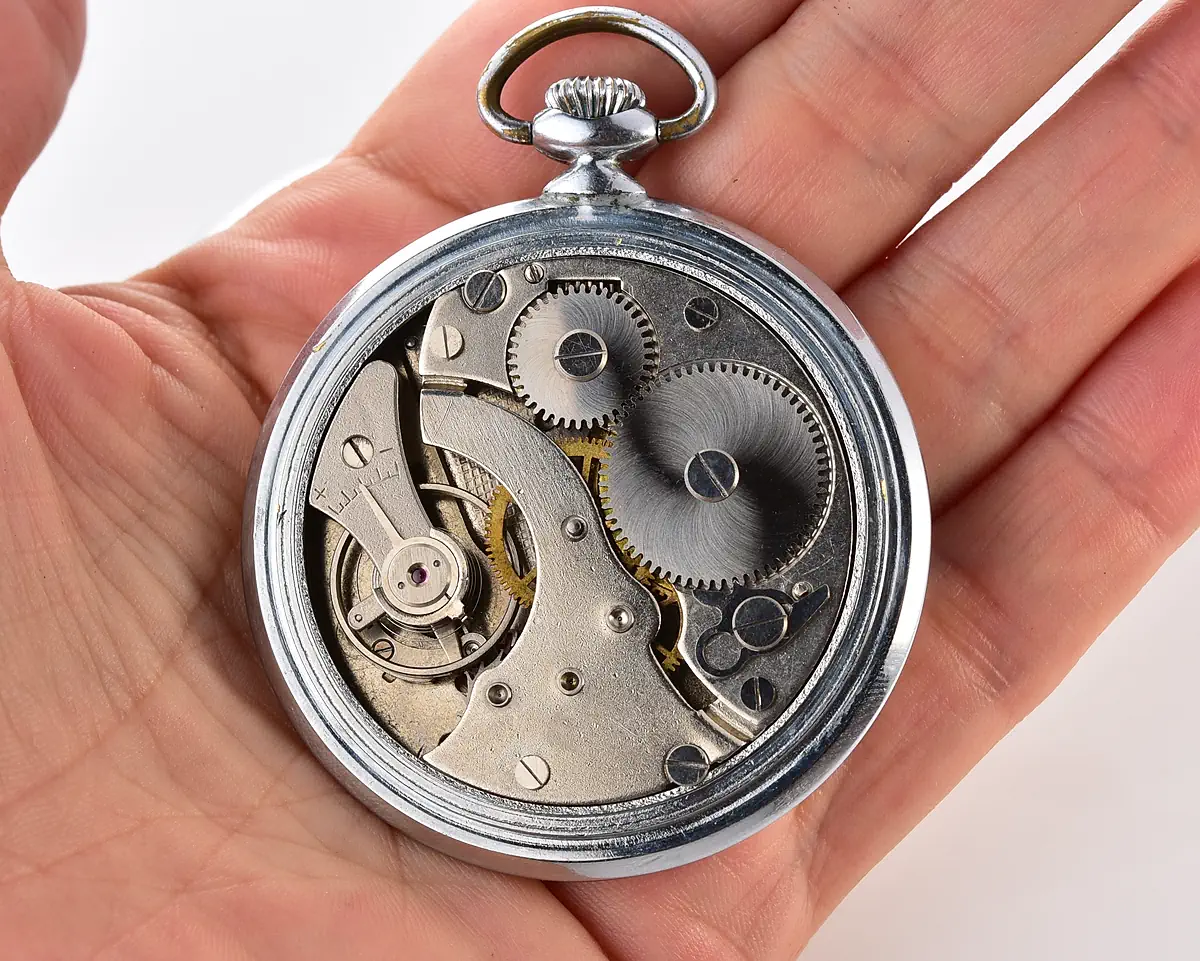
- Movement: Saturn calibre, 18 lines, manual wind, Swiss lever escapement, 7 jewels — the calibre’s documented specification; the plates themselves are unsigned
- Winding: Coupling winding system, pull-out stem for hand-setting, crown at 12
- Production Date: 1950s (the UMF dial signature dates from 1952; Saturn production ended in 1961)
- Case Material: Chrome-plated, open face
- Case Diameter: Approx. 50 mm (excluding crown and bow)
- Dial: Two-tone — silvered outer ring with railway minute track, sunburst centre disc; outlined Arabic numerals with luminous fill; subsidiary seconds at 6
- Hands: Dark steel with luminous fill; blued subsidiary seconds hand
- Crystal: Domed, clear
- Case-back: Engine-turned with fine vertical lines
- Dust Cover: Separate inner cover, hand-engraved with a foliate cartouche around a monogram
- Chain: Vintage steel curb-link chain with spring hook and clip
- Country of Manufacture: Germany (GDR)
Condition Report
Dial & Hands: The two-tone dial is clean and even, with the railway track and both signatures crisp and complete. The luminous fill in the numerals has aged to a dry cream and has crazed and flaked in places — clearest on the 12, 10, 9 and 3, and shown in the close-up photos. It is original, age-dulled compound and should not be expected to glow. The dark hands are straight and complete, with their luminous inserts aged to the same cream tone.
Case: The chrome plating is bright, with light hairlines and handling marks across the engine-turned back consistent with decades of pocket carry. The bow shows honest brassing where the plating has worn through, visible as a warm yellow tone in the photographs.
Crystal: Clear, with no cracks.
Dust Cover: The hand-engraved inner cover is sharp and complete, with the cartouche and monogram fully legible.
Movement: Clean and bright, running well, with the jewelled balance and graduated regulator clearly visible in the movement photographs.
Chain: Solid and functional, with an honest patina that matches the watch.
This watch has recently been serviced by a professional watchmaker and keeps good time.
Comes complete with vintage steel chain.
This watch ships from 🇺🇦 Ukraine with tracking number
Why Collectors Want This Watch Today
Ruhla pocket watches survive in large numbers, and most of them are the plain pin-lever models the factory sold to everybody — worn hard, rarely serviced, and usually worth less than the cost of fixing. The Saturn is the one that is different: a jewelled, Swiss-lever calibre that Thiel designed as the top of its range in 1937 and that the state factory went on building for another two decades. They were made in quantity and they carry no collector premium, so this is value rather than rarity — a genuinely well-made mid-century German pocket watch for the price of a curiosity. What is not repeatable is the engraved dust cover: somebody paid to have that done, and it has come through seventy years intact. Serviced, running and on its chain, it is ready to be carried rather than shelved.
Modes of payment:
- PayPal
- Credit Cards (VISA, MasterCard, American Express, Discover)
- bitcoin
We guarantee the item you receive looks and works exactly as advertised — or your money back.
About the watch factory
The factory in Ruhla, a small town in the Thuringian Forest, was founded in 1862 by the brothers Christian and Georg Thiel to make pipe fittings, watch cases and other small metal goods. It moved into complete pocket watches in the 1890s and industrialised them ruthlessly: by 1897 Gebrüder Thiel was turning out some 4,000 watches a day, built around cheap pin-lever movements that put a working timepiece in reach of ordinary wages.
On 1 May 1952 the works were nationalised and became VEB Uhren- und Maschinenfabrik Ruhla — the UMF on this dial. The state factory kept the Thiel calibres in production while developing its own, and in 1961 it built the first electric wristwatch made in the GDR. Its greatest success came two years later with the Kaliber 24, a pin-lever wristwatch movement produced from 1963 to 1991 at up to 30,000 pieces a day and sold more than one hundred million times — one of the most-produced watch calibres in history, and a fixture on wrists across the Eastern Bloc.
Three plants were merged into the VEB Uhrenkombinat Ruhla in 1967, and the enterprise was renamed VEB Uhrenwerke Ruhla in 1978. After German reunification the Treuhand broke it into some forty separate companies; only Gardé Uhren carried on making watches in Ruhla, until the business passed to new owners in 2019. A clean, running Saturn is a surviving piece of the factory in its best years — the model where Ruhla built to a standard rather than to a price.