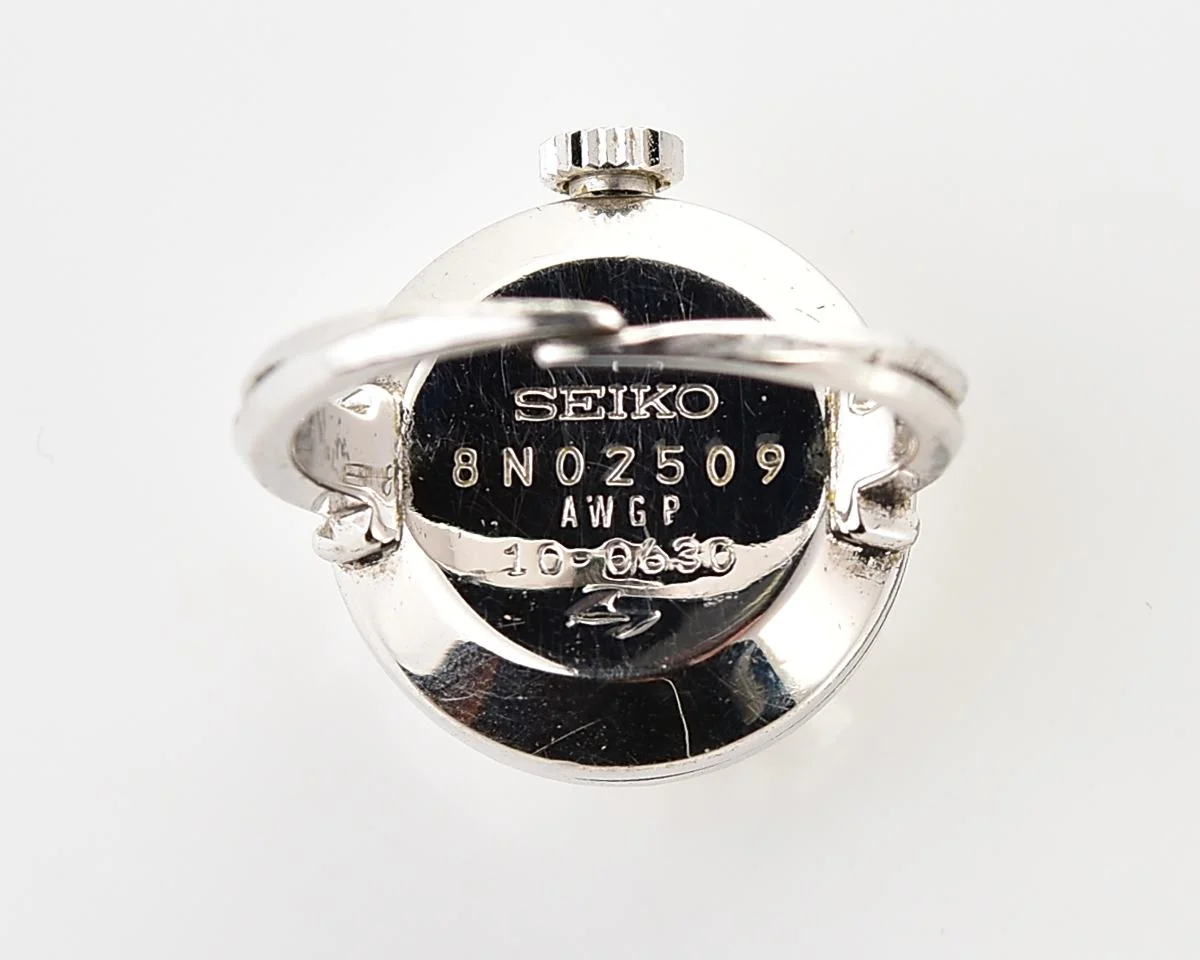
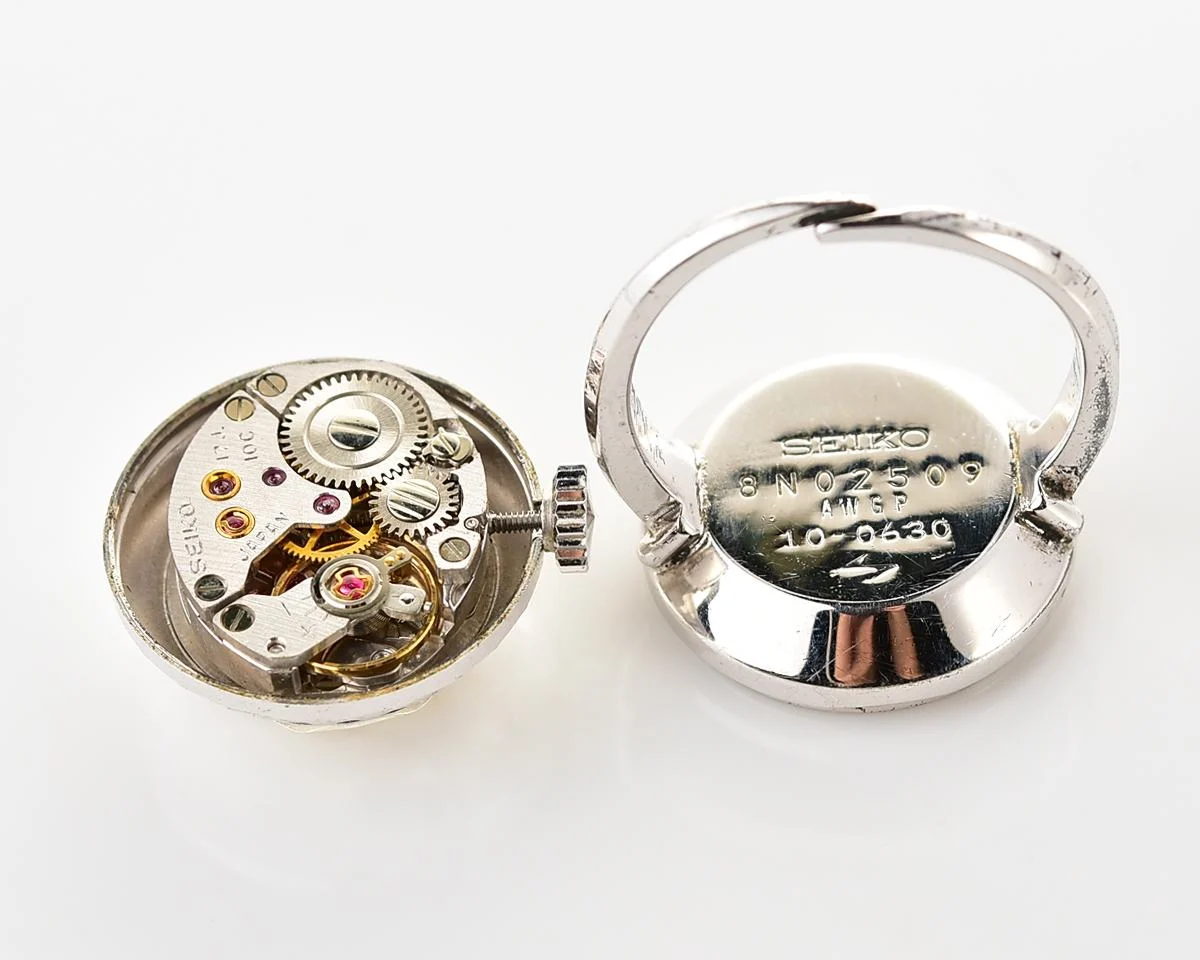
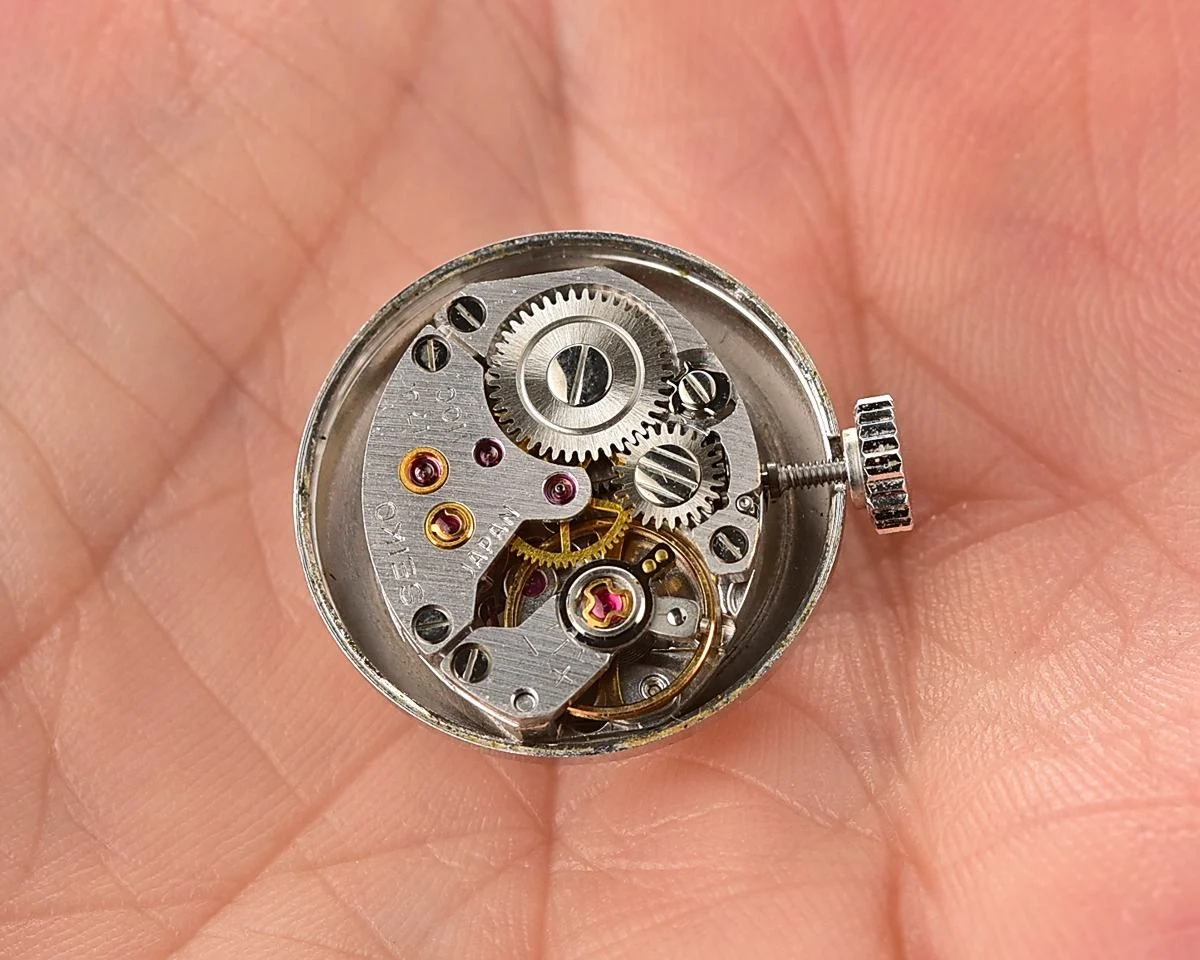
Description
SEIKO vintage mechanical watch
MADE IN JAPAN
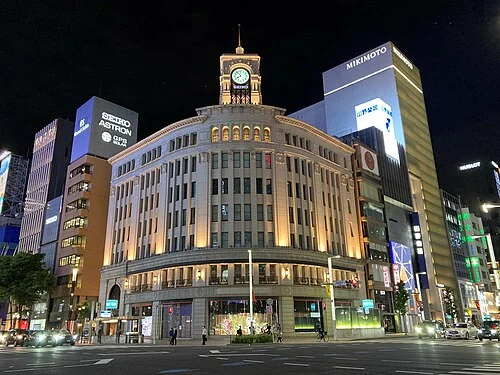
“Seiko” (精工) is a Japanese word meaning “precision,” “exquisite workmanship,” or “refined craftsmanship.”
It comes from the characters:
- 精 (sei) – fine, precise, refined
- 工 (ko) – craft, workmanship
Originally, Seiko’s watchmaking division was called Seikosha (精工舎), meaning “House of Precision.”
The name first appeared on a watch dial in 1924, shortened from Seikosha and keeping the core meaning; the company itself was renamed Hattori Seiko in 1983 and Seiko Corporation in 1990.
So the brand name literally ties directly to the idea of precision engineering—which is exactly what the company wanted to be known for in its watches.
About Seiko Ring Watches
By the late 1960s Seiko was making far more than wristwatches. Alongside its dress and sports lines — and its pendant watches worn on a neck chain — the company built one of the smallest wearable timepieces of the era: the ring watch, a working mechanical watch set into a finger ring and worn as a piece of jewelry.
The engineering behind it is the real story. To fit a watch onto a ring, Seiko used its miniature 10- and 11-series calibers — hand-wound movements barely larger than a fingernail, yet genuine 17-jewel mechanicals with the same in-house Diashock shock protection as its full-size watches. There was no room for compromise and none was made: it winds and sets from a tiny crown on the side of the ring, and keeps time like any other Seiko of the period. Freed from a wrist strap, the case could be kept minute and the top face given over entirely to decoration, so the watch reads first as a ring and only second as an instrument.
Most were plated rather than solid precious metal — “AWGP” (All White Gold Plated) for the silver-toned rings, gold-plated for the yellow ones — which kept them affordable while giving the bright, formal look the style called for. They were sold as elegant novelties and gifts, and examples turn up today in every state from freshly serviced to long stopped.
About This Watch
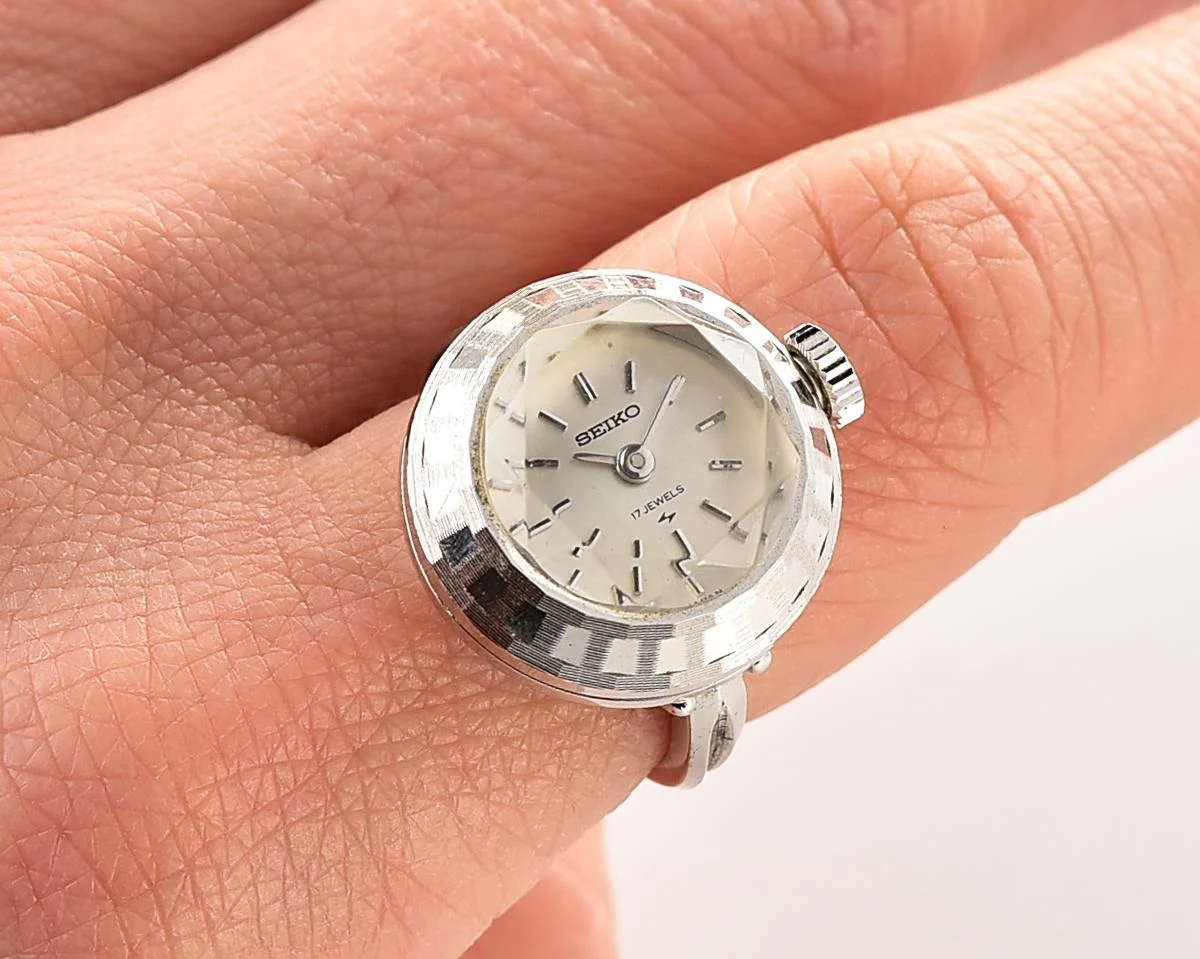
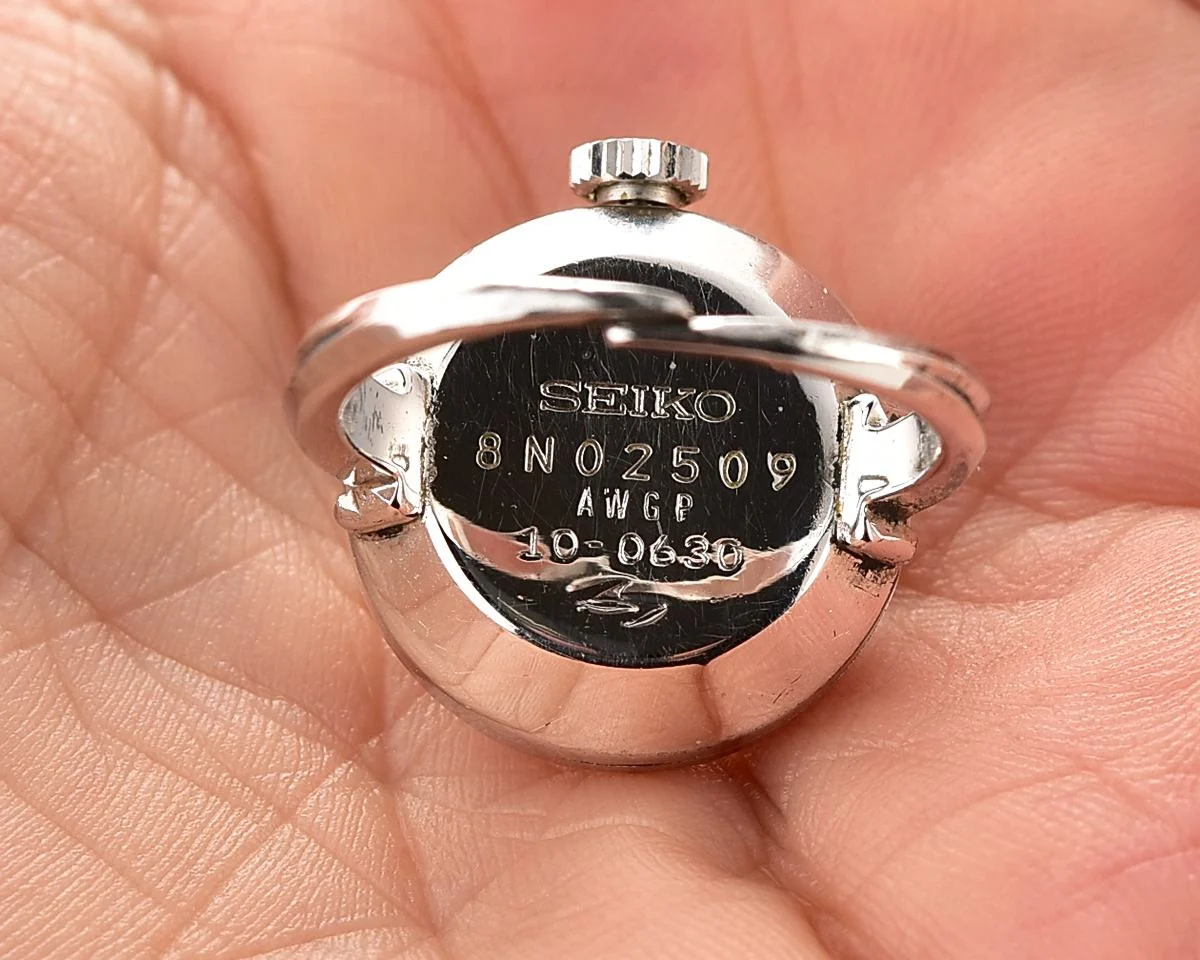
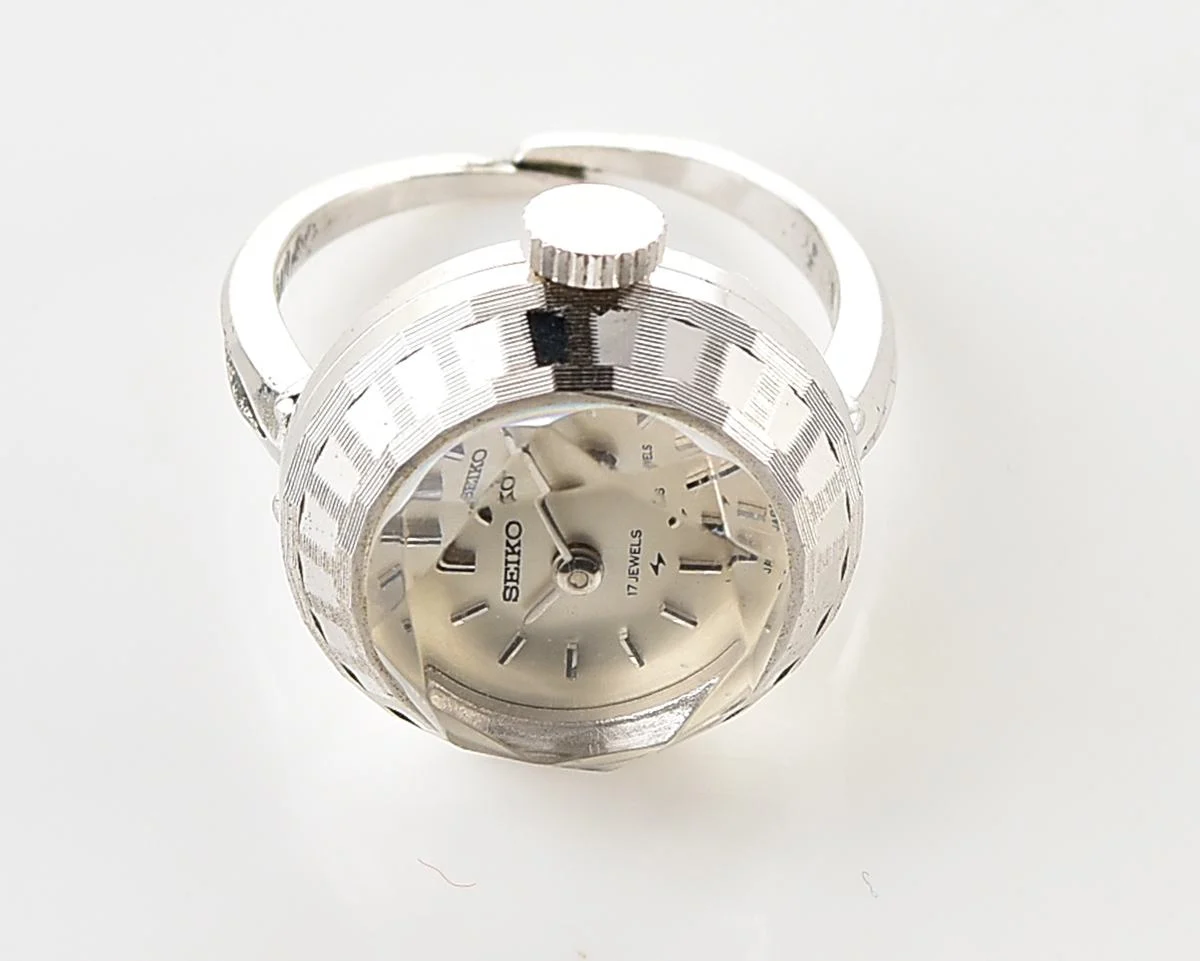
This is a genuine Seiko ring watch — a fully working mechanical watch built into an adjustable finger ring, and one of the smallest wearable timepieces Seiko ever produced. Its serial number (8N02509) dates it to November 1968.
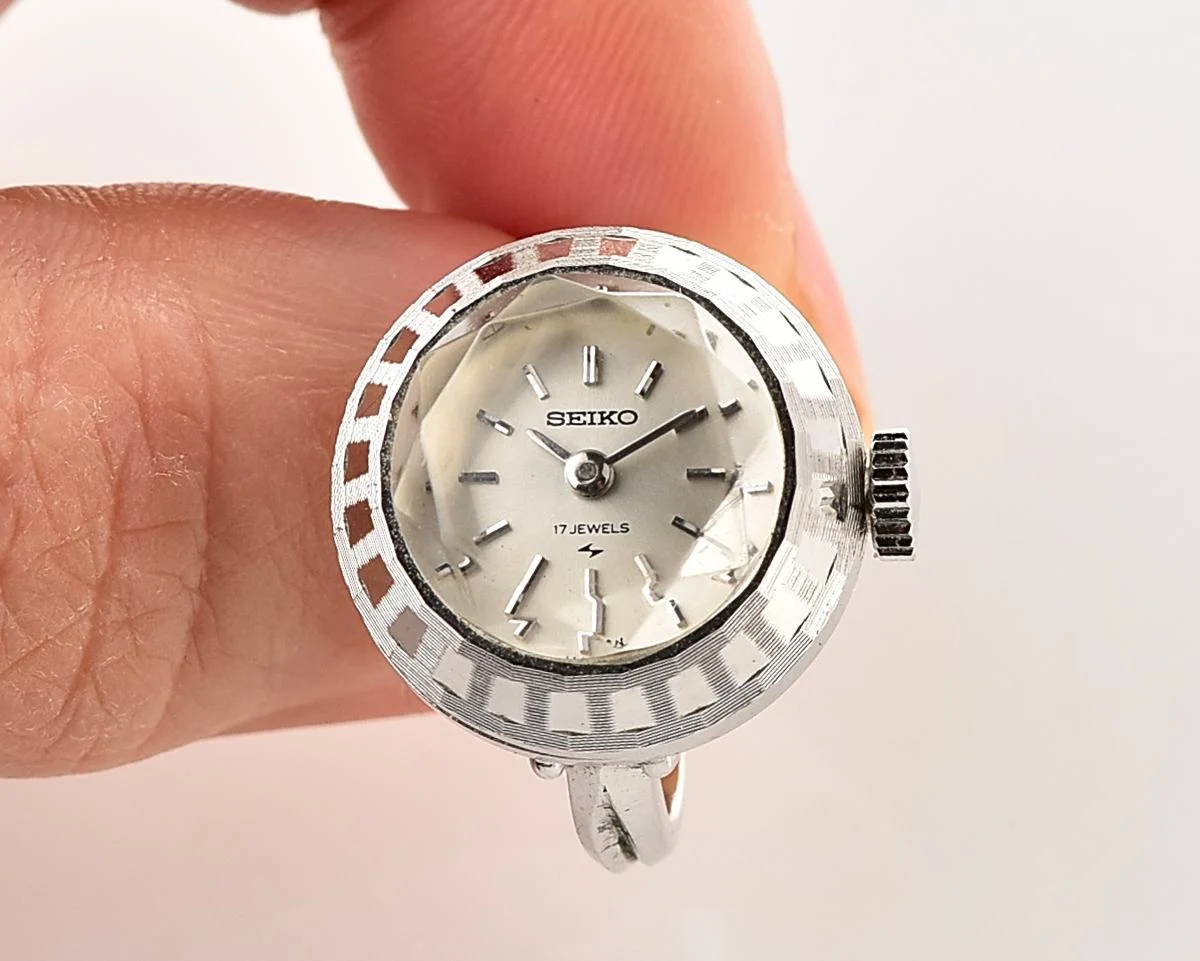
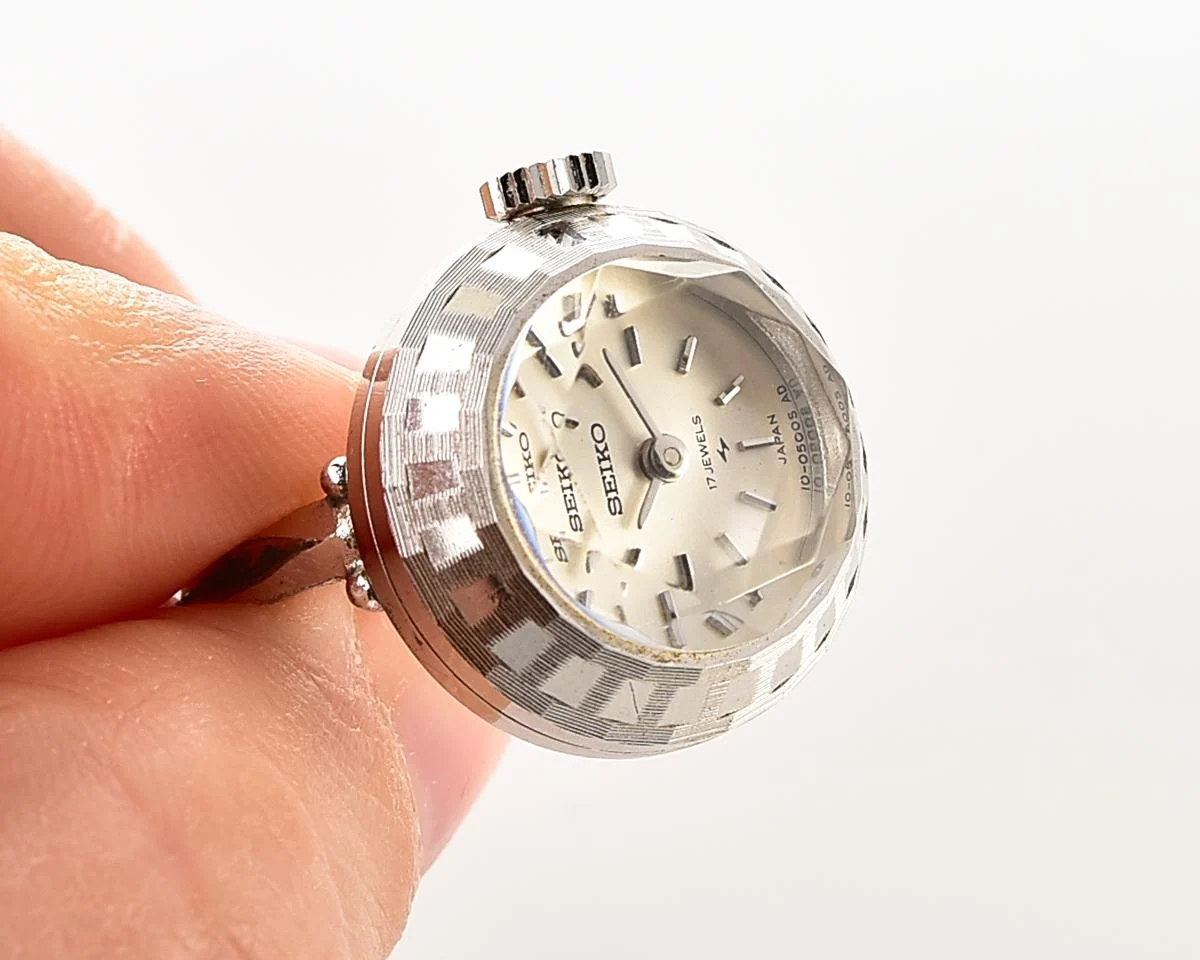
The round case is finished in AWGP — All White Gold Plated — for a bright, silvery tone, and the bezel is worked with a fine, coin-edged engine-turned pattern. Behind a faceted, jewel-cut crystal, the pale silver dial shifts and sparkles as it catches the light; it is signed “Seiko / 17 Jewels” and carries slim applied baton markers with matching hands. A tiny winding crown sits at the top of the case, and the split band is adjustable to fit a range of finger sizes.
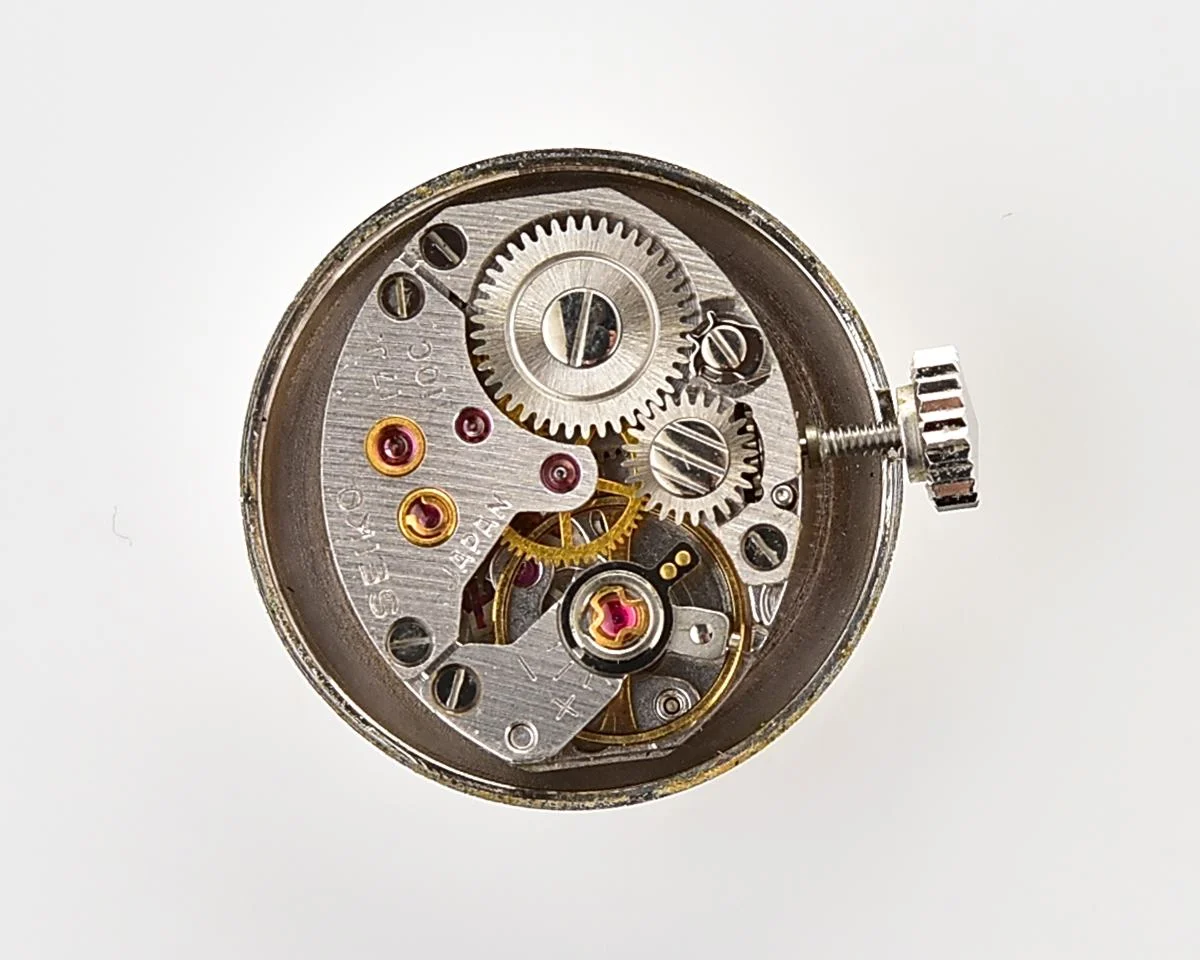
Inside runs Seiko’s hand-wound caliber 10C — a 17-jewel movement barely larger than a fingernail, and a genuine piece of mechanical watchmaking rather than a novelty. It winds and sets from the crown and keeps good time.
Technical Specifications
- Brand: Seiko
- Line: Ring Watch
- Reference Number: 10-0630
- Movement: Manual-wind (hand-wound), Seiko cal. 10C, 17 jewels
- Serial Number: 8N02509
- Production Date: November 1968
- Case Material: White-gold-plated (AWGP)
- Case Diameter: ≈ 18 mm watch head (≈ 20 mm incl. crown); adjustable band
- Dial: Silver, faceted jewel-cut crystal, applied baton markers
- Crystal: Faceted (jewel-cut) glass
- Case-back: Snap-on, engraved “SEIKO 8N02509 AWGP 10-0630”
- Country of Manufacture: Japan
Condition Report
The watch is in very good vintage condition. The AWGP case and finely coin-edged bezel remain bright, with only light surface marks consistent with age. The faceted crystal is clear and sparkles well, with no distracting chips; the silver dial is clean and its applied markers are all intact. The adjustable split band is firm and holds its shape. It winds, sets and keeps good time.
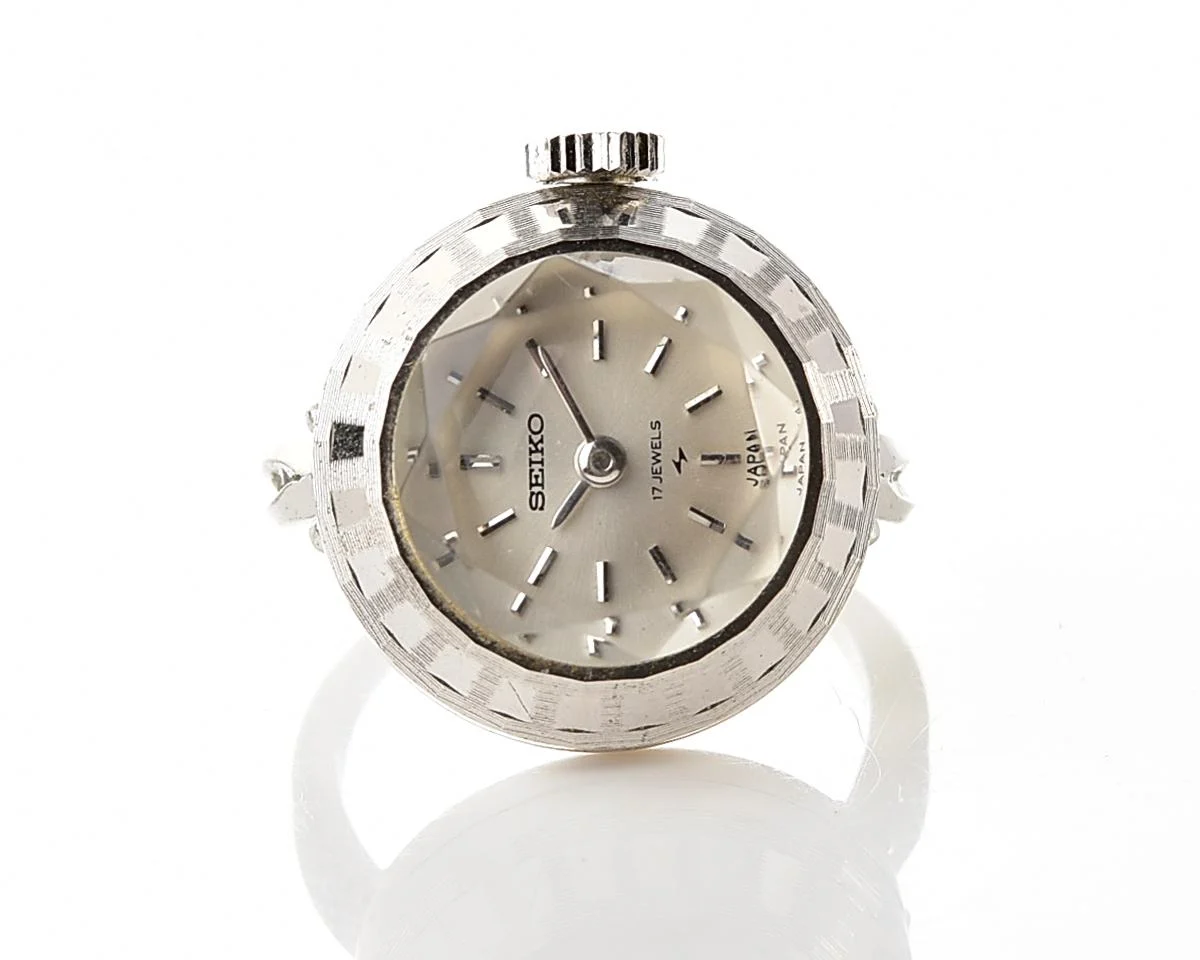
This watch has recently been serviced by a professional watchmaker and keeps good time.
This watch ships from 🇺🇦 Ukraine with tracking number
Why Collectors Want This Watch Today
Seiko built mechanical ring watches in quantity through the late 1960s and 1970s, selling them as dress novelties and gifts, and they still come up regularly on the vintage market. What separates one example from another is condition and completeness — a clear faceted crystal, a bright AWGP case, a silver dial with its finish and markers intact, and a movement that still winds and keeps time. This one carries a genuine 17-jewel Seiko mechanical caliber shrunk to fit a finger ring, and worn on the hand it is an easy conversation piece: a proper mechanical watch where nobody expects to find one.
Modes of payment:
- PayPal
- Credit Cards (VISA, MasterCard, American Express, Discover)
- bitcoin
We guarantee the item you receive looks and works exactly as advertised — or your money back.
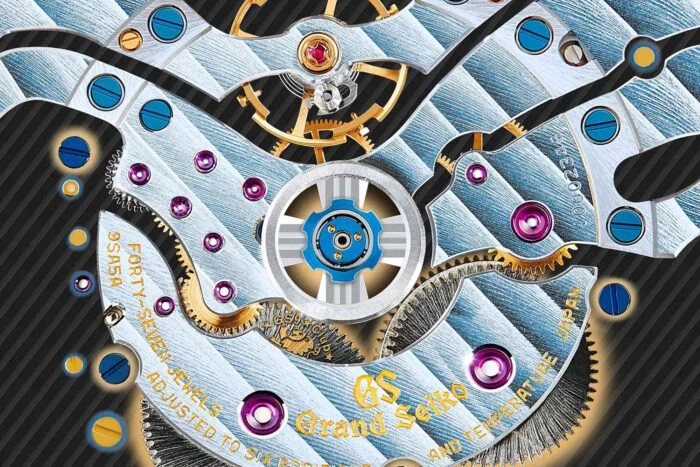
About the watch factory
Seiko Group Corporation (セイコーグループ株式会社, Seikō Gurūpu kabushiki gaisha), commonly known as Seiko, is a Japanese maker of watches, clocks, electronic devices, and semiconductors. Founded in 1881 by Kintarō Hattori in Tokyo, Seiko introduced the world’s first commercial quartz wristwatch in 1969.
Seiko is widely known for its wristwatches. Seiko is one of the few watch companies that is fully vertically integrated. Seiko is able to design and develop all the components of a watch, as well as assemble, adjust, inspect and ship them in-house. Seiko’s mechanical watches consist of approximately 200 parts, and the company has the technology and production facilities to design and manufacture all of these parts internally.
Seiko offers one of the widest ranges of watch technologies in the world—quartz, kinetic, solar, mechanical, and Spring Drive—spanning everything from affordable everyday pieces to six-figure haute horlogerie. Over the decades it has launched multiple global brands, including Lorus, Pulsar, and Alba, while elevating its prestige through innovations like Spring Drive, which helped push Seiko into higher-end territory. In 2017, Grand Seiko was spun off into its own standalone luxury brand, while Credor remains part of Seiko’s own lineup, sold primarily in Japan. Seiko’s own global lineup now includes Grand Seiko, King Seiko, Prospex, Astron, Presage, and Seiko 5 Sports.
Among Seiko’s key lines, Seiko 5 (born in 1963) is the gateway mechanical series known for durability and value; Lord Matic defined 1970s style with faceted crystals and colorful dials; Astron remains Seiko’s flagship GPS-solar tech line; Presage focuses on traditional mechanical craftsmanship with enamel and urushi dials; and Prospex delivers professional-grade dive, field, and pilot watches often embraced by enthusiasts. At the top end, Grand Seiko emphasizes precision, Zaratsu polished design, and movements like Spring Drive, while King Seiko—revived in the 2020s—brings back sharp, elegant 1960s styling with modern calibres.
Finally, Credor represents Seiko’s pinnacle of artisanal watchmaking, producing low-volume pieces in precious metals and showcasing Japanese decorative arts and haute complications from the Micro Artist Studio. Beyond watches, Seiko has also produced various electronic devices and, historically, jewelry and eyewear—though those divisions have since shifted to other companies.