Description
Citizen quartz wristwatch
MADE IN JAPAN The Citizen Legacy: A Pioneer of Precision Founded in 1918, Citizen is now one of the largest watch and movement groups in the world. The Japanese brand is known for its highly accurate and reliable Eco-Drive solar-powered watches. The Citizen group owns Bulova, Alpina, Frederique Constant, and Arnold & Son, as well as movement manufacturers Miyota and La Joux-Perret.
About the CQ (Citizen Quartz) Line
“CQ” stands simply for Citizen Quartz. It is a stylised monogram that Citizen printed on its quartz dials through the 1970s and into the early 1980s — the same idea as the “SQ” Seiko was using on its own quartz watches in exactly those years.
The CQ range was introduced during the height of the quartz boom, and it was deliberately broad. It spanned everything from slim gold-plated dress watches to solid stainless steel sports models like this one. What held the line together was not a case style but a promise: quartz accuracy and almost no maintenance, in a watch an ordinary buyer could actually afford.
CQ watches of the period share a common recipe — solid stainless steel cases, screw-down case backs carrying Citizen case codes such as GN-4W-S, and Citizen’s own plain, unadjusted quartz calibres with a two-jewel count. They were built to be used, and to ask for nothing but a fresh battery every few years.
The line marks the point at which quartz stopped being an expensive novelty and became the everyday standard — which is a large part of why so many CQ watches are still running today.
About This Watch
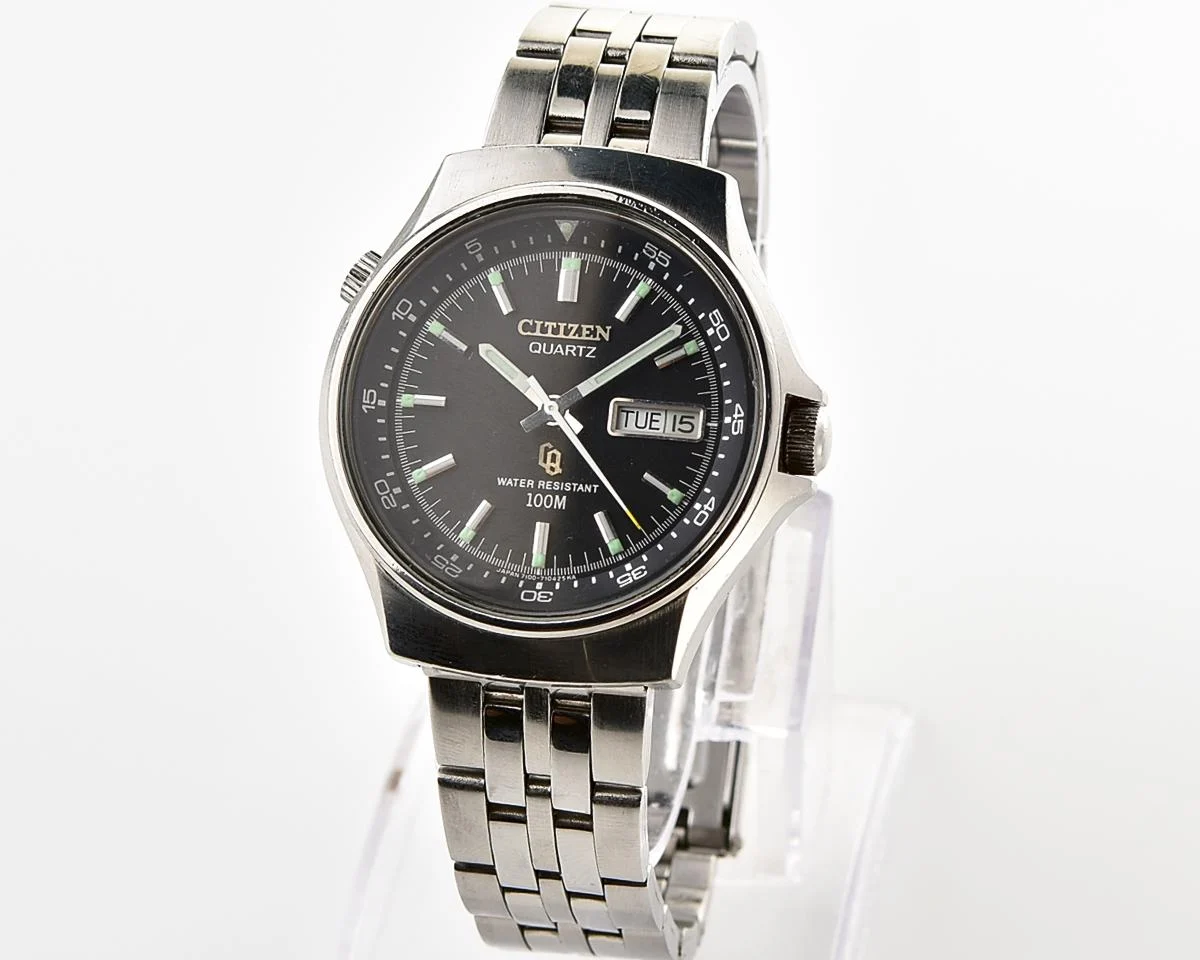
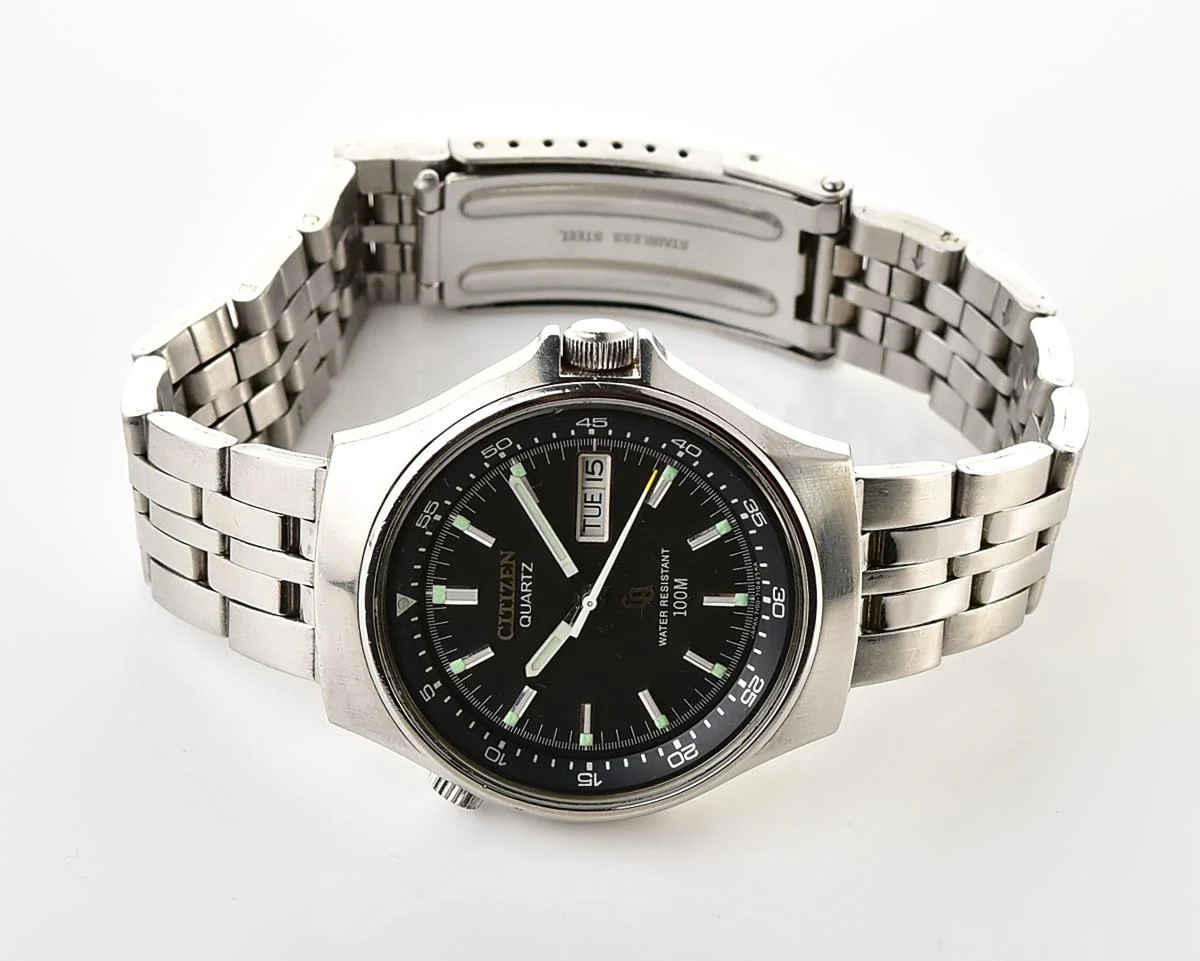
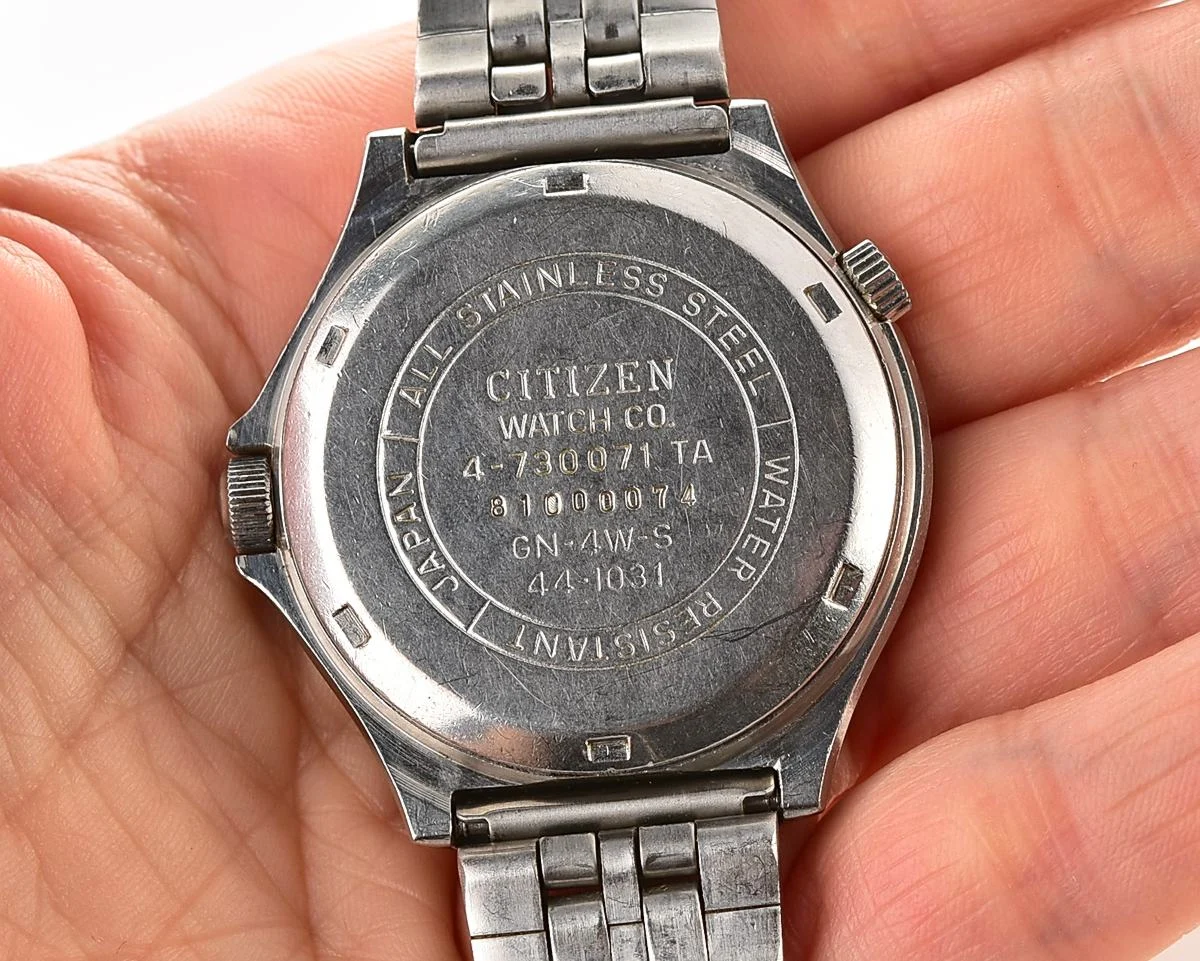
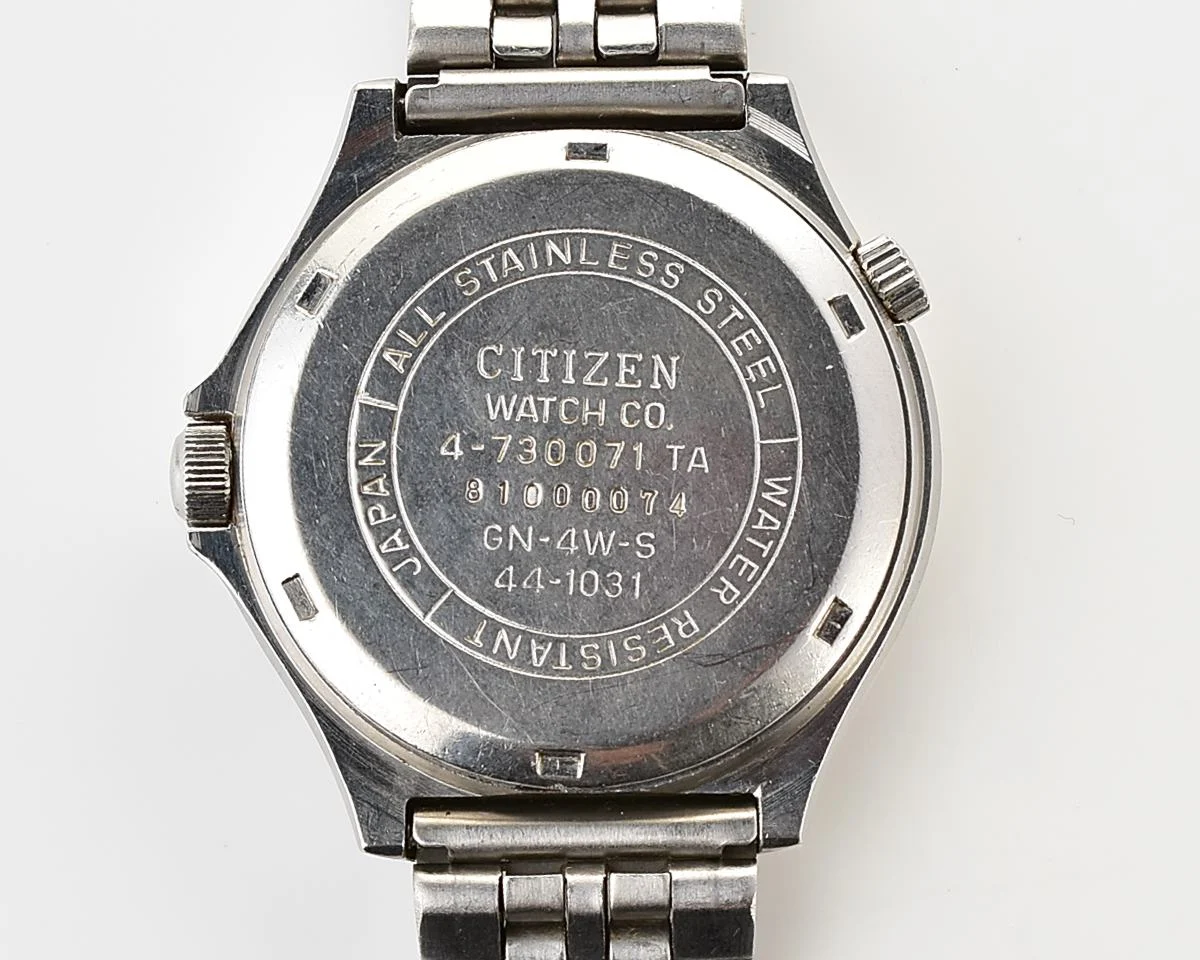
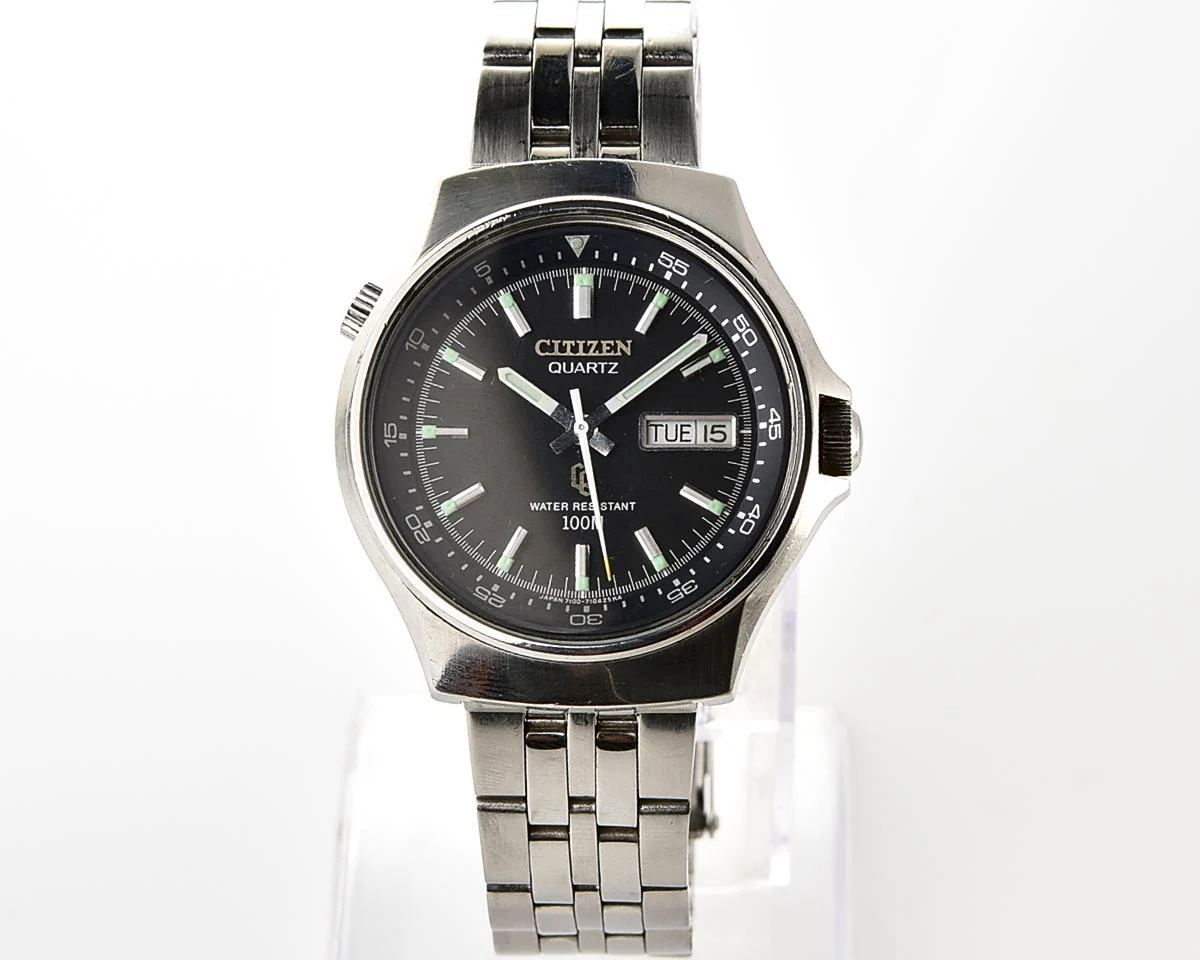
This Citizen CQ left the factory in October 1978. Its case back carries Citizen’s own reference 4-730071 TA, the serial 81000074 and the case code GN-4W-S, ringed by the words ALL STAINLESS STEEL · JAPAN · WATER RESISTANT.
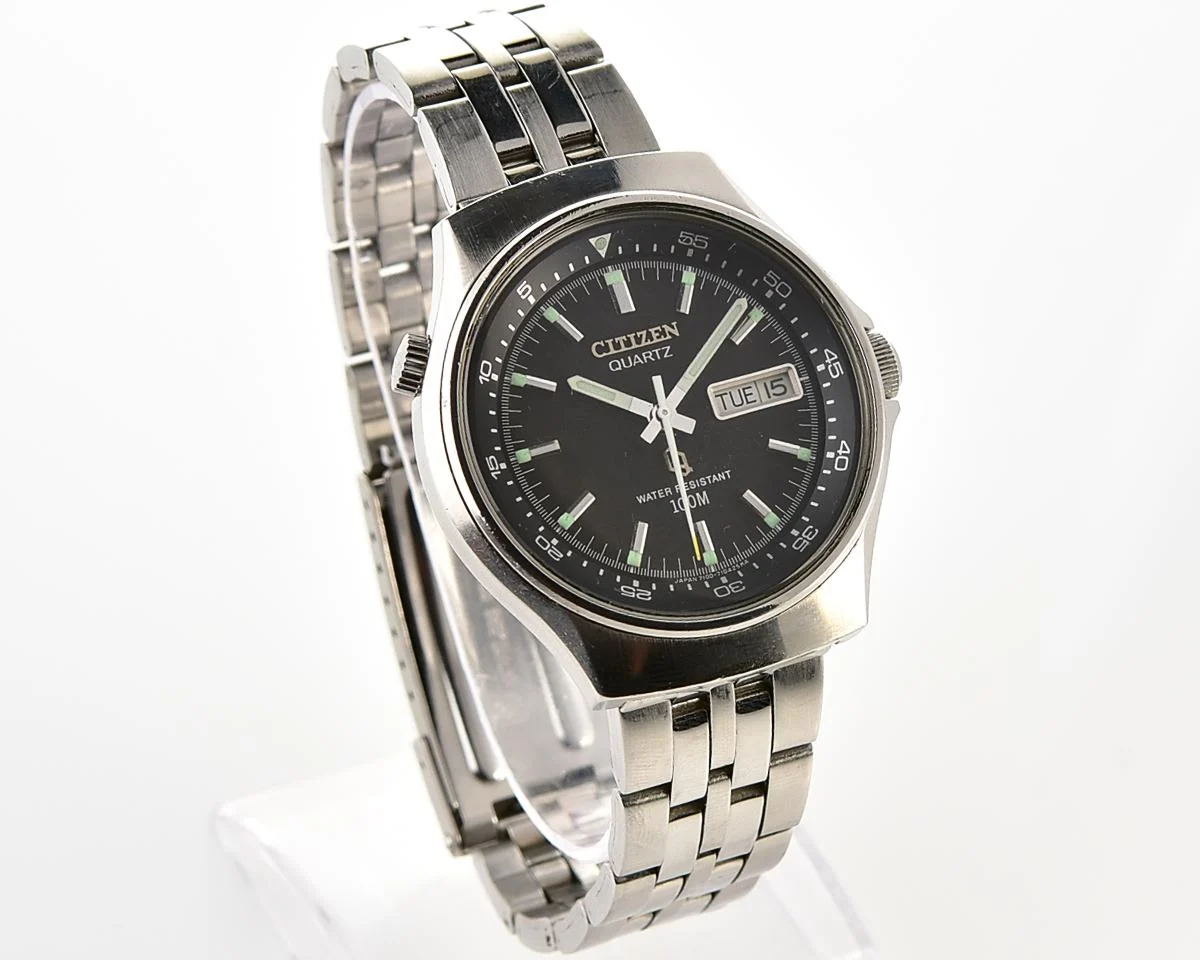
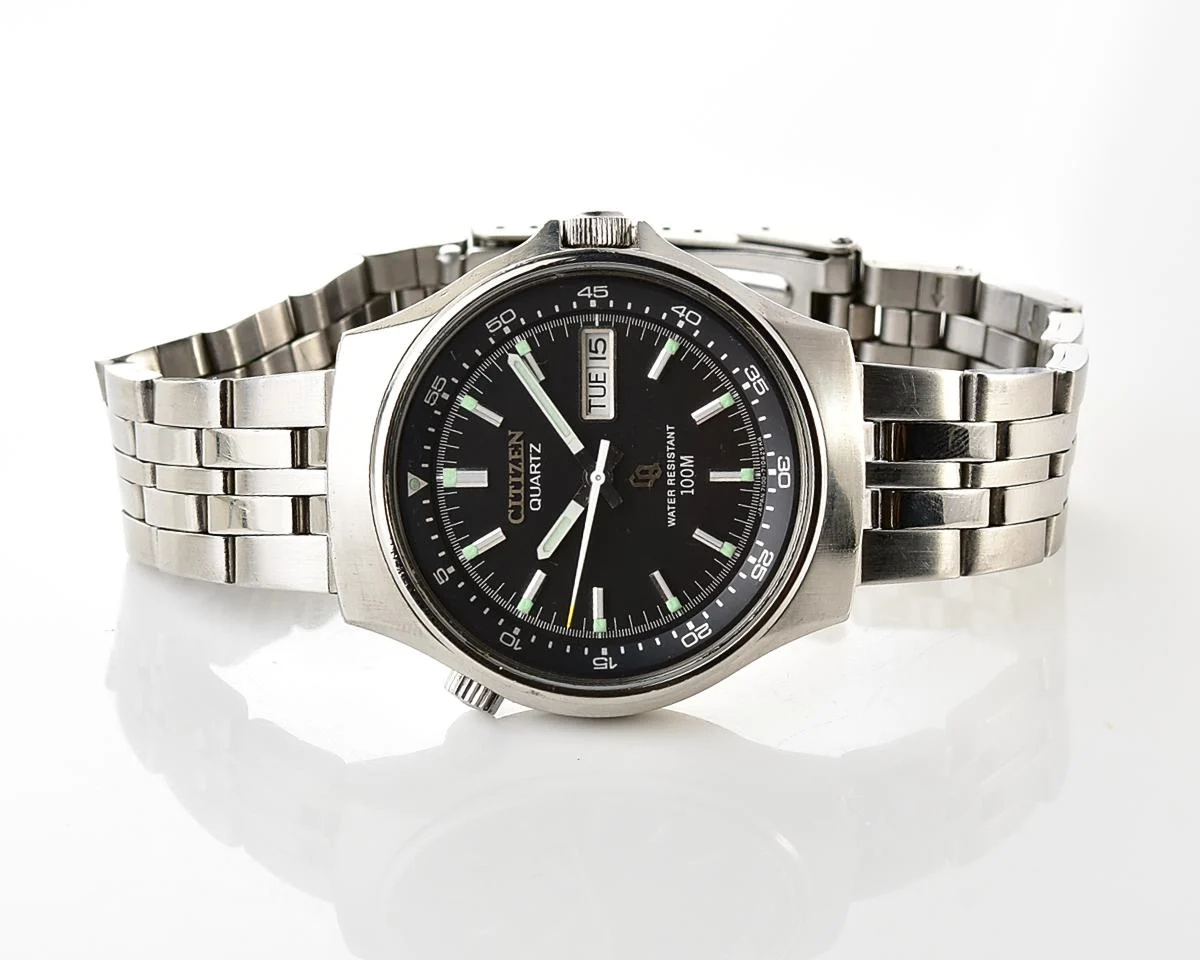
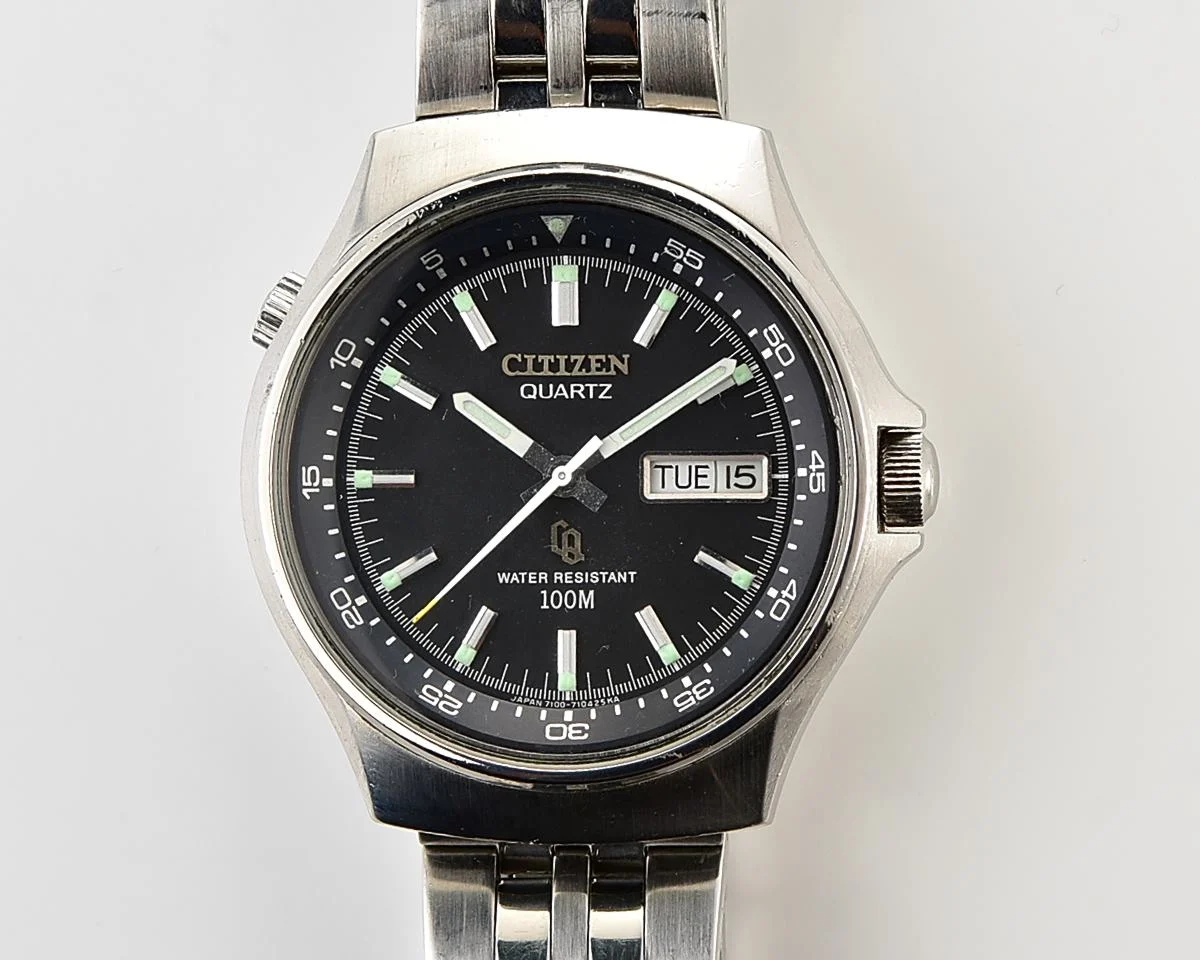
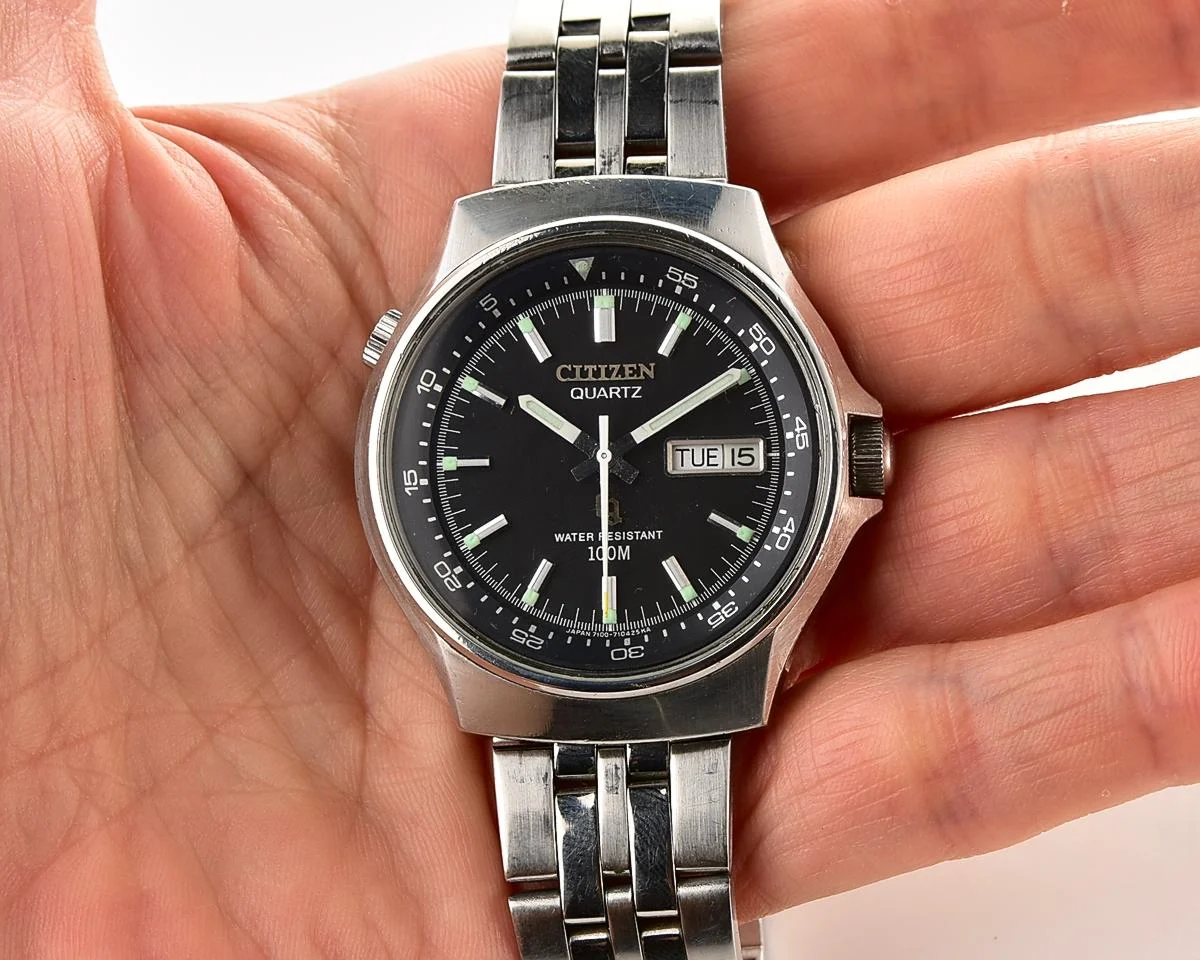
This is the sporting end of the CQ range rather than the dress end. The case is solid stainless steel, rated to 100 m, and it carries two crowns: the one at 3 o’clock sets the time and the day-date, while a second, smaller crown at 10 o’clock turns the internal timing ring running around the inside of the dial. That inner ring carries a luminous triangle index and a 60-unit scale, so an elapsed or remaining interval can be marked off without an external bezel to catch on a cuff or get knocked out of position.
The dial is black, with a finely printed minute track, applied baton markers tipped with lume, and matching lume-filled hands. It reads CITIZEN over QUARTZ at twelve, carries the CQ monogram above WATER RESISTANT 100M at six, and the day and date sit together in a framed window at three. The dial’s own code, JAPAN 7100-710425 KA, is printed at the foot.
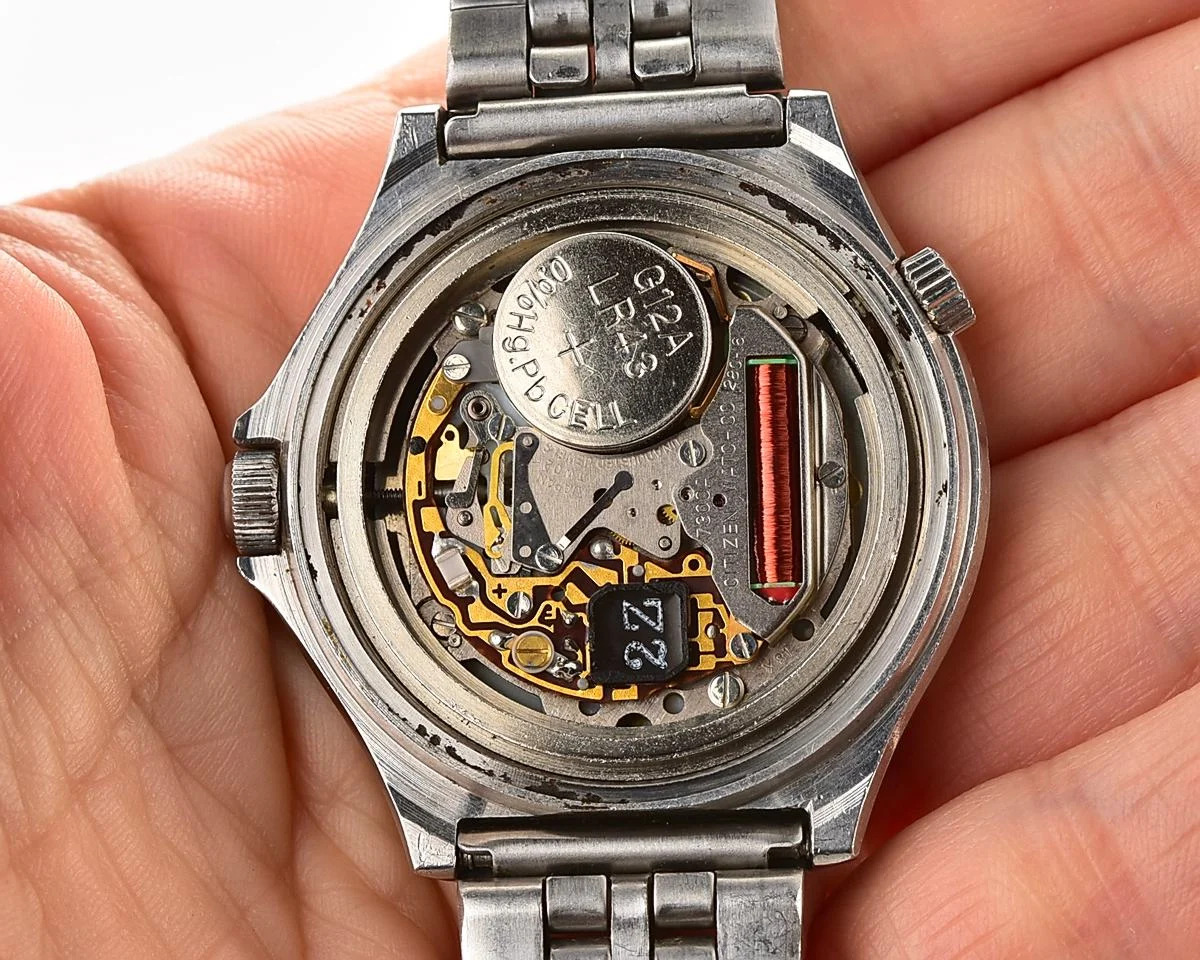
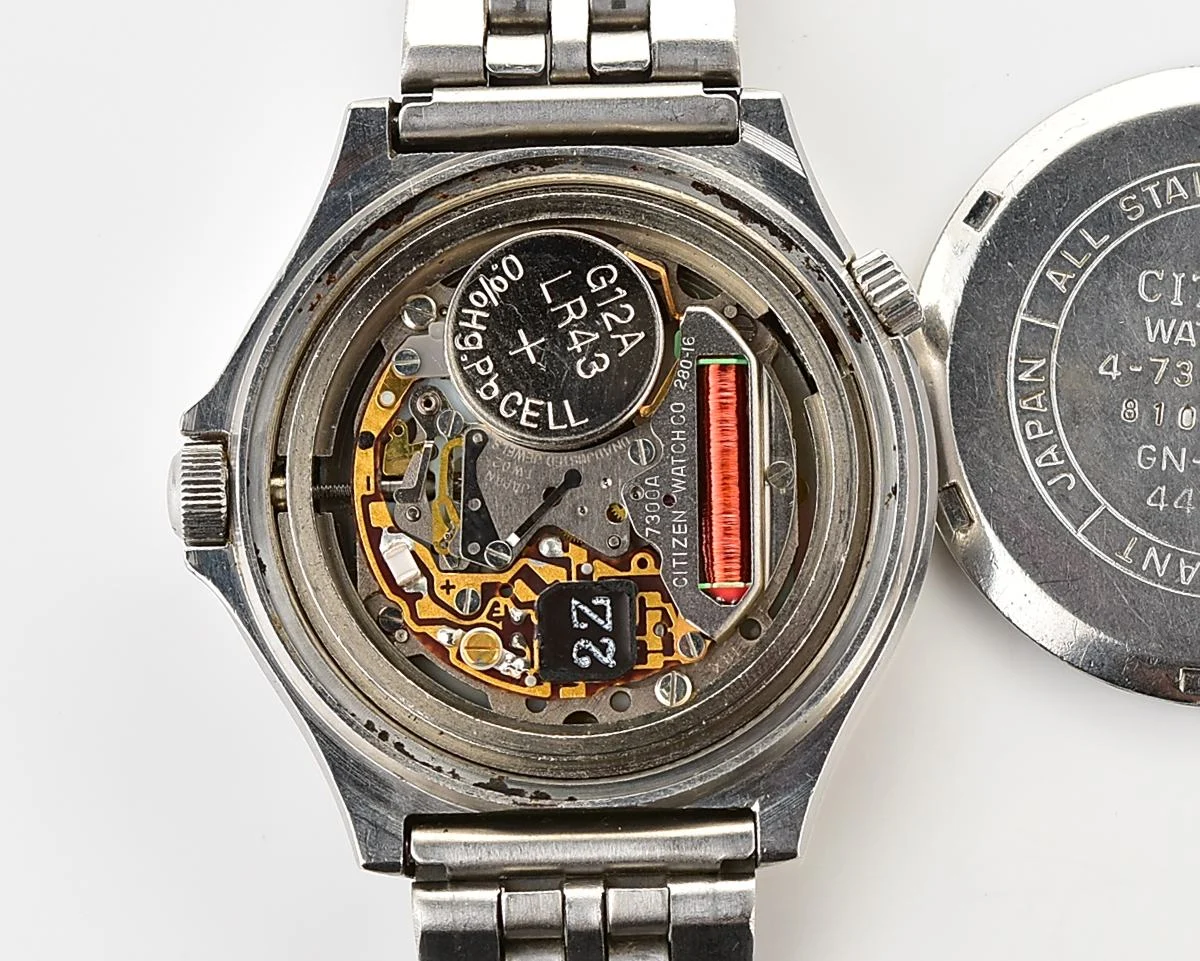
Inside is Citizen’s calibre 7300A, stamped on the plate alongside CITIZEN WATCH CO 280-16 and TWO (2) JEWELS UNADJUSTED. One note for the detail-minded: the dial code opens with 7100 while the movement plate reads 7300A. That pairing is normal for this family rather than evidence of a swapped movement — the case reference itself (4-730071) points at the 7300 series, and other documented examples carrying the same 7100-coded dial are found with 7300-series plates.
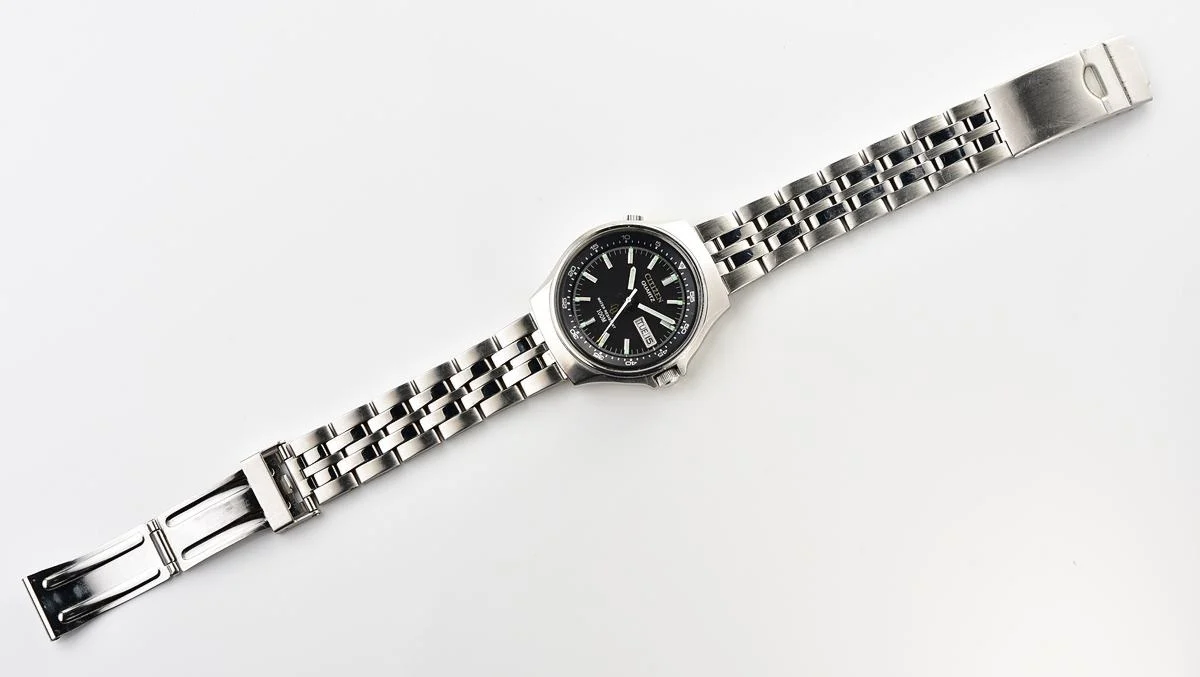
It comes on a steel bracelet with a plain fold-over clasp.
Technical Specifications
- Brand: Citizen
- Line: CQ (Citizen Quartz)
- Reference Number: 4-730071 TA
- Movement: Citizen calibre 7300A — quartz, two jewels, unadjusted (Japan)
- Serial Number: 81000074
- Production Date: October 1978
- Case Material: All stainless steel, twin crowns (3 and 10 o’clock)
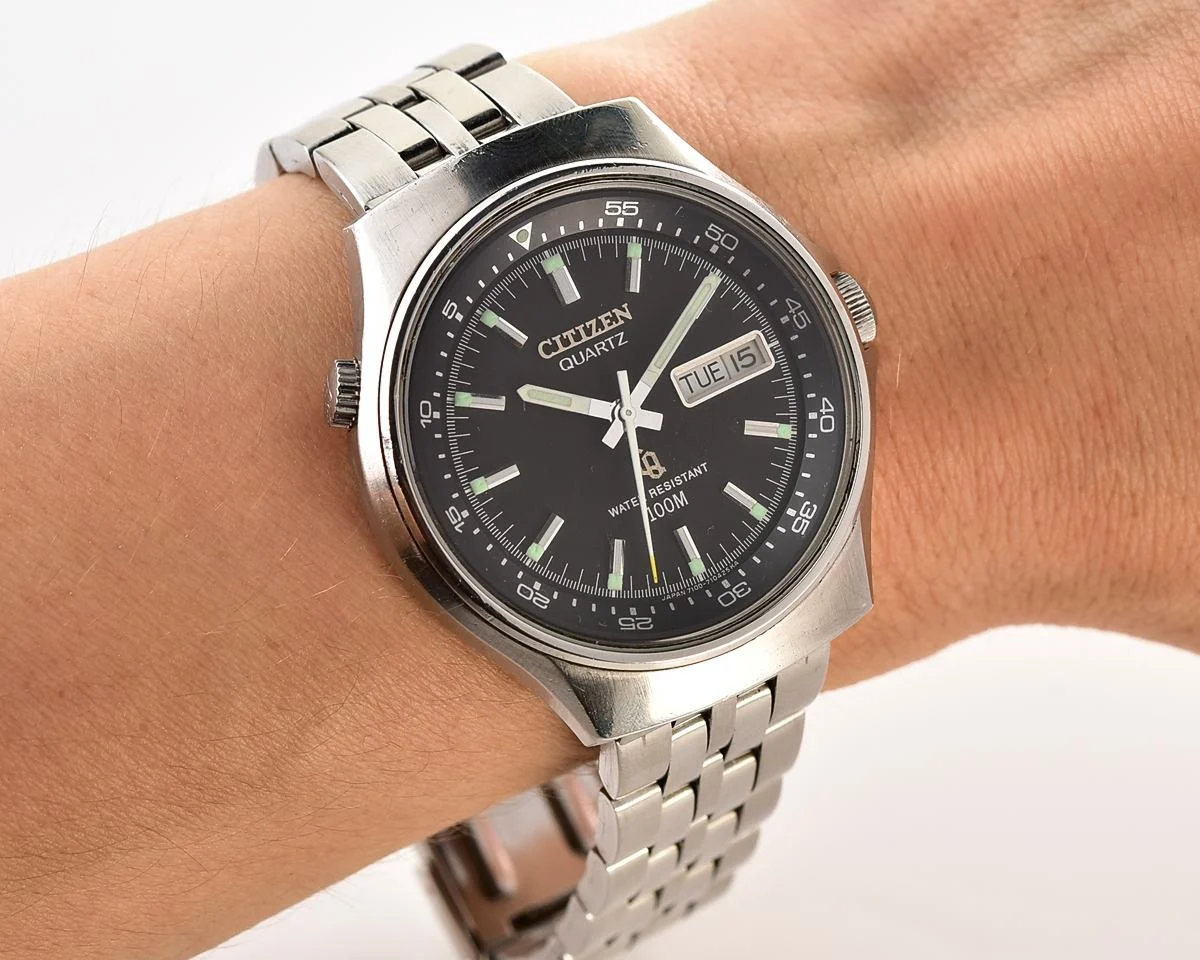
- Case Diameter: Approx. 35 mm (excluding crown)
- Dial: Black, applied lume-tipped baton markers, day-date at 3, internal rotating 60-unit timing ring
- Crystal: Original, with light surface wear
- Case-back: Screw-down, stamped ALL STAINLESS STEEL / JAPAN / WATER RESISTANT, case code GN-4W-S
- Water Resistance: 100 m / 10 atm factory rating — not pressure-tested at this age; treat as splash-resistant only
- Country of Manufacture: Japan
Condition Report
The black dial is clean and even — no fading, no staining, no lifted or missing lume. The applied markers are all present, and their lume tips match each other and the hands in colour. The hands are straight and undamaged.
The stainless steel case shows the light scuffs and softened edges you would expect of a watch this age, most visible on the polished flanks, but the case shape is unworn and the case-back engraving is crisp and fully legible. The crystal is original and carries light surface wear. Both crowns are present and intact, and the internal timing ring is clean with its luminous index undamaged. The interior of the case shows some age-related discolouration around the gasket seat, visible in the movement photographs.
The 100 m marking is Citizen’s original factory rating. The seals on a watch of this age have not been pressure-tested, so we would treat it as splash-resistant only and not swim with it.
The bracelet is a period steel bracelet on a plain fold-over clasp, stamped STAINLESS STEEL on the inside. The clasp carries no Citizen signature, so we describe it as a vintage bracelet rather than claim it as this watch’s factory-original one. It is sound and works correctly, with light wear across the links.
This watch has recently been serviced by a professional watchmaker and keeps good time.
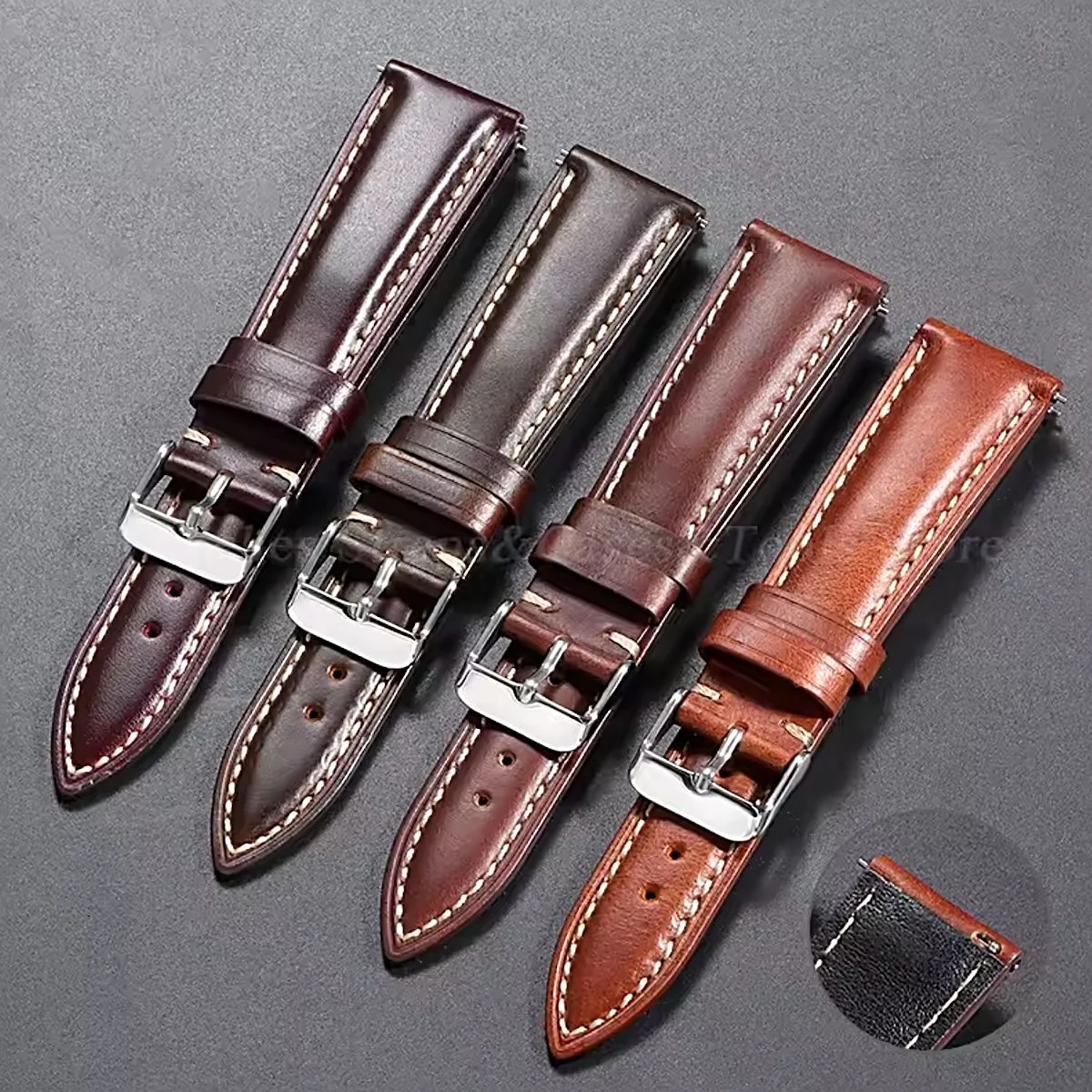
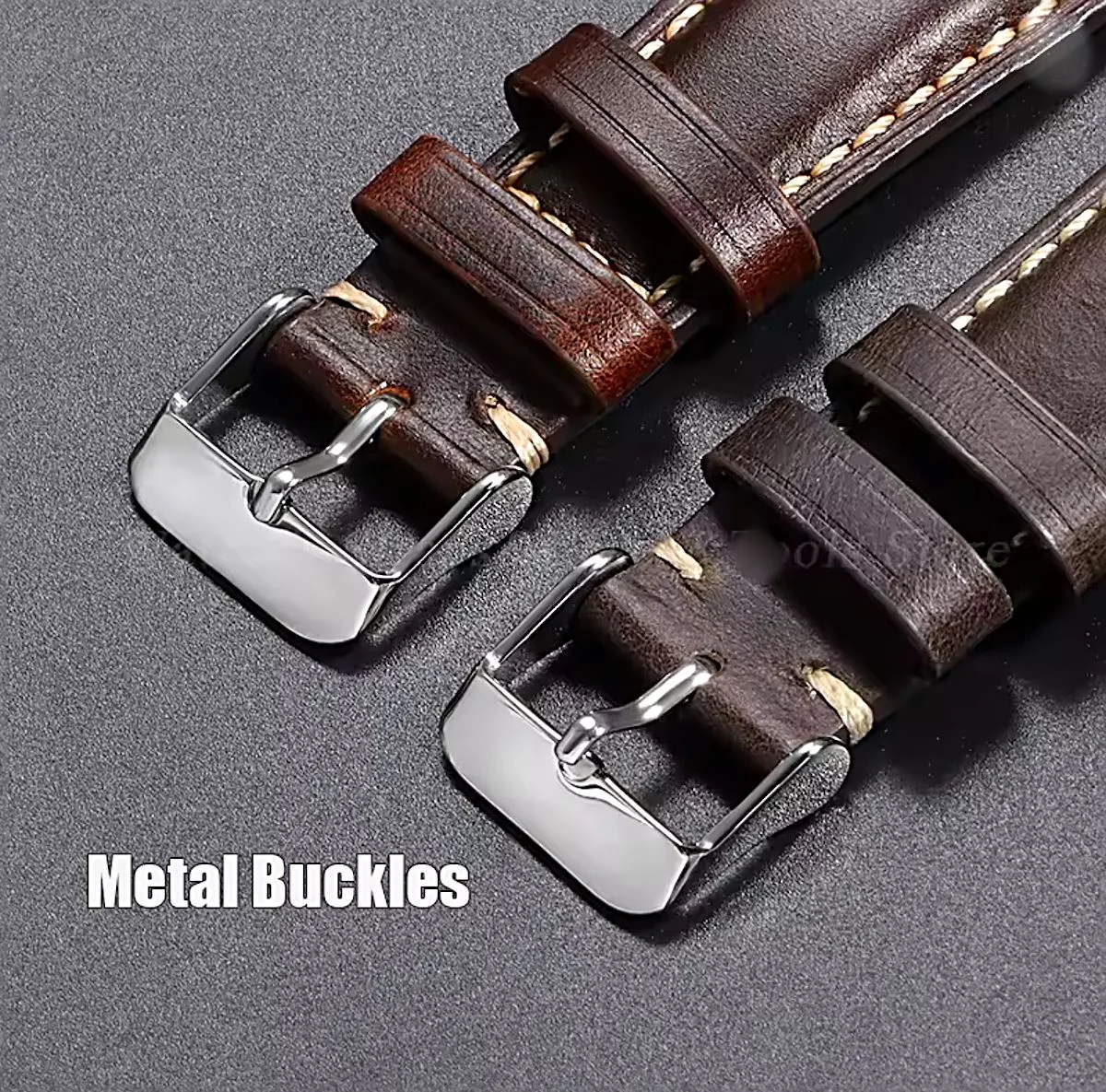
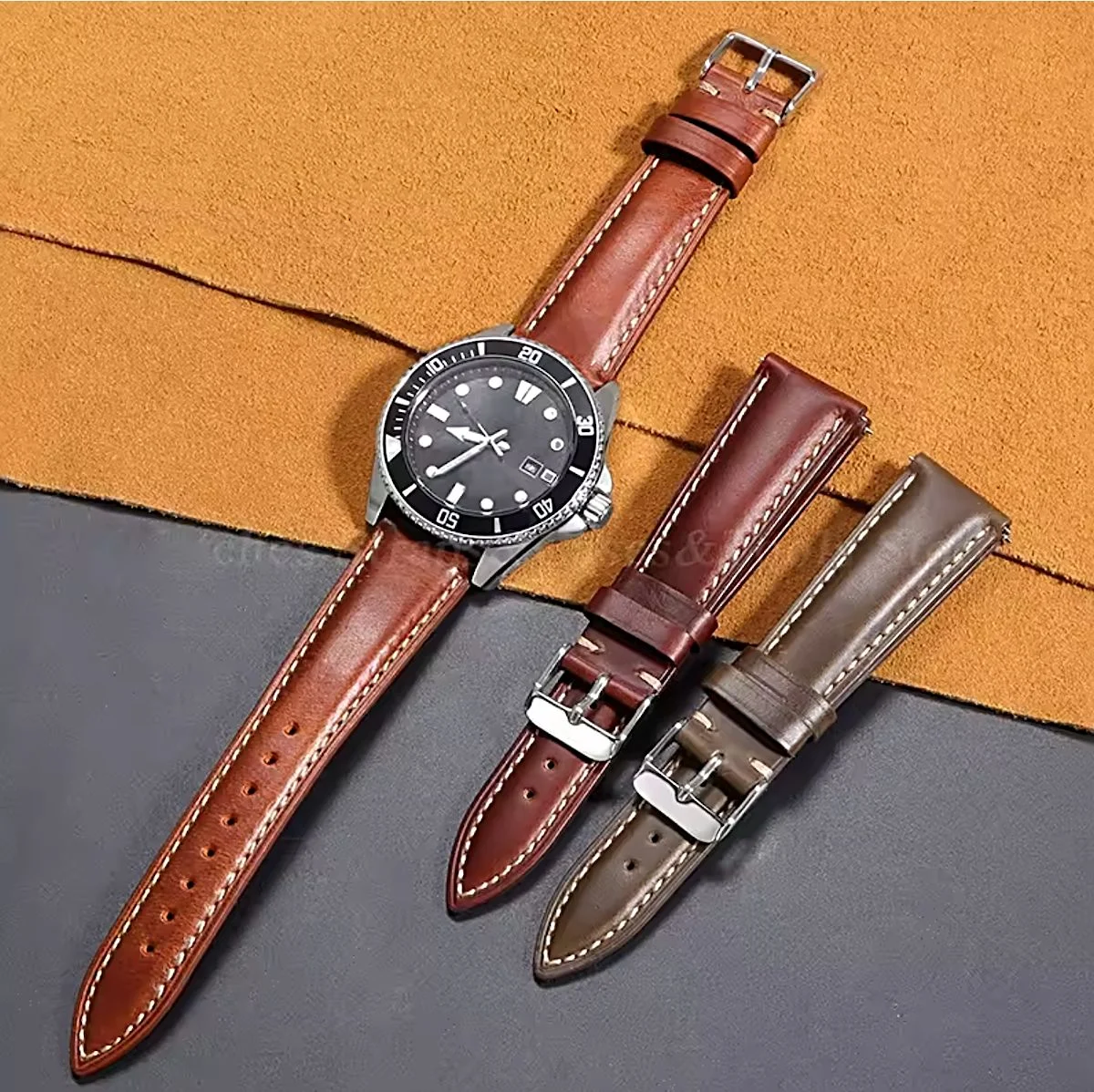
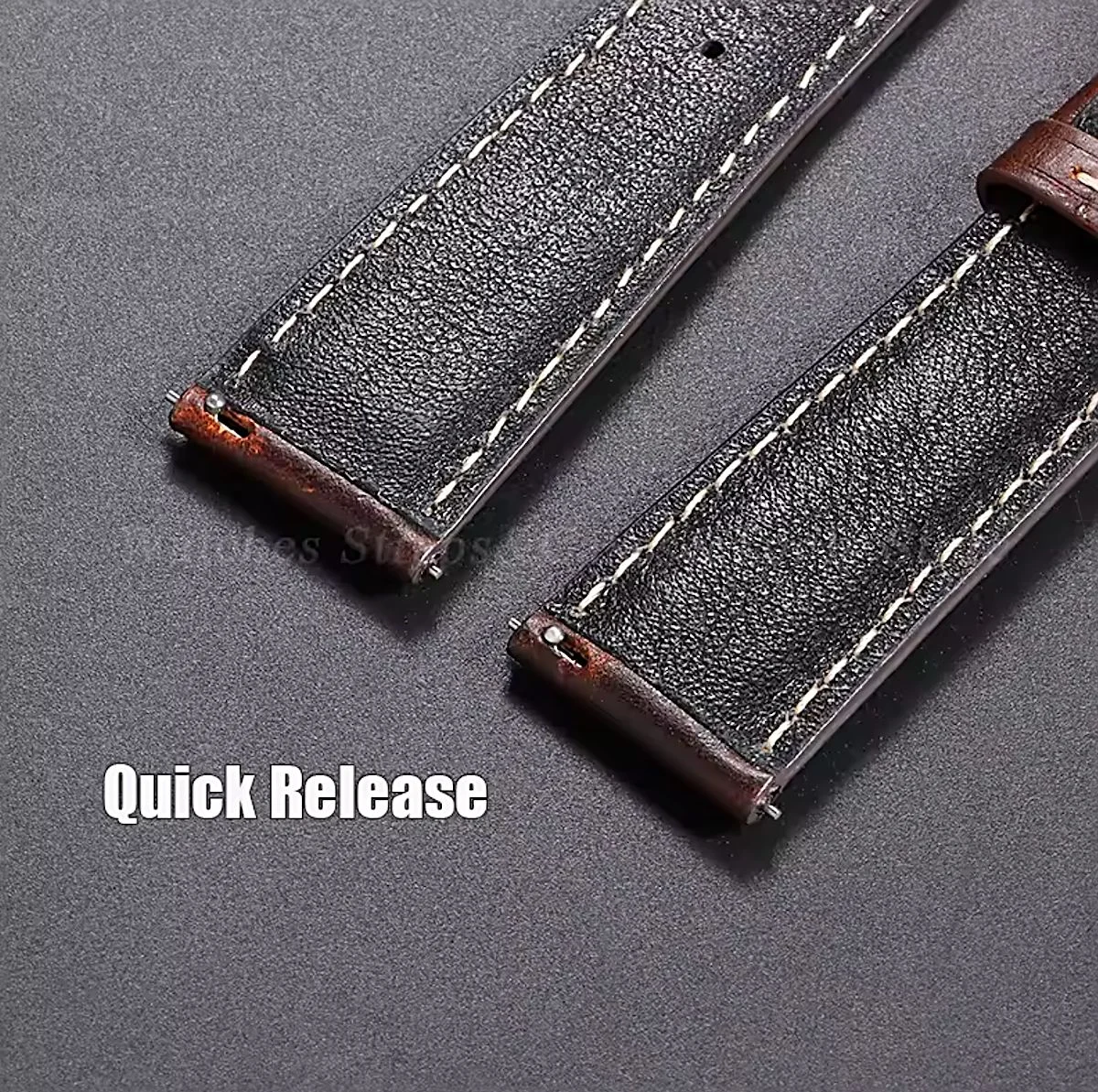
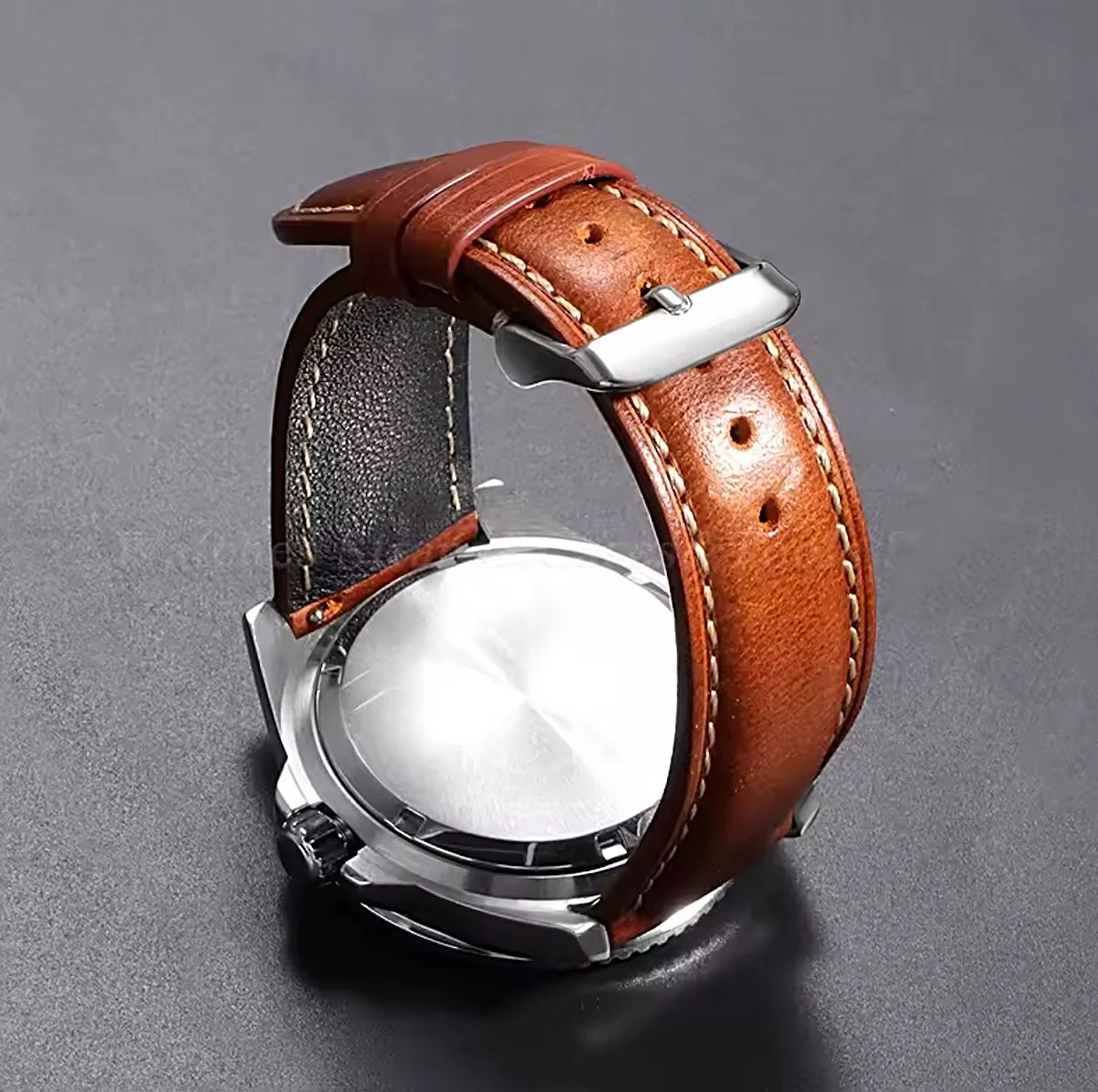
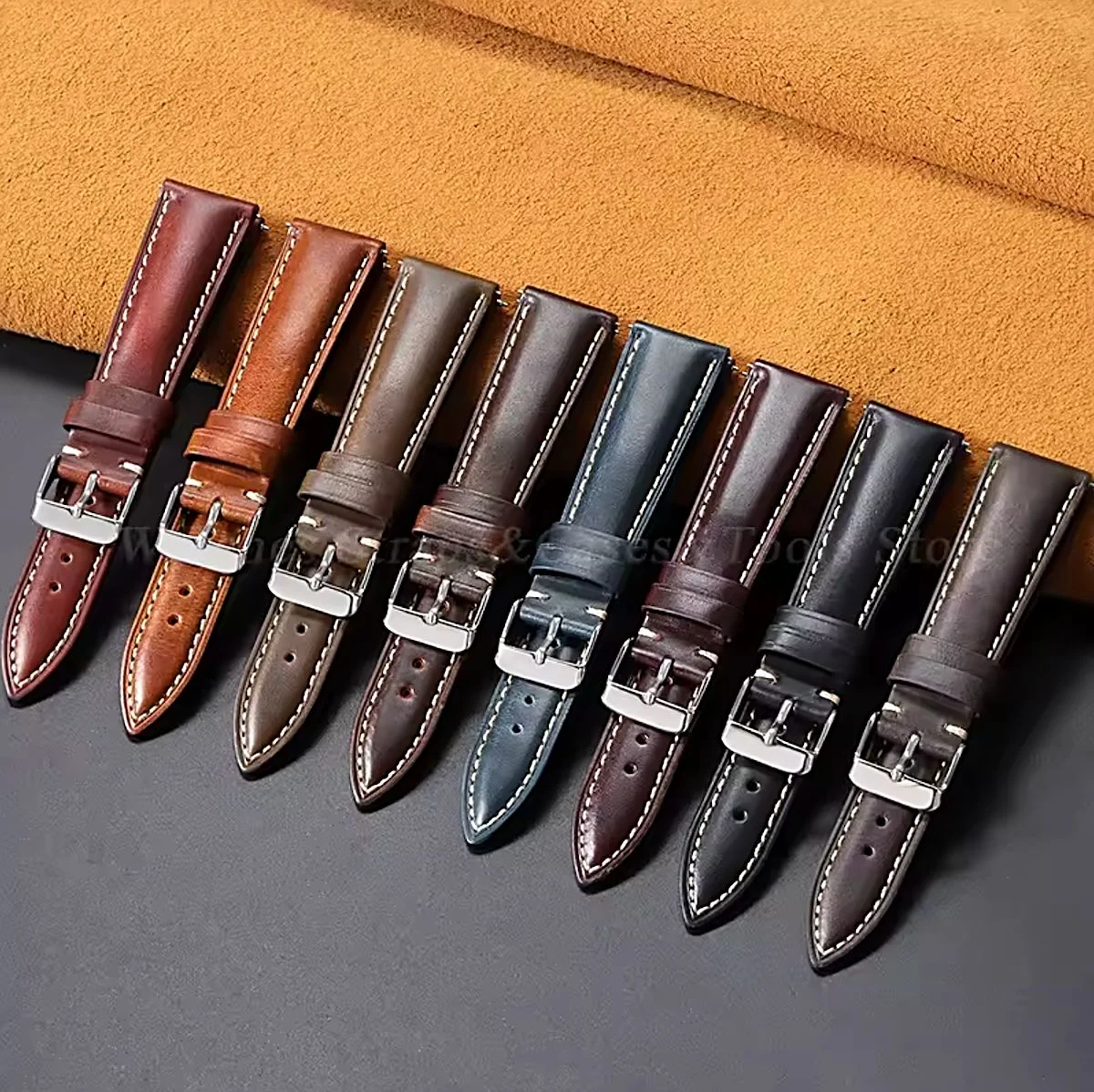
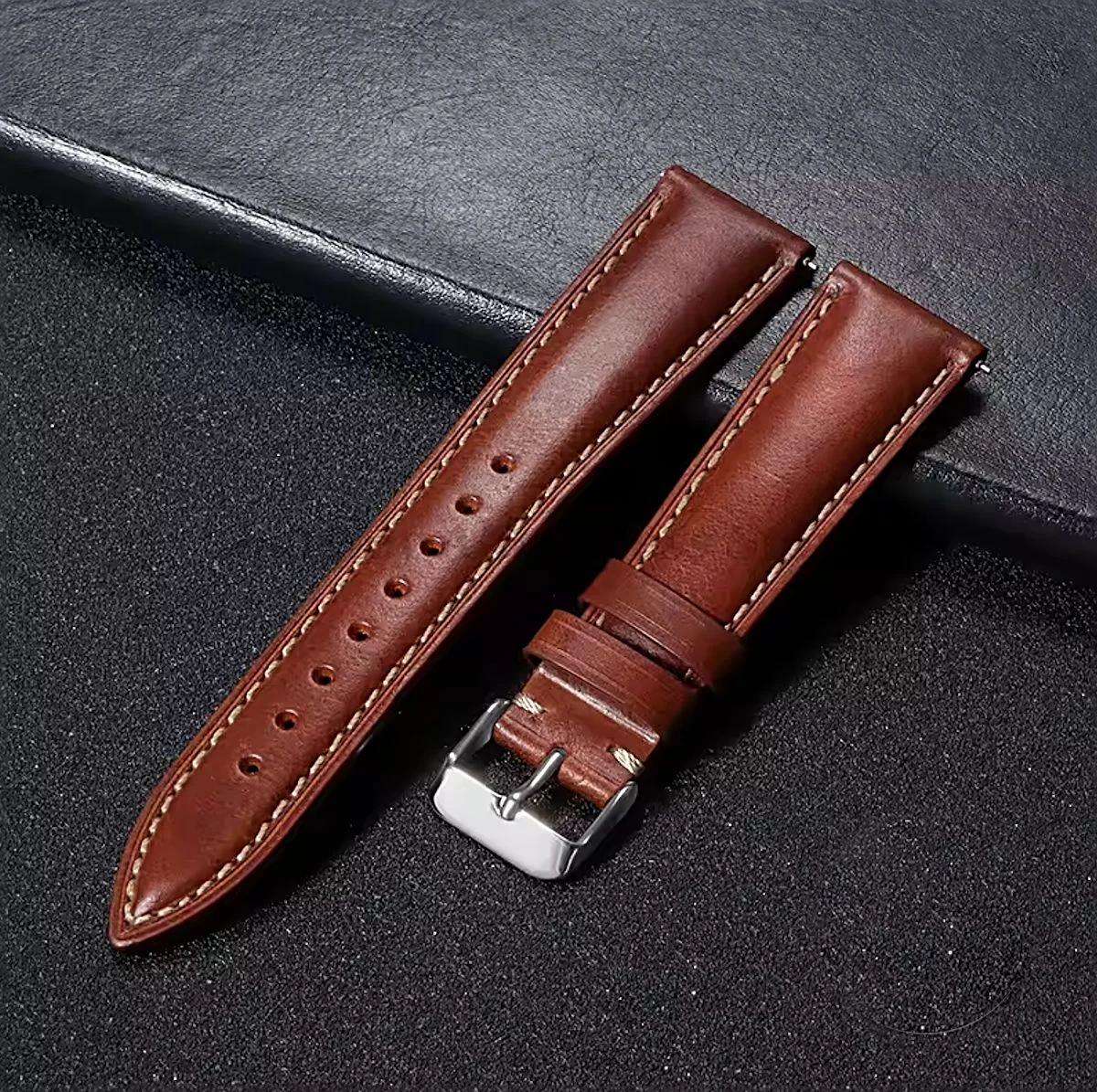
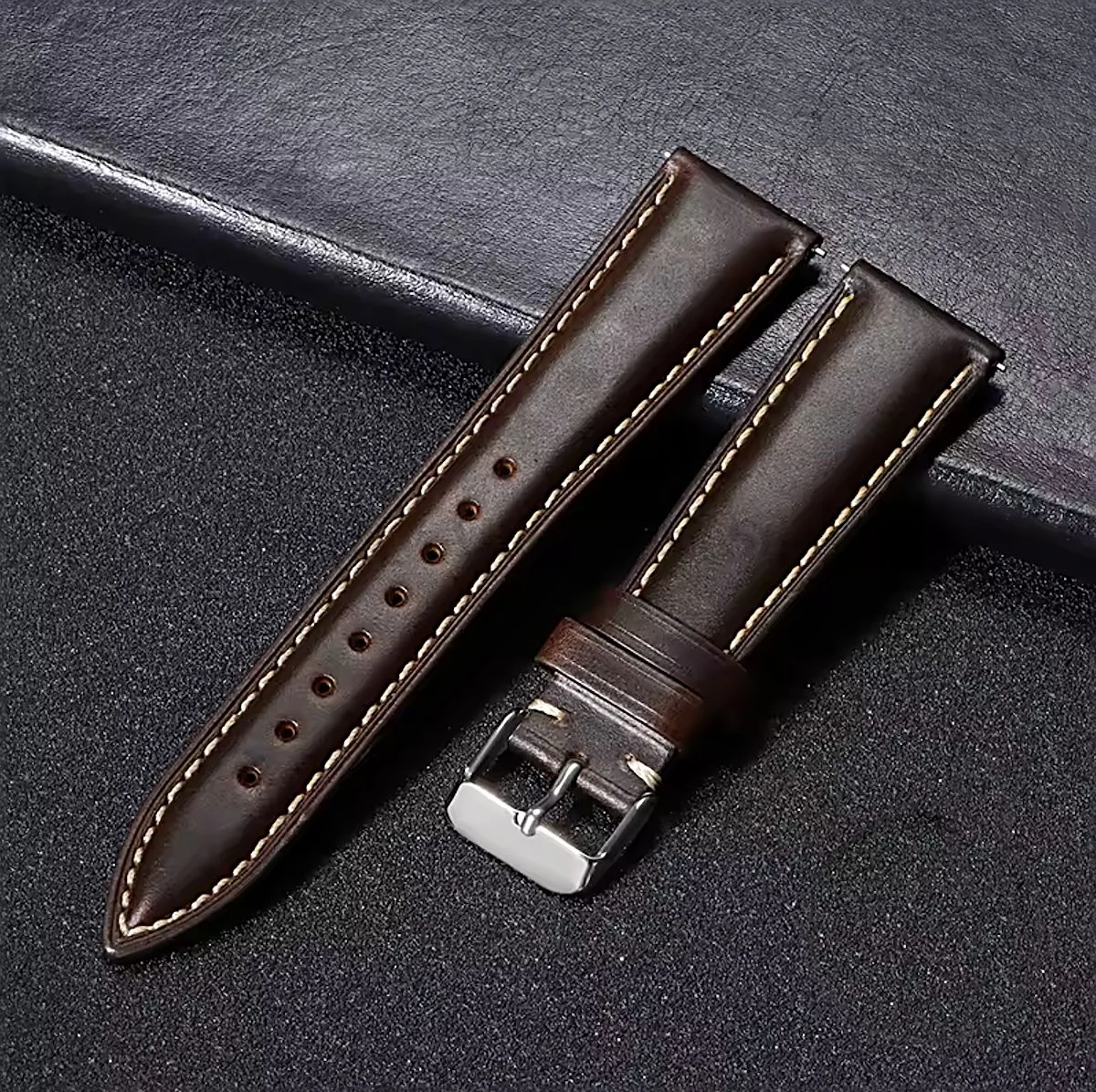
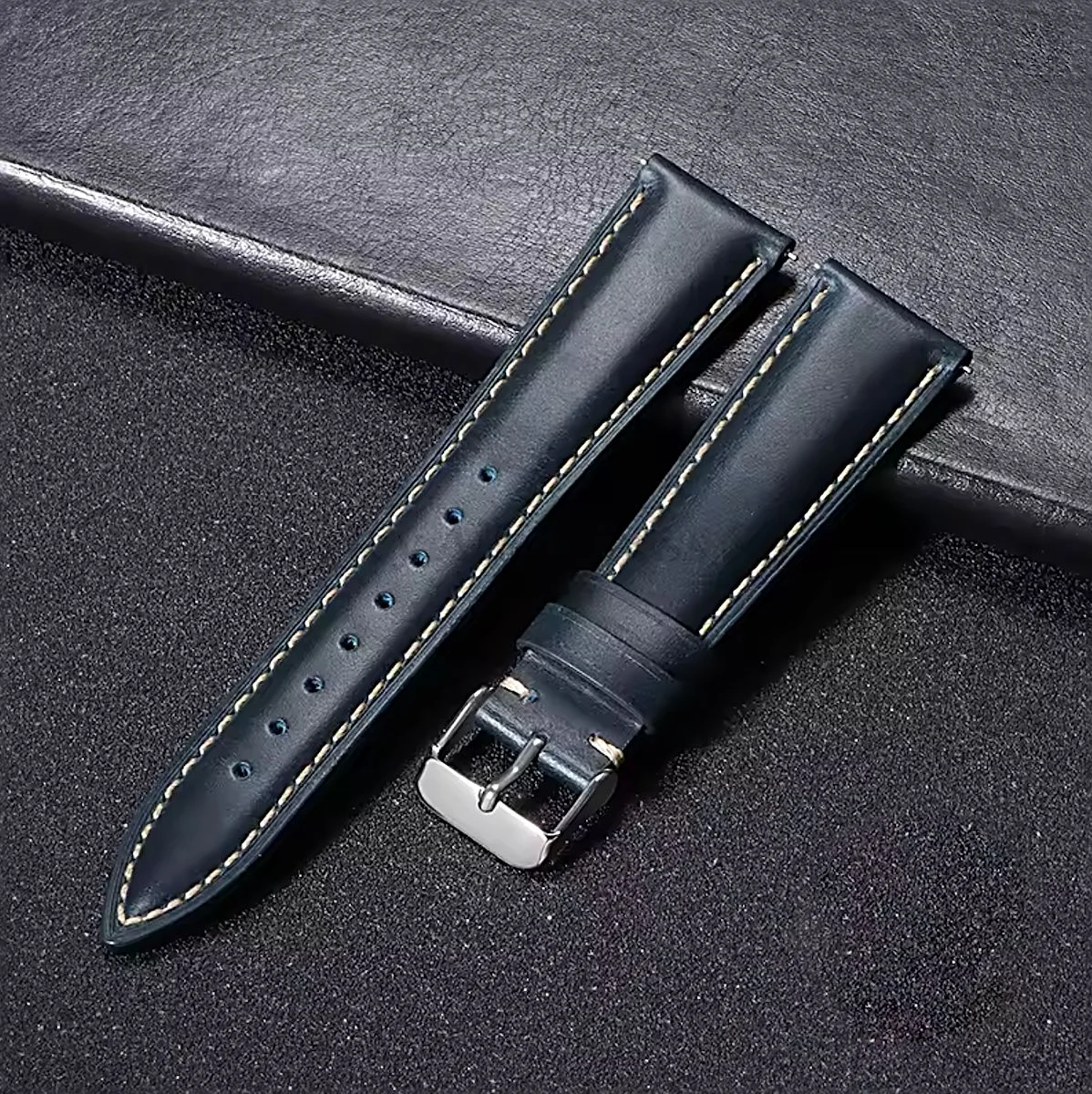
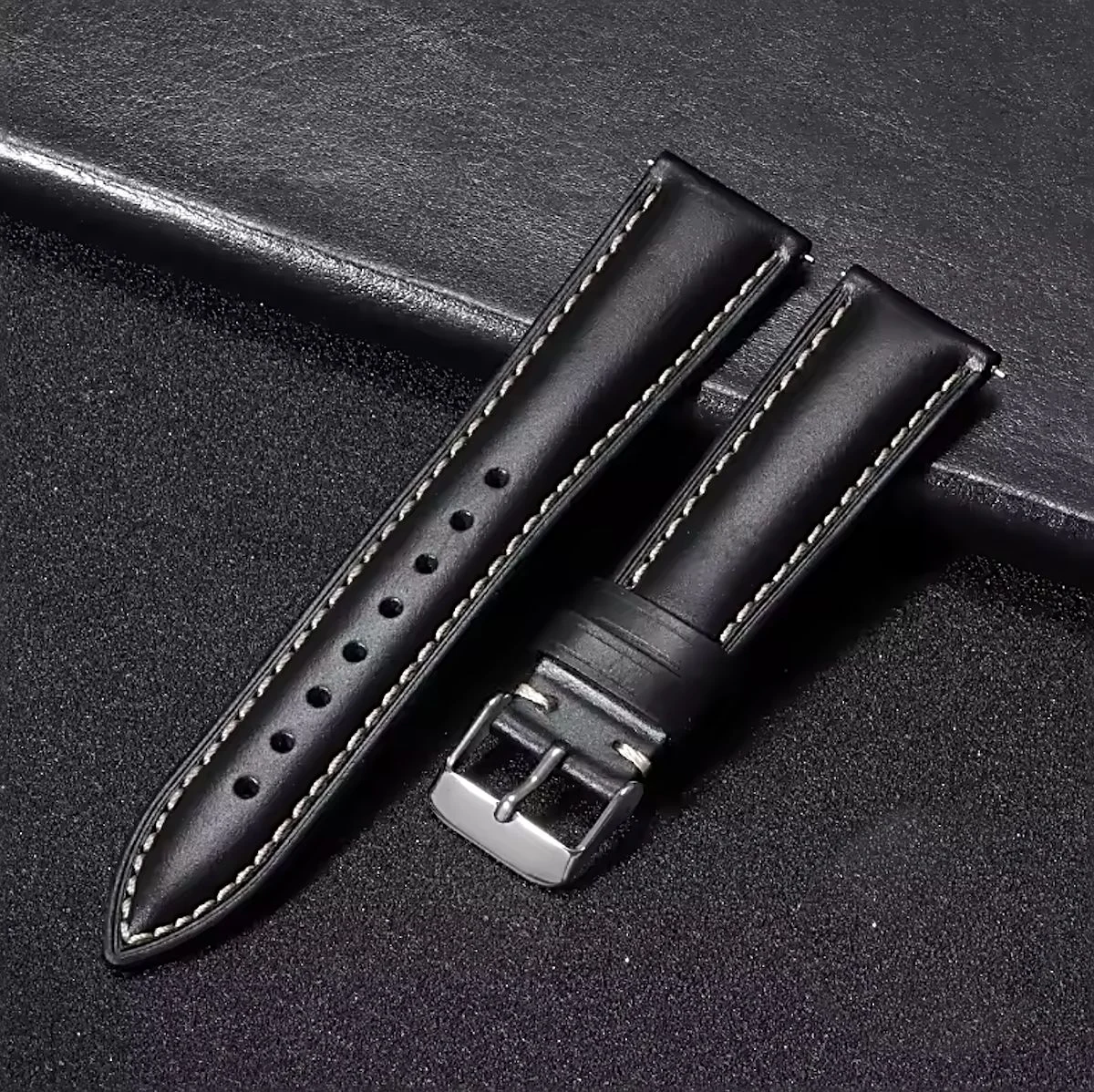
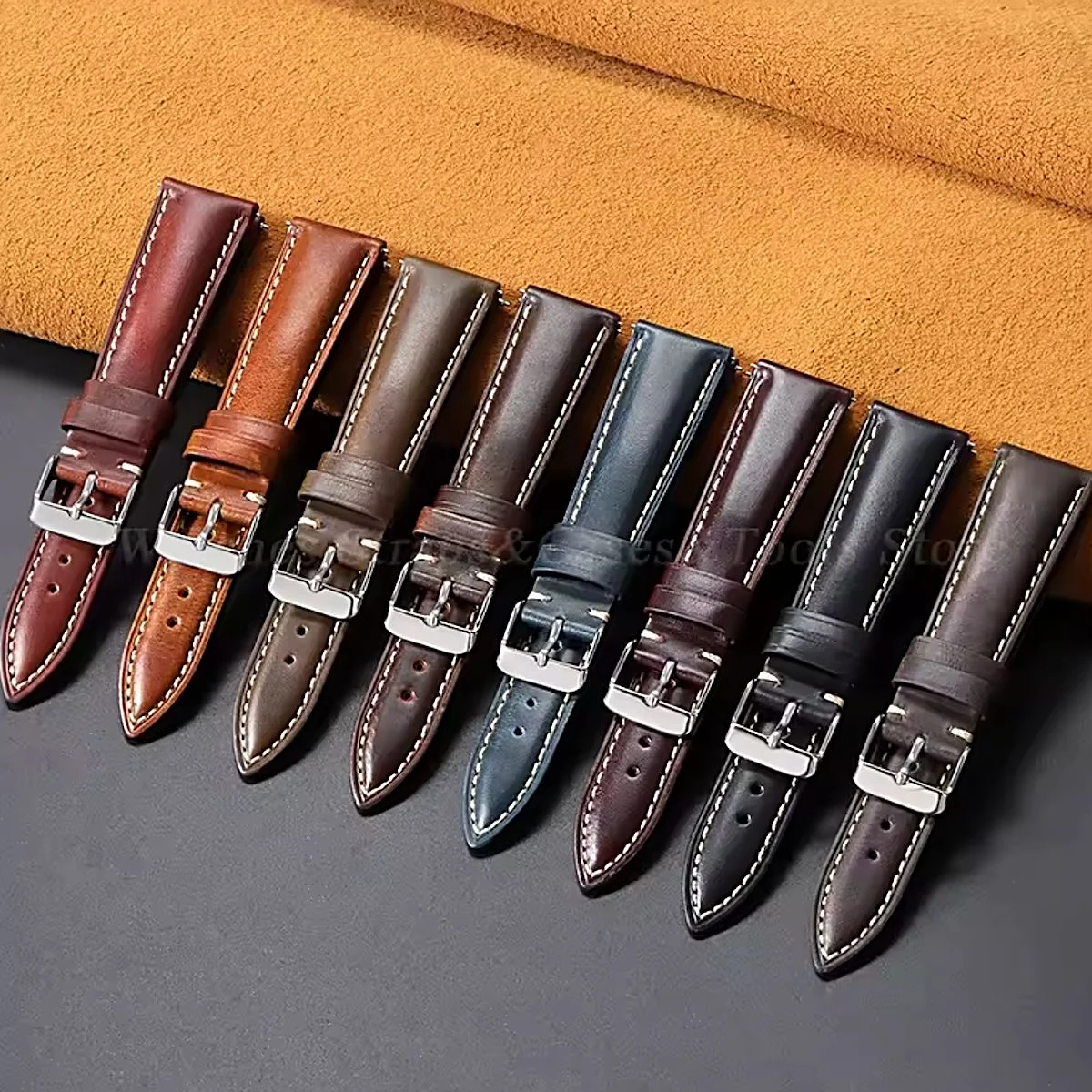
Comes complete with vintage steel bracelet*. (*)Note: Stock bracelets are often shortened by previous owners and may not fit you(see bracelet size in the product images). We match the strap to this watch’s lug width, so there is nothing for you to measure — just pick a padded leather strap for Citizen from the options at the top of the page.
This watch ships from 🇺🇦 Ukraine with tracking number
Why Collectors Want This Watch Today
Vintage Citizen quartz is one of the last genuinely underpriced corners of 1970s Japanese watchmaking, and the sports models are the most interesting part of it. This one is not rare — Citizen built CQ watches in very large numbers and 7300-series examples turn up regularly — but the particular combination here is a good deal less common than the plain dress CQs that make up most of what survives: a 100 m steel case, twin crowns, and a working internal rotating timing ring, under a black day-date dial.
The appeal is that it is a proper piece of late-1970s design that still does its job. The internal bezel is exactly the sort of detail that disappeared from affordable watches almost entirely, the case has the slightly angular presence of its decade, and the 7300A asks nothing of its owner but a battery every few years.
At around 35 mm it wears as a compact everyday sports watch rather than a modern-sized one — which is very much back in fashion.
Modes of payment:
- PayPal
- Credit Cards (VISA, MasterCard, American Express, Discover)
- bitcoin
We guarantee the item you receive looks and works exactly as advertised — or your money back.
Citizen lug-width matched leather straps — 18 / 19 / 20 mm
About the watch factory

The Spirit of Innovation: The Citizen Legacy Founded in 1918 with the mission of creating timepieces that are “Citizens” of the world, the Citizen Watch Company has spent over a century redefining the boundaries of horology. From its origins as the Shokosha Watch Research Institute, the brand has remained steadfast in its philosophy: “Better Starts Now.” This belief—that it is always possible to make something better—transformed a local Japanese workshop into a global powerhouse of precision and craft. By controlling the entire manufacturing process in-house, from the individual components to the final assembly, Citizen ensures an uncompromising standard of quality that few manufacturers on earth can match.
What truly sets Citizen apart is its relentless pursuit of pioneering technology paired with environmental consciousness. The brand made history by introducing the world’s first light-powered analogue watch — the Crystron Solar Cell of 1976, the technology Citizen later branded Eco-Drive, which eliminated the need for battery replacements and forever changed the industry’s approach to sustainability. Beyond its eco-friendly milestones, Citizen’s history is decorated with “world firsts,” including the first professional diving watch with an electronic depth sensor and the most accurate satellite-synchronized timekeeping systems. When you wear a Citizen, you aren’t just wearing a watch; you are wearing a piece of history engineered for the future. Why Choose Citizen?
- In-House Manufacturing: Citizen designs and builds its own movements — its Miyota calibers are among the most widely used in the world.
- Built to Last: Citizen engineered its 1960s–70s calibers to be serviced rather than discarded, which is why so many are still keeping good time today.
- Heritage of Firsts: The first light-powered analogue watch (1976, the technology that became Eco-Drive), the first dive watch with an electronic depth sensor, and satellite-synchronised timekeeping.